
Conducting interviews
Effective and inclusive recruitment helps you to attract a wider talent pool and identify the best talent while providing a professional experience for each candidate. Use this guide to design your robust, efficient, and fair recruitment process.
Preparation: designing an inclusive process
Logistics
- The interview panel: To ensure a range of viewpoints and groups are represented, the interview panel should be as diverse as possible, considering the panel members’ gender, ethnicity, age, disability, occupational role, etc.
- Venue: Inviting candidates to the workplace allows them to get a feel for the working environment and culture. For in-person interviews, use a private, professional space (avoid public areas like cafes, which can be distracting and off-putting). Alternatively, you can conduct the interview virtually using an online platform, ie Zoom, MS Teams, Google Meet.
- Interview invitations: Include an interview invite, via email, which clearly highlights: location, time, who the candidate will be meeting, what to expect on the day, and any interview-related information, ie questions or task materials if providing in advance.
Shortlisting candidates
- Criteria and assessment: Only list and assess requirements which are truly necessary for the role to encourage applicants from all backgrounds, and decide how you will objectively assess each candidate, ie use a scoring matrix.
- Anonymise applications: Replace names with reference numbers and remove details like age, gender, and names of universities and schools to mitigate unconscious bias.
- Employment visa sponsorship: You should include the following question on the application form, although it should not form part of your assessment of the candidate: “Will you now or will you in the future require employment visa sponsorship?”
During the interview: structure & techniques
The 60-minute timeline
- 0–2 mins | Ice breaker: Put the candidate at ease with brief small talk.
- 2–7 mins | Introduction: Introduce the panel, outline the format of the interview, and mention that you’ll be taking notes.
- 7–32 mins | Core questions/tasks: Focus on motivations, strengths, behaviours, potential, and technical knowledge (as required).
- 32–42 mins | Candidate questions: Give them space to ask about the role or the culture of the organisation.
- 42–45 mins | Next steps: Explain the timeline for feedback and close on a neutral note.
- 45–60 mins | Scoring: Immediately record your ratings while the conversation is fresh. Score against the criteria, not against other candidates, and do not confer with other panel members until after scoring has taken place.
Questions and tasks
The questions you ask and how you ask them are crucial to ensuring that the best data is collected and in a fair way. Avoiding the use of slang and industry jargon helps prevent any miscommunication. You could ask:
- Open questions to encourage candidates to lead the conversation (Who…? What…? Why…? How…?).
- Strengths-based questions to allow the candidate to discuss their abilities more openly (What energises you? How do you feel about deadlines?).
- Competency-based questions to focus on a particular skill which is important to undertake the role (Describe a situation in which you led a team? How do you cope with adversity?)
- Probing questions to explore an answer in more detail (Can you explain more about…? What do you mean by…? What was your particular role during…?). Remember to probe fairly with all candidates and avoid prompting answers.
Consider the STAR(R) framework to ensure their answers are complete:
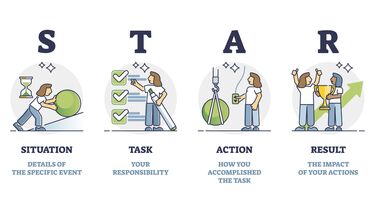
- S - Situation: A succinct overview of the background.
- T - Task: The specific goal they were working towards.
- A - Action: Exactly what they did (not the team).
- R(R) - Result & Reflection: The outcome, and what they learned from the experience.
Interview tasks, such as presentations or simulated work tasks, can help you assess particular skills; presenting, attention to detail, or technical abilities, ie coding. Tasks can be completed before or during the interview. Be aware that tasks should be designed with inclusivity and accessibility in mind, so reasonable adjustments should be made available to each candidate.
Accessibility: reasonable adjustments
Equity recognises that each person has different circumstances and requires tailored support to reach an equal outcome.
- Ask proactively: Ask all candidates if they have access requirements or reasonable adjustment requests before the interview.
- Offer examples: Mention possible adjustments, such as sending questions in advance, allowing "thinking pauses," or providing materials in large print.
- Neurodiversity support: Be aware that "Situational Judgement Tests" can be ineffective for neurodivergent applicants; consider practical tasks instead. Tasks which are timed or involve processing information can be more stressful. Time extensions or providing task details prior to the interview will help to ease this process, and you’ll be able to assess the specific skill, rather than how well they can cope with stress, which may not be a factor when undertaking the task during the role.
Objectivity: avoiding bias
- The 4-minute trap: Research shows most interviewers make a decision within the first four minutes; challenge your initial "gut feeling".
- The 'Likeness' factor: We naturally gravitate toward people similar to us in background or education. Focus strictly on the job criteria.
- Criteria over competition: Compare candidates against the Job Description, not against each other. Benchmarking candidates against each other can lead to poor hiring if the overall pool is weak.
Evaluation: the ORCE method
To stay objective, follow the ORCE steps:
- Observe: Listen actively to what the candidate says.
- Record: Take notes using the candidate's actual words to provide evidence-based feedback.
- Classify: Map their answers to your specific criteria.
- Evaluate: Score evidence on a scale of 1 (No evidence) to 5 (Excellent).
After the interview: feedback & compliance
- Candidate feedback: Offer a 5–10 minute verbal feedback call as soon as possible.
- Right To Work in the UK: You must check that a job applicant is allowed to work for you in the UK before you employ them. You can check the applicant’s right to work online using their share code (if provided), or check the applicant’s original documents with the applicant present.
- Legal compliance: Store all interview notes and scoring forms for 6 months. Under the Equality Act, you must be able to produce objective, criteria-linked notes to prove your decision was fair.
Additional support
For questions about recruiting a student or graduate from the University of Sheffield, please get in touch:
Email: employers@sheffield.ac.uk
For more information about inclusive recruitment, please read the Yorkshire Universities Inclusive Recruitment Guide