
Multiscale modelling and optimisation
Enabling comprehensive understanding and control of complex systems by linking phenomena across spatial and temporal scales, from atomic-level interactions to macroscopic process behaviours.

Our research expertise
Our research embodies intelligent, adaptive systems capable of autonomously designing and optimising complex processes and products across scientific domains.
This research theme underpins the work carried out across the school:
- In materials science, multiscale models bridge quantum mechanical simulations with continuum mechanics to predict material properties and device performance, allowing for the rational design of next-generation materials.
- In chemical processing, such models integrate molecular-level reaction mechanisms with process-level operations, enhancing reactor design, process intensification, and dynamic control strategies.
- In bioscience, multiscale modelling captures the hierarchical structure of biological systems, linking molecular interactions with cellular and tissue-level responses. This is essential for advancing drug delivery systems, synthetic biology, and bioprocess development.
Key research areas
- Predictive modelling of material properties and devices
A core component of this theme, leverages physics-based models and data-driven techniques to forecast system behaviour under diverse conditions. These models serve as digital twins in both materials and biosystems, accelerating innovation while reducing reliance on costly experimental trials.
- Process systems engineering
Provides the integrative framework that binds these components, ensuring scalable, reliable, and economically viable implementations. By uniting multiscale modelling, predictive analytics, and AI-driven optimisation, this cross-disciplinary paradigm offers a powerful toolkit to address pressing challenges in energy, sustainability, and healthcare.
- Optimisation
Optimisation particularly when augmented by artificial intelligence (AI), is central to unlocking the full potential of multiscale modelling. AI algorithms can efficiently explore high-dimensional design spaces, identify optimal operating conditions, and adaptively refine models based on new data. This synergy enables inverse design of materials, real-time process control, and personalised medicine strategies.
Research centres and institutes
Sheffield's cross-faculty research centres harness the University's wealth of interdisciplinary expertise and research excellence to solve the world's most pressing challenges. Our researchers are closely aligned with the Centre for Machine Intelligence.
Partnerships
The longstanding relationship between the University of Sheffield and Siemens has already generated valuable and diverse projects. Continued involvement is strengthening ties and developing work in new fields, channelling innovative research into pioneering solutions for today’s global challenges.
The United Kingdom Atomic Energy Authority (UKAEA) and the University of Sheffield are working in partnership to drive the development of fusion technology and the UK’s future fusion industry.
Impact

| Fusion: a future answer to sustainable energy? Professor Chris Race, United Kingdom Atomic Energy Authority (UKAEA) Chair in Fusion Materials, is using modelling techniques to better understand the materials used inside a fusion reactor. |
Turning sunlight into greener aviation fuel To support the future of net-zero flight, researchers employed comprehensive computer modelling and simulation to determine the industrial-scale functionality and deployment of this first-of-a-kind technology. | 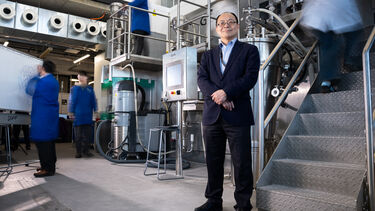
|

| Kausalyze, a spinout from the University of Sheffield's School of Chemical, Materials and Biological Engineering, is providing systems-level intelligence to help process manufacturers reduce downtime and increase operational efficiency. |