Spinout spotlight: Kausalyze
Kausalyze, a spinout from the University of Sheffield's School of Chemical, Materials and Biological Engineering, is providing systems-level intelligence to help process manufacturers reduce downtime and increase operational efficiency.

Led by Dr Louis Allen, with technology developed from Professor Joan Cordiner's research group, Kausalyze collaborates with multinational companies in chemicals, energy, and pharmaceuticals to analyse, diagnose, and prevent equipment failures across their manufacturing processes.
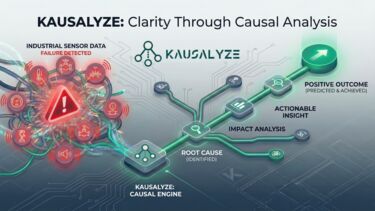
Using its causal AI platform, the spinout goes beyond traditional predictive maintenance to identify the root causes of process issues before they lead to costly breakdowns.
Kausalyze provides systems level monitoring to help industry partners eliminate recurring faults, reduce unplanned downtime, and retain critical engineering expertise as experienced operators retire. Ultimately, this enables manufacturers to shift from reactive firefighting to proactive improvement.
Founder and CEO of Kausalyze, Dr Louis Allen, provides a deeper overview of the spinout's technology, the support used to commercialise it, and the team's future plans.
Can you describe the research that led to your spinout, Kausalyze, and how it is addressing gaps in current industrial solutions?
The research originated in the University's School of Chemical, Materials & Biological Engineering, and from some of the observations made by my supervisor, Professor Joan Cordiner. During her 35 years working in industry, she noticed a dramatic drop in the average time a plant operator stayed in their job - from 25 years when she first started to just 5 years by the time she finished her career.
This decline in tenure is driven by a large number of senior, experienced people retiring. In fact, 30% of the manufacturing workforce is currently 55 or older. This means that we’re going to lose critical expertise needed to solve complex, interconnected problems in facilities like chemical plants. So, with the retirement of those experienced engineers and operators, who are crucial for diagnosing problems, finding root causes, and implementing solutions, coupled with fewer new entrants into manufacturing roles, this creates a real problem for industry.
Some companies are trying to fill this skills gap with AI solutions and machine learning, which look to flag anomalies for operators to go and investigate but don't necessarily solve the problems. It’ll show that something is wrong, but it won’t tell you why that piece of equipment’s not working as it should. So, what you’ll end up doing is treating the symptoms, not the root causes - and those problems will keep coming back, costing more money and time.
Our solution combines causal AI and chemical engineering expertise to diagnose equipment failures before they happen and identify the root causes of any breakdowns. The system monitors the entire process to understand what is happening, why it's occurring, and how to prevent it happening again in the future.
What inspired you to start a company, and what has it been like working with the Commercialisation team?
I presented this work at a few conferences, and afterwards, companies kept coming up to me saying, "this is so interesting, where else can we use it?". After having several of those conversations, it became clear that it wasn't just a general interest in the technology, but there was a genuine, practical need for it. That was the moment I realised we probably have a business here, since these companies are actively asking how they can get their hands on what we’re working on.
So, we decided to start talking to people about spinning out - and that’s when we got in touch with the University’s Commercialisation Team. It was a pretty organic process. The team was really helpful, offering lots of resources and workshops on topics like market discovery and what goes into building a successful startup - because it's so much more than just having the product. As we progressed, they helped us access Innovate UK programmes which were super valuable, as it expanded our market research far beyond Sheffield, taking us into the US and other global regions.
How did you navigate the transition from completing your PhD to leading a company?
It was definitely a gear change. I guess with a PhD, you have the freedom to explore every research avenue, but when you're in a startup, you haven't really got time for that. You have to be laser focused on understanding what the customer needs and delivering those requirements to them. You can't spend all your time on the product because, as a startup founder, you're also responsible for all the other business tasks - like fundraising, recruiting, and marketing. Once you spin out, you have to build your own support network which is kind of similar to doing a PhD in some ways. It is very much a change in pace, but it's exciting.
Since spinning out, what’s been your biggest achievement, and what traction has the company made so far?
Having officially spun out in May 2025, we are still in the relatively early stages of our company's journey and are currently prioritising fundraising.
Our most significant milestone so far was the first time a customer paid for our work. It is incredibly validating to see major companies approach us and actually pay money for something that at one point, was just research code. For me, witnessing that transition from an academic project to a commercially viable product being utilised for fairly major industrial projects is something I’m really proud of.
We’ve established some really strong relationships and are seeing promising traction across several key geographies, including the UK, Europe, the US, and emerging markets in the Middle East. We have early stage and commercial projects starting in all these different regions because we’re offering a solution that is genuinely different from what’s currently available - and these talks are turning into commercial contracts, which is the ultimate sign of approval.
What is your long-term vision for Kausalyze?
I think the goal for Kausalyze is to become the default solution for production engineers - eliminating firefighting and preventing unplanned downtime. We want engineers to focus on implementing meaningful improvements rather than spending their time solving crises from the past 24 hours.
As the industry transitions to net zero and faces increasingly complex global challenges, the traditional model of relying on long-tenured, experienced operators is no longer viable due to workforce retirement - so there's going to be a real need for reliable engineering expertise.
Kausalyze provides the necessary solution by acting as an immortalised engineering expertise platform, ensuring reliable engineering knowledge is always available.
Kausalyze is currently looking for industrial partners who want to move beyond reactive maintenance and start solving problems at their root cause. If you're a process manufacturer interested in an early collaboration, reach out to Louis via LinkedIn or the Kausalyze website.
To find out more about the Commercialisation Journey, visit their website or contact the team directly at commercialisationteam@sheffield.ac.uk.