Recruiting researchers in Animal Studies (humanities and social sciences)
Last year, ‘Multispecies Mutualisms’ was successfully awarded a Wellcome Trust grant of £1.6 million. We are now recruiting four new Post Doctoral Research Associates to join the team.
This advert has now expired.
We are seeking four Postdoctoral Research Associates (PDRAs) to join the Multispecies Mutualisms research team. These three-year positions will begin in September 2026 and are based in the School of Sociological Studies, Politics & International Relations.
We are looking for individuals who are keen to engage in interdisciplinary research, with an arts & humanities and/or social sciences background in animal studies.
These PDRA positions will help us reframe how we understand health, care, and mutual dependency across species.
Closing date for applications is 12/04/2026
Contact us
For informal enquiries or if you have any questions about your suitability for these roles, please contact the project lead, Rosaleen Duffy on r.v.duffy@sheffield.ac.uk.
If you would prefer to speak to someone over the phone, please let us know.
Disability Confident: Our Commitment
The University of Sheffield is proud to be a Disability Confident Employer. We are committed to supporting disabled applicants throughout the recruitment process. We offer reasonable adjustments, accessible resources, and an inclusive working environment where everyone can thrive. If you apply for a role, you can indicate whether you wish to opt-in under the Disability Confident scheme. If you opt-in and meet the essential criteria for this role you will be invited to take part in the next stage of the selection process. Learn more about the University of Sheffield's commitments to the scheme.
The Project
Multispecies Mutualisms is based within the School of English in the Faculty of Arts and Humanities and School of Sociological Studies, Politics and International Relations, part of the Faculty of Social Sciences at the University of Sheffield. Starting in September 2025 and running for five years, Multispecies Mutualisms investigates how partnerships between humans and animals can support mental, physical, and material health, while also examining the inequalities and harms that may arise from these relationships. The project focuses on four case studies: nature-based therapies, ethical dairy production, equine-assisted therapy, and hypoallergenic dog breeding.
The project addresses three ambitious research questions:
How are the benefits of multispecies mutualism conceived, represented and contested in public understandings of a healthy life?
How are the different, sometimes competing, interests of humans, animals and ecosystems negotiated in practices of multispecies mutualism?
How might the development of new theories of multispecies mutualism transform ethical and conceptual pathways into human, animal, and ecosystem health?
As the first comprehensive critical interrogation of multispecies mutualism, Multispecies Mutualisms will:
Enable comprehensive understanding of how health and wellbeing outcomes of multispecies mutualism are perceived and practised in a range of contexts
Provide new empirical and conceptual tools for policymakers, practitioners and activists working on multispecies health
Pioneer new theoretical trajectories and ethical frameworks for how multispecies mutualism can be understood and implemented
The team
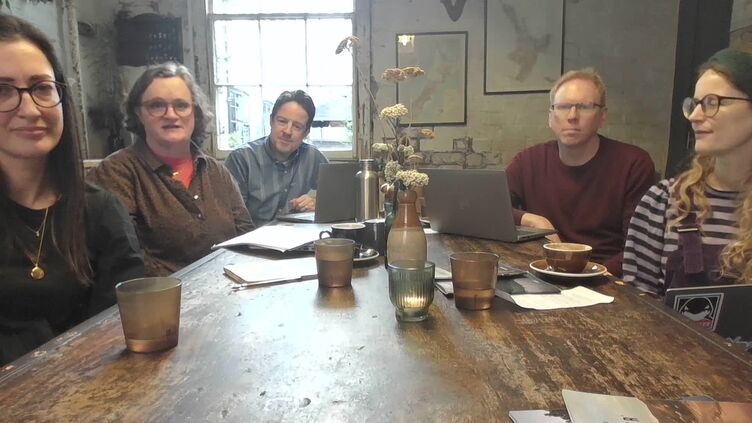
The team adopts a multidisciplinary approach, bringing together expertise from political ecology, sociology, literary studies, and political theory. It includes Professor Rosaleen Duffy, Dr Eva Giraud, and Professor Alasdair Cochrane from the School of Sociological Studies, Politics and International Relations, and Professor Bob McKay from the School of English. The project is supported by Project Manager Lucy Dunning, who oversees successful delivery of the programme of work.
Your development
Your development is really important to us. As a PDRA, we’ll work with you to establish an individual development plan that will be reviewed on a bi-annual basis. You’ll have 10 days per year to undertake training and continuing professional development (CPD) in line with the Wellcome Trust Concordat to Support your Career Development. We will provide support and coaching for you to develop and lead your own grant applications, publications and other project outputs.
Frequently Asked Questions
- I’m outside of the UK, can I apply?
Yes - but the posts will be UK based. We are not able to support applications from people who wish to work remotely for extended periods from outside the UK. This is because of UK employment law. Some further details about this are available on our website.
- Can I work remotely or request flexible working?
We are a campus-based University, and staff are normally expected to carry out their role from the University. We recognise that flexibility is important, and any hybrid or flexible working request will be considered reasonably in line with UK legislation and University policy.
We are not able to support employees who wish to work all or part of the time outside the UK. If currently living outside the UK then successful candidates will be required to relocate to the UK. We are not able to remunerate employees for travel to the University campus or for overnight accommodation in Sheffield to carry out work on the project. International working is supported for specific project related activities only e.g. conferences.
While we support flexible working, we value regular in-person collaboration. Team members are encouraged to be available for on-campus meetings, as these help strengthen connections and keep projects aligned.Curious about life in Sheffield? Get a feel for the city’s community, character, and opportunities on our dedicated University page.
- Will I be expected to travel (and if so, what support is available to enable this)?
This post may involve travelling to relevant fieldwork sites within the UK. There is no expectation for international fieldwork, but there may well be opportunities for international events and conferences, where you will have the opportunity to present. Many of these are now online or hybrid. Where these are in-person, we will work with event organisers to maximise accessibility for our researchers.
- Can I apply if I'm in the process of completing my PhD?
Unfortunately, no. You’ll need to have fully completed your PhD (therefore any required amendments must already be accepted by examiners), before you can apply. Once everything is officially finalised, you’ll be eligible to submit an application.
- Use of AI in Applications
We recognise that applicants may choose to use AI tools when preparing their materials. However, your submission should clearly represent your own skills, experience and motivations. Our selection process is focused on understanding your individual contributions and potential, so please ensure that your application is written in your own voice and accurately reflects your capabilities.
- Is the start date flexible?
Our preference is for all four PDRAs to start simultaneously in September 2026. Nonetheless, we can offer some flexibility to defer the start date by a short period where required.
- Is there a possibility of the PDRA posts being continued into the future?
The PDRA roles are fixed term for three years. In addition, the research team is keen and committed to supporting researchers to explore job opportunities post-award. We can, for example, explore future-facing research funding and grant applications. There are also often redeployment opportunities at the end of a grant.
- How will you support my career development?
The University is committed to the Concordat to Support the Career Development of Researchers, also known as the Researcher Development Concordat. This is an agreement between employers of researchers and research funders on the expectations for the professional development and employment conditions of researchers in the UK. We are committed to achieving its Principles for the environment and culture, employment and professional and career development of researchers. PDRAs in our previous teams have gone on to academic posts, successfully applied for major grants and secured permanent roles in Non-Governmental Organisations.
- Can I apply for more than one position?
We are recruiting two PDRAs with expertise in researching representations and two PDRAs with expertise in researching the practices of multispecies mutualism. You will be asked to indicate which you are applying for and tailor your application accordingly. If you wish to be considered for both, you are welcome to do so; please ensure your application clearly demonstrates how you meet the criteria for both.
- Tell me about accessibility at the University of Sheffield?
The Multispecies Mutualisms team will be based in the Elmfield building in Sheffield. There is more information on access via the AccessAble guide to the Elmfield building.
- Tell me about your commitment to disability access.
It is vital to ensure all activities and events are accessible to those who may need specialist equipment or specialist services like BSL Interpreters, captioners and personal assistants. The University of Sheffield also engages with individuals to shape policies and continuously reviews its practices to remove barriers and promote equality.
- Are the posts part-time or full-time?
The PDRA posts are full-time. We are, however, committed to exploring flexible working opportunities with our staff which benefit both the individual and the University. Therefore, we would consider flexible delivery of the role subject to meeting the business needs of the post. We will explore flexible working opportunities with shortlisted candidates as part of the recruitment process but are also happy to take any queries in advance. Please see contact information above.
- Will there be opportunities to publish?
Yes. We are committed to a number of outputs aimed at different audiences, such as podcasts, policy briefs, animations, films etc. All academic papers will be produced in compliance with a CC-BY Gold Open Access licence.
- What skills and capabilities will I develop in the course of working on these projects? Will I be connected to fellow researchers?
You will be part of a large team and there will be plenty of opportunities to collaborate on research, publishing, organising events and much more. We are keen to work with you to develop and support a bespoke plan for developing the skills and capabilities you will need to make your next career step at the end of the project. You will also be able to join the more general training programmes offered by the University which span a wide range of topics.
- When will interviews be?
We are planning on these taking place on 18 and 19 May 2026.
The recruitment process will involve an initial application, followed by an interview which will include a 10 minute presentation. The purpose of the presentation is for the panel to gain an understanding of how you will approach the research, it is not to assess your presentation skills.
We will notify shortlisted candidates in advance to arrange a suitable interview slot. We will also share more guidance on the presentation as well as interview questions well in advance of the interview.
- Are the post docs linked to a specific case study or approach?
In a very basic sense, the four posts are as follows:
- 1x PDRA on representations of multispecies mutualisms, focusing on equine therapy and hypoallergenic dogs
- 1x PDRA on practices of multispecies mutualisms, focusing on equine therapy and hypoallergenic dogs
- 1x PDRA on representations of multispecies mutualisms, focusing on bird conservation and dairy
- 1x PDRA on practices of multispecies mutualisms focusing on bird conservation and dairy
- If I research equine therapy and hypoallergenic dogs, will there be opportunities to collaborate with those researching bird conservation and dairy, and vice versa?
Yes. We are keen to support collaboration that draws links across themes and case studies. So for example the two PDRAs working on representations of mutualism may want to collaborate on comparing research findings across their case studies. So there is plenty of support for collaboration.
- Should I submit a research proposal as well?
No. Please do not submit a research proposal as part of the application - if called for an interview, we will ask you to do a presentation on how you would carry out the research. Instead you should focus your covering letter OR application statement on how you meet the criteria for the role.
This is to reduce the burden on applicants in such a challenging job market.
- You ask for a piece of writing, what sort of writing should I submit?
We’re looking for a piece of work - published or unpublished - which you feel best demonstrates your research capability. This may include publications, preprints, project reports, grant proposals, or other relevant outputs. Written pieces should not exceed 10,000 words. You are welcome to submit work completed at any point in your career. We recognise that applicants may have taken career breaks for a variety of reasons.
- Are the research programme and any fieldwork sites already decided?
No. We will support the PDRAs to design and carry out their own research linked to the project. For posts that include support for fieldwork, this must be carried out in the UK, but there is flexibility around the exact location. we will work with you to develop your own ideas. However you do not need to develop a research proposal for the application stage, your application should focus on how you meet the criteria for the role instead.
- The covering letter and application statement text box ask for the same information. Do I fill out both with the same information?
As the application statement box is limited to 4,000 characters, we recommend that you upload a document in support of your application via the "Cover letter" function. Here you will have more space to set out how you meet the job specification. In the application statement text box you can just write 'see uploaded documents'. This is to reduce the burden on applicants in a challenging job market. If you have filled out the application statement section as well as/instead of the cover letter - do not worry - that is fine. We will read your application in the format you submit.
- Can I talk to anyone in the team about the roles?
Yes. You are welcome to contact any member of the team about the roles.
*Please note - these Google conference call slots are now fully booked. Rosaleen Duffy has also set up some conference call times, which you can book directly.
- Will I be able to teach as part of the post doc? Will I be able to design and run my own course?
No. These are 100% research positions. However, in order to support career development we will be able to explore other opportunities to undertake relevant training or guest lectures on courses.
- I've contacted one of the project team, when can I expect a reply?
The team will aim to get back to you within 3 working days (we don't pick up emails during the weekends). Please also be aware that the project team will be taking a break from 30th March - 6th April inclusive, so you won't receive a reply from us during this period.