Pioneering safer lung imaging for children
Researchers at the University of Sheffield have developed a new radiation-free lung imaging technology for children, opening up new possibilities for diagnosing and treating respiratory diseases.

Every breath matters, especially for children living with lung conditions. Yet, early diagnosis and ongoing monitoring of illnesses like asthma and cystic fibrosis remains a challenge for clinicians.
Children under five are often too young to reliably complete standard breathing tests, and although chest X-rays and CT scans can be useful at first, repeated imaging increases exposure to radiation, especially for those who require long-term observation throughout their lives.
At the University of Sheffield, Professor Jim Wild and his team from the POLARIS research group and the Insigneo Institute are helping to change this. They have developed a pioneering imaging technology that enables doctors to see inside children’s airways and track lung changes without using radiation.
The technique combines magnetic resonance imaging (MRI) with inhaled xenon gas, which safely illuminates the lungs during scanning. The result is a detailed picture of how air moves through the lungs, helping clinicians identify problems earlier and monitor conditions more accurately over time.
This breakthrough is opening new possibilities for diagnosing and treating respiratory diseases in children.
“The technology is clearly demonstrating that it can detect signs of lung disease before existing lung function tests and even before conventional imaging methods. In children, reducing exposure to ionising radiation is especially important. MRI allows us to identify early functional changes and monitor disease safely over time", explains Professor Wild.
“When the opportunity came up to carry out the research in my hometown of Sheffield, I was really excited. Very quickly we were developing new techniques and began applying them in adults and children with lung disease, working closely with Sheffield Teaching Hospitals and Sheffield Children's Hospital. Translating technological research into clinical practice has always been important to me - and the ability to make a real difference to patient care has always been central to my work", adds Professor Wild.
A collaboration between the University of Sheffield and GE HealthCare
The new lung MRI technology has been developed through a collaboration between the University of Sheffield and GE HealthCare, bringing together expertise in advanced MRI systems and novel gas imaging methods.
This work forms part of 19 initiatives supported by a £149 million investment from the Engineering and Physical Sciences Research Council (EPSRC), alongside UKRI’s Biotechnology and Biological Sciences Research Council (BBSRC) and Medical Research Council (MRC).
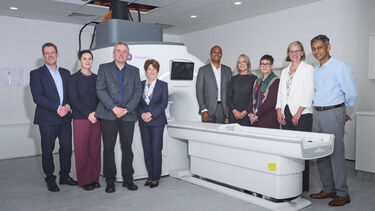
“The technology we’ve developed in Sheffield includes equipment that generates magnetised gas with lasers, but that is only one part of the system. We also need MRI scanners to carry out the imaging, and over many years we have worked closely with GE HealthCare to develop the hardware and software needed to adapt these scanners to detect signals from hyperpolarised gases", explains Professor Wild.
“That partnership has been very enjoyable and fruitful for both parties. We've trained PhD students and developed joint projects together. Perhaps, most importantly, Sheffield’s lung imaging protocols have now been integrated into GE HealthCare systems, allowing other hospitals to adopt the technique in a routine clinical setting”, adds Professor Wild.
Sheffield leads rollout of new imaging technology
Children and young people being cared for at Sheffield Children’s NHS Foundation Trust are the first in the UK to access the new breakthrough technology. The scans are being delivered as part of cutting-edge research taking place at Sheffield Teaching Hospitals NHS Foundation Trust bringing world-leading imaging innovation directly into patient care.
By combining advanced physics, engineering, medical imaging and clinical expertise, researchers in Sheffield are helping transform how childhood lung disease is diagnosed and monitored, improving care for young patients today while shaping the future of respiratory medicine.
“Building on the research carried out in 2015, the University of Sheffield led the progression of the technology through MHRA regulatory approval, becoming the first institution in the world to apply it clinically. Since then, we have worked closely with partner hospitals including Sheffield Children's Hospital and Sheffield Teaching Hospitals, using the technology for diagnostic purposes within the NHS. Patients have also been referred from other NHS trusts across the UK to receive scans", explains Professor Wild.
Shaping the future of respiratory medicine
Looking ahead, Professor Wild and his team aim to make the technology available on commercial MRI scanners, allowing more hospitals and healthcare centres nationally and internationally to use it in everyday care. In the longer term, wider access could help establish lung MRI within routine clinical pathways and support NICE approval for use across the NHS.
“My interest in this research comes from both a technological and personal perspective. As an MRI physicist, it is exciting to work with advanced imaging techniques that can be applied directly to lung disease. I also have close family experience of childhood asthma care at Sheffield Children’s Hospital, which makes improving outcomes for young patients particularly meaningful to me", explains Professor Wild.
We have already seen real clinical impact. One of the first patients we scanned was a young athlete whose performance was declining despite normal breathing tests. The MRI revealed an underlying lung abnormality, leading to early treatment that resolved the infection and restored her ability to run. In this case, the imaging directly guided diagnosis and enabled earlier, more effective intervention.
Professor Jim Wild
Professor of Magnetic Resonance Physics and Executive Director of Insigneo Institute
For further information contact: mediateam@sheffield.ac.uk.
Written by Anna Blagg (Marketing and Communications Officer, Research)