
More than what's on the plate: How school meals shape lives across generations
What can 120 years of school meals teach us about childhood? Dr Heather Ellis explores the lasting impact of school food on children and families, and why universal school meals could help create a fairer, more inclusive service.

School meals are about far more than what appears on a child’s lunch tray. For well over a century, they have reflected Britain’s changing attitudes towards childhood, education, health and inequality, revealing broader concerns around how society responds to the needs of children and families. Yet behind the policies and menus are the everyday experiences of the children who use the service - stories that are often missing from discussions about school food.
As 2026 marks 120 years since school meals were first introduced in 1906, a major research project at the University of Sheffield, UCL and the University of Wolverhampton has been looking back at that history to understand what school meals have meant to the generations of children and families they have supported, and what their past can teach us about future decision making.
The School Meals Service: Past, Present – and Future? (SMS) project brings together archival research, oral histories, and ethnographic research in schools across England, Scotland and Wales. The project explores school meals not simply as a question of nutrition or cost, but as a reflection of wider social values - including ideas about care, belonging and childhood.
At the heart of this work is Dr Heather Ellis, Senior Lecturer in the School of Education at the University of Sheffield and member of the Institute for Sustainable Food. Her research explores how education policy, including the history of school food, has shaped children’s lives across generations, with a broader focus on understanding education through the experiences of those it is intended to serve.
Funded by the Economic and Social Research Council (ESCR), the interdisciplinary project is led by Dr Heather Ellis, Professor Gary McCulloch from UCL and Professor Gurpinder Lalli from the University of Wolverhampton. Together, the team has examined more than a century of changing provision to ask a timely question: what can the history of school meals teach us about creating a more equitable, dignified and nourishing service for children today?
Understanding school meals through history and lived experience
With data collected between 2023 and 2025, the SMS project is organised around three interconnected strands, each offering a different perspective on the history and experience of school food. It combines policy and archival research with personal memories and observations from schools to explore not only how school meals have changed over time, but how they have been experienced by the people at the heart of the service.
At the University of Sheffield, Dr Ellis led the project’s oral history research - collecting more than 50 new interviews from caterers, parents, teachers, dinner ladies, catering managers, farmers and others involved in school food across the UK, as well as analysing many interviews from existing oral history collections.
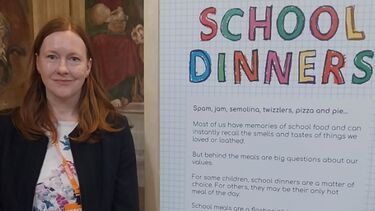
“We put out a nationwide call for people to share their experiences of school food with us. Participants reflected on their own experiences of school meals, including memories from when they were children and their experiences as parents and professionals” explains Dr Ellis.
“Across all three areas, it was important that we looked beyond the food itself. We wanted to understand the educational and social impact of school meals, as well as what helps children to eat well, feel a sense of belonging and experience dignity within that space” adds Dr Ellis.
The lifelong impact of policy on children
One of the most significant findings from the SMS project was just how deeply school meal experiences stay with people throughout their lives. Decisions that may appear administrative or technical at a policy level can have lasting effects on children, shaping their relationships with food, their sense of wellbeing and belonging for decades.
For some participants involved in the study, school meals were associated with care, stability and security, particularly when food at home was uncertain. For others, especially children receiving free school meals in the 1960s and 1970s, or those with sensory or neurodivergent needs, the school dining room was a source of exclusion and shame.
“We found that experiences of school meals could shape people’s attitudes towards food, eating habits and weight management, even 40 or 60 years later” explains Dr Ellis.
“One contributor, named Jim to protect his identity, recalled being bullied when his family relied on free school meals while his father was out of work. He remembered the humiliation of being singled out in front of other children and developed ways of hiding the fact that he was receiving free meals” adds Dr Ellis.
Jim’s story became one of the project’s most powerful examples of how school meals policy can impact individual lives, and was later featured in a touring school dinners exhibition at the House of Commons. The exhibition gave MPs an opportunity to hear directly from people reflecting on their experiences of school meals.
“These accounts showed that children’s experiences of school meals extend far beyond what is served on the plate. The sensory environment can play an important role too - from how food tastes and smells to how the dining room or canteen feels. Because of this, we recommend investing in inclusive dining spaces - which are designed for calm, comfort, and neurodiverse needs” explains Dr Ellis.
Building a case for universal school meals
While the project provides new historical insight into school meals, its ambitions extend beyond understanding the past. Dr Ellis and the wider research team want children's experiences and long-term historical evidence to play a greater role in shaping future policy decisions.
“It’s seeking to do something a bit more foundational with policy. To try and embed historical experience, so a long-term perspective into future policy, and also the lived experience of children” explains Dr Ellis.
To date, the project's findings have contributed to wider conversations about school food, including discussions around the Government’s recent review of school food standards - the first major review in more than a decade. They have also informed the work of the School Food Alliance, prompting further research into the continuing stigma experienced by children receiving free school meals.
Since 1906, means-tested free school meals have often carried a stigma - and our oral histories revealed how children hid meal tickets or went without food rather than risk being identified as ‘poor’. While the recent shift to cashless payment systems have helped to reduce some of the visible markers of who receives free school meals, the underlying stigma still continues to shape children’s experiences today.
Dr Heather Ellis
Senior Lecturer in the School of Education
Drawing on more than 100 years of evidence, the research team therefore argues that universal provision - giving every child access to a school meal regardless of family income - offers the strongest way to remove stigma, not only for economic reasons but because of the shared experience it creates among pupils.
Bringing the research to the public
Beyond policy, the project is working to raise public awareness through its partnership with the Food Museum and a touring exhibition.
In 2025, the Food Museum in Stowmarket launched a two-year exhibition exploring the history of school dinners in Britain. The SMS project was the exhibition's official academic partner, with research findings woven throughout the visitor experience.
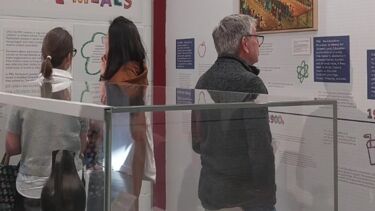
“It was a really nice coincidence as we were looking for a museum partner, while the Food Museum was looking for an academic research partner to help develop an exhibition about school dinners” explains Dr Ellis.
“Over 12 months, we worked together with the Museum to bring our research into the exhibition. Visitors can explore oral histories, museum collections and school meals from different decades through a tasting kitchen. The exhibition looks beyond nostalgia to explore experiences of poverty, stigma and exclusion, as well as the role school meals can play in supporting children and families” adds Dr Ellis.
By recreating the sights, sounds, smells and memories associated with school dinners, the exhibition aims to spark conversation, deepen public understanding and encourage support for school meals today. It also explores how ideas about British food have shaped school meals, and how this can differ from the food children experience at home.
“There’s a whole part of the exhibition that looks at what British food is, how that's been framed, and the differences with children's food cultures at home, particularly if they have a different heritage or belong to a particular community” explains Dr Ellis.
Making the research accessible to the public is an important part of influencing the future of school meals. The exhibition shows how decisions that may appear small at the time can have lasting consequences for children and families - and how many of today’s debates about nutrition and obesity have deep historical roots.
“We want recommendations to be informed by what the public who visit have said matters to them, because they're ultimately the ones who elect the MPs” adds Dr Ellis.
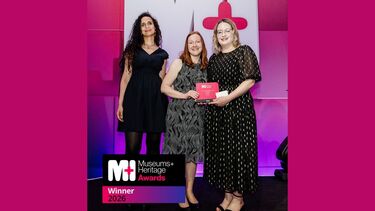
Earlier this year, the School Dinners exhibition won ‘Temporary or Touring Exhibition of the Year’ at the 2026 Museums and Heritage Awards, as well as the ‘Food on Display Award’ at the British Library Food Season Awards. The exhibition will run until September 2027.
Rethinking school meals as social infrastructure
One of the project’s key messages is the need to rethink school meals as part of the infrastructure that supports children and communities.
“More than anything else, we need to reconceptualise school meals as social infrastructure like trains and roads. It is something that sustains us. It's not just food” adds Dr Ellis.
As the project moves towards its next stage, the team hopes its findings will contribute to stronger evidence-based recommendations for the future - supporting a school meals system that is universal, inclusive and responsive to the diverse needs of children and families.


Written by Anna Blagg (Marketing and Communications Officer, Research)
For further information please contact: mediateam@sheffield.ac.uk.