Helping stroke survivors regain independence
Could an earpiece help stroke survivors regain arm function? A UK-wide trial led by the University of Sheffield is exploring whether vagus nerve stimulation, combined with rehabilitation exercises, could support the brain’s ability to recover after stroke and help people live more independently.

For many people, the impact of a stroke continues long after they leave the hospital. Around 60 per cent of stroke survivors are left with arm and hand weakness, making everyday tasks such as getting dressed, preparing food or carrying shopping much harder than before.
While rehabilitation can help, a considerable proportion of people never fully regain the use of their arm, highlighting the need for new treatments that can aid recovery and improve independence.
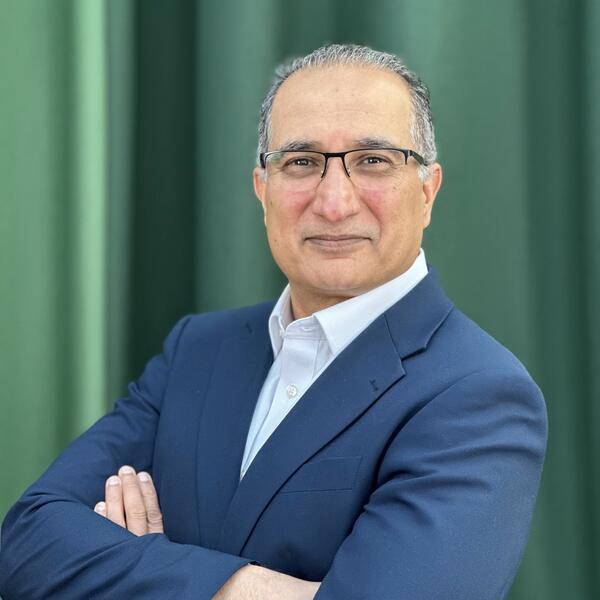
At the University of Sheffield, Professor Arshad Majid, Professor of Cerebrovascular Neurology, is leading the TRICEPS trial, a UK-wide study exploring whether a non-invasive form of vagus nerve stimulation can enhance recovery after stroke. The treatment, known as transcutaneous vagus nerve stimulation (TVNS), delivers gentle electrical stimulation to a small branch of the vagus nerve through the outer ear while participants carry out rehabilitation exercises at home.
By stimulating the vagus nerve at the same time as movement, researchers believe it could support neuroplasticity - the brain's ability to reorganise and form new connections after injury - potentially helping stroke survivors recover lost abilities.
TRICEPS is led by researchers from the University of Sheffield and Sheffield Teaching Hospitals NHS Foundation Trust and funded by a partnership between the National Institute for Health and Care Research and the Medical Research Council and the Association of British Neurologists Fellowship (co-funded by the Stroke Association and Berkeley Foundation).
A non-invasive approach to stroke rehabilitation
Launched in 2023, the TRICEPS trial recruited 270 participants in 20 centres across the UK, exceeding its recruitment target and making it one of the largest studies to test this type of treatment. The trial is led by the University of Sheffield in partnership with Sheffield Teaching Hospitals NHS Foundation Trust, supported by the University's Clinical Trials Research Unit and the Sheffield Institute for Translational Neuroscience (SITraN), and funded by the National Institute for Health and Care Research (NIHR).
For Professor Majid, the strength of Sheffield’s research infrastructure has been key to making the trial possible.
"When you work on a stroke ward, you quickly realise there's only so much we can do with the treatments we currently have. Seeing the long-term impact that disability has on people's lives is what motivated me to find ways to improve recovery, not just survival” explains Professor Majid.
"Sheffield has been the ideal place to do that. The expertise within our Clinical Trials Research Unit is recognised nationally and has been essential in making a study of this scale possible. Combined with the support from Sheffield Teaching Hospitals, it's given us the opportunity to take an idea from the laboratory into a large clinical trial that could ultimately change patient care” adds Professor Majid.
The trial builds on Professor Majid's long-standing research into neuromodulation and stroke recovery. Although implanted vagus nerve stimulation has previously been shown to improve arm recovery after stroke, it requires an operation to implant a device in the chest with electrodes connected to the vagus nerve in the neck, making the treatment costly and limiting its widespread use.
TVNS avoids the need for surgery altogether. Instead, patients use a small, portable device worn on the ear at home, making it more practical, less invasive, and potentially more cost-effective.
Beyond the devastating impact to stroke survivors and their families, stroke is also the leading cause of adult-onset disability in the UK. Finding ways to help people shift their recovery from their own homes can be vital in current and future avoidable costs of stroke.
The focus on arm function was shaped by what matters most to stroke survivors themselves.
Stroke survivors have actually identified arm weakness as one of the main issues affecting their daily lives. From a research point of view, it’s also a relatively straightforward measure. We can assess it using established clinical scales, which makes it easier to track changes in a reliable way. That’s particularly important because we’re working in a new area where no one has really done this before, so we needed something simple but meaningful that would still reflect impact on patients’ lives.
Professor Arshad Majid
Professor of Cerebrovascular Neurology at the University of Sheffield
Alongside looking at improvements in arm function, the study is also investigating how TVNS works. Using advanced brain imaging and blood-based biomarkers, the research team are exploring whether vagus nerve stimulation influences brain activity, blood flow and inflammation after stroke, helping to build a clearer understanding of the biological processes behind recovery.
Improving everyday life after a stroke
The research team involved in the TRICEPS trial have heard first-hand how regaining small movements can make a meaningful difference to stroke survivors. For some participants, improvements have enabled them to carry out everyday tasks that they had previously struggled with, helping them to regain confidence, independence and a greater sense of normality following stroke.
“People have told us very clearly what arm weakness means in real life. One patient said they couldn’t put a key in a lock, which as you can imagine is a huge problem when you’re trying to get into your own home. Another woman told us she couldn’t change her grandson’s nappy. Now she can do that again. These everyday activities might sound small, but even slight improvements in function can make a big difference to independence” explains Professor Majid.
Understanding how the therapy works
Neuromodulation is still a developing field, but researchers believe it could move quickly if trials like TRICEPS continue to show positive results. One of the next challenges is understanding why some people respond better than others, and whether treatment can be tailored to each individual.
“In the longer term, we are looking to explore ‘closed-loop’ systems, where stimulation is automatically adjusted based on how the brain is responding. At the moment, patients set the level of stimulation themselves, but the optimal dose for each individual is not yet known. Future devices could potentially monitor brain activity in real time and adjust stimulation accordingly” explains Professor Majid.
“There is also interest in whether combining vagus nerve stimulation with drug treatments could further enhance recovery, using a multi-approach strategy to support brain repair” adds Professor Majid.
From stroke rehabilitation to broader neurological conditions
Professor Majid and his research team are already planning research into whether patients with other neurological conditions could potentially benefit from vagus nerve stimulation. The aim is to investigate whether stimulating the vagus nerve could support the brain's ability to ‘rewire’ itself, with healthier areas potentially taking over functions from damaged ones.
“There’s a lot of interest in other conditions. People have talked about sleep paralysis and dementia, and we’re currently in the process of planning a study in mild cognitive impairment - which is the stage before dementia. These patients have some memory impairment, and a proportion will go on to develop Alzheimer’s disease” explains Professor Majid.
“Beyond that, there’s interest in conditions such as cerebral palsy, and even arthritis and inflammatory bowel disease, given the anti-inflammatory effects” adds Professor Majid.
Connect with Professor Arshad Majid on LinkedIn
Written by Anna Blagg (Marketing and Communications Officer, Research).
For further information please contact: mediateam@sheffield.ac.uk.