
Drawn together: 20 years of shared innovation with Magnomatics
As the former Sheffield spinout prepares to toast their 20th anniversary, we caught up with the team to reflect on two decades of working together to bring world-class engineering to life.

From high-performance hybrid vehicles and marine propulsion, to aircraft control systems and floating wind farms, Magnomatics is an engineering powerhouse at the forefront of the electric energy revolution.
But ask the team at Magnomatics about the secret to their success, and they’ll point straight to their people. By opening the doors to a steady stream of students and graduates over the years, they’ve turned the path from the classroom to the workshop into the company’s competitive edge.
What do Magnomatics do?
Magnomatics specialises in something called contactless magnetic gearing, a technology that replaces traditional interlocking "teeth" (like you’d find in a gearbox) with magnetic fields. Because the components never physically touch, they don’t suffer from the friction and wear that cause standard machinery to break down. This means they can stay efficient and reliable, even in harsh or remote environments where maintenance can be tricky.
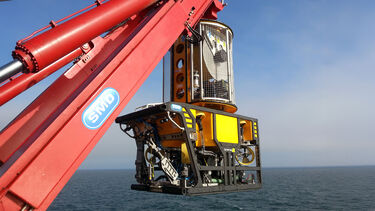
Few environments are as harsh as the open ocean. Some of their most ambitious projects to date include developing marine propulsion thrusters and underwater clean-energy turbines to capture the constant power of the Gulf Stream off the Florida coast. By using their magnetic gears, Magnomatics can keep these powerful machines running efficiently while completely submerged in these unforgiving conditions.
But before they were designing solutions for the untamed Atlantic, the team’s biggest challenge was proving their ideas could work outside of a university workshop. Success wasn't just about the technology, but about finding the right people to build it.
Skills shortage? What skills shortage?
In 2006, Professors Kais Atallah and David Howe took their groundbreaking research from our Electronic and Electrical Engineering labs into the business world, launching a spinout based in the Ella Armitage building (which now sits in the Sheffield Innovation Spine) that would grow into a pioneering force in UK manufacturing. They didn't do it alone. From day one, the secret to their growth has been a constant influx of new perspectives.
For 20 years, Magnomatics have been engaging with Sheffield engineering students early, from undergraduates to PhDs, offering jobs and placements to the best young minds.
For Magnomatics, finding talented new engineers has never been much of a problem.
"We take enormous pride in engaging University students, often making first contact through Year in Industry placements that lead directly to full-time roles," says Dr David Powell, Engineering Business Development Director. "They bring boundless enthusiasm and new skills that invigorate the workplace, flipping the industry skills shortage on its head."
Meanwhile, the students get the chance to gain hands-on experience and potentially secure full-time jobs.
Tom Wright, now a Mechanical Design Engineer, graduated in 2024 with an MEng in Mechanical Engineering with a Year in Industry. His relationship with the firm started long before graduation, securing a short placement at the end of his second year.
"With industry experience being harder to get and increasingly beneficial for new engineers, the close relationship with the University allowed me to gain that early on, which then later helped me gain a placement at a Formula One team in 2022," Tom explains. "Since then, being drawn back to Magnomatics has enabled me to accelerate my career and gain incredible experience."
Instead of being treated as temporary help, placement students at Magnomatics are immediately handed the keys to industry-defining projects.
Chris Peston, a Junior Mechanical Design Engineer, spent his placement year with the firm before returning full-time after graduating in 2024. He was quickly dropped into the heart of the global push for cleaner aviation.
"I worked on the ROTATOR EU Cleansky 2 project, which is part of a larger project designing future aeroplane propulsion," Chris says.
For Chris, the thrill was seeing his ideas jump from a computer screen into the real world, including helping to design a new type of magnetic clutch for aircraft that transfers power through the air without any parts actually touching.
"I was on the project all the way through, from electromagnetic design to testing the prototype," says Chris.
Tom agrees that this ability to immediately make a tangible impact is what draws ambitious students to the company. "The scale of the company means everyone is truly having an impact on each project and the business as a whole," Tom notes. "The encouragement you get from everyone to think of new ideas and to problem-solve feels really exciting."
A two-way street in Sheffield
The collaboration goes beyond recruitment. Magnomatics staff frequently return to the University to pursue advanced qualifications and sharpen their technical skills. The partnership also gives the company access to expert advice, specialised labs, and new funding opportunities. This constant exchange of knowledge ensures the team has the skills and resources needed to remain a global leader.
"Our strong relationship with the University of Sheffield is proven across numerous joint projects with the Engineering Department, The Management School (SUMS), the AMRC, and the Royce Institute," Dr Powell adds.
"Sharing facilities and knowledge broadens our perspectives, fosters new avenues of collaboration, and drives real innovation and growth."
Dr David Powell, Engineering Business Development Director, Magnomatics
Choosing to stay in Sheffield has also been paramount to the success of the business. The region's deep industrial roots provide a natural ecosystem for an innovation-led company to thrive.
As Tom points out, the city's unique mix of academic brilliance and industrial heritage makes it the ideal home base for a global green energy revolution.
"With places like the AMRC and the University, Sheffield is a hub of research and development within industry. This is critical for Magnomatics, as it helps us to be at the forefront of industry and electrification. Also, the ability to have a local supply chain that has a wealth of experience is great for overcoming challenging projects and pushing boundaries of what is possible with electric machines."
Two decades of turning university research into global technology has proven that the talent pipeline works. Now, the company is focused on scaling that success even further.
"Over the last 20 years, we’ve built exceptional technology, thriving partnerships, and a remarkable team," says Chief Technical Officer & Co-Founder Dr Stuart Calverley.
"We’ve helped shape the future of electrification across multiple industries, but as we enter serial manufacture and expand our operations in Sheffield, we’re only just getting started. I'm enormously proud of what we've achieved, and even more excited about what comes next."
Find out more about what Magnomatics are up to on LinkedIn.