
University of Sheffield physicists secure key role in £15M international push to upgrade CERN’s ATLAS experiment
Physicists are embarking on a major international construction project to install a pioneering tracking system at CERN, designed to help the world’s largest experiment ATLAS handle unprecedented data levels.

IMAGE: Members of the Sheffield ITk cooling team—(left to right) Dr. Mitch Norfolk, Mr. Sam Edwards, and Mr. Paul Kemp-Russell—inside the SR1 cleanroom facility at CERN. The team is pictured during a recent visit, standing in front of the detector’s carbon fiber outer cylinder during a crucial cooling-pipe welding session.
The project, which follows years of development across the UK’s leading physics departments, aims to complete the construction and integration of the UK’s contribution to the ATLAS experiment. This Phase-II upgrade is essential to meet the technical challenges brought by the High-Luminosity Large Hadron Collider (HL-LHC) era.
For the global physics community, the challenge of the next decade involves more than just raw power. As the LHC increases its collision rate, existing detectors face a much harsher environment defined by high radiation and "pileup" - where up to 200 proton-proton interactions occur simultaneously. Currently, standard instrumentation would be overwhelmed by this intensity, potentially obscuring the signals of new particles or forces.
Funded by a £14.9M investment from the Science and Technology Funding Council (STFC) the team - which includes the University of Sheffield and 14 other UK institutions including STFC Rutherford Appleton Laboratory will now move to the final phase: the delivery and commissioning of the Inner TracKer (ITk). This all-silicon detector is designed to replace the experiment’s current Inner Detector, providing the precision needed to track sub-atomic particles in a high-density environment.
Led by Dr Trevor Vickey the University of Sheffield plays a central role in this hardware build. Specifically in the production and testing of silicon detector modules. There are 12,000 modules, each containing 2,560 - 5,120 read-out channels, which are the fundamental building blocks of the tracker.
Beyond the sensors themselves, Sheffield leads the UK’s efforts in the CO2 evaporative cooling systems for both the ITk Strips and Pixel detectors. Because the new sensors generate significant heat and are susceptible to radiation damage, they must be kept at stable, sub-zero temperatures (down to -30°C) to function.
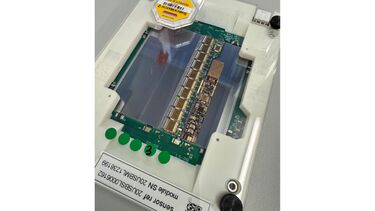
IMAGE: A completed "Long Strip" silicon detector module built at the University of Sheffield. Measuring approximately 10 cm x 10 cm, this ultra-precise component features 2,560 individual readout channels split across two rows of silicon strips. It is one of 1,000 modules being meticulously assembled and tested by the Sheffield team for the outer layers of the new ATLAS Inner Tracker (ITk) barrel.
Every piece of silicon, every wire-bond, and every cooling tube being integrated into the new ATLAS tracker is an investment in the next twenty years of human discovery. The ITk is being built to withstand conditions that would destroy ordinary electronics, all so we can answer the biggest questions in physics - from the precise nature of the Higgs boson to the identity of dark matter. It’s a testament to what global scientific collaboration can achieve when we push the absolute boundaries of technology
Dr Trevor Vickey
These technical insights and hardware components are now being prepared for final delivery to CERN. By integrating advanced software and firmware with this new hardware, the researchers will ensure that the ATLAS detector can process over a billion interactions per second.
The findings from this upgrade will provide the evidence needed to push the frontiers of scientific knowledge. By ensuring the ATLAS detector remains fit for purpose in the High-Luminosity era, researchers will be able to test the Standard Model to its absolute limits, searching for the precise points where our current understanding breaks down and uncovering the new, undiscovered particles that make up the missing pieces of our universe.
The research team will be working across a global collaboration of over 5,500 members to ensure the transition to the new system is seamless. This collaboration ensures that as the LHC enters its most intense era of discovery, the UK remains at the heart of the world’s most significant scientific breakthroughs.