
Sheffield brings clinicians, scientists and industry together to explore AI's potential in cancer research
Clinicians, researchers and industry partners came together for a joint workshop exploring how artificial intelligence can transform cancer research and care.

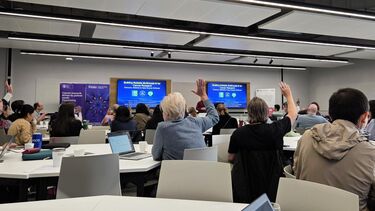
The event, held this week at The University of Sheffield, was co-organised by the Sheffield Centre for Cancer Research, the Insigneo Institute for Healthcare Technology and the Centre for Machine Intelligence (CMI). Its aim was to bring clinicians together with researchers from across the three organisations to find ways of working together and to identify opportunities where AI can be applied to cancer through collaborative research. The programme combined keynote talks, shorter presentations, open discussion and networking across a full day.
The breadth of the response reflected how wide this field has become. More than 130 people registered, drawn from four University faculties and 13 schools and departments, from Medicine and Population Health and Computer Science through to Biosciences, Clinical Dentistry and the electrical, mechanical and chemical engineering schools, together with 21 colleagues from Sheffield Teaching Hospitals and other NHS organisations, industry partners and three other universities. Roughly equal numbers described themselves as working on cancer, clinically or in the laboratory, and as building AI methods, with a real overlap between the two.
The workshop opened with welcomes from Professor Jim Catto, Co-Director of the new Sheffield Centre for Cancer Research, Professor Jim Wild, Co-Director of the Insigneo Institute for Healthcare Technology, and Dr Denis Newman-Griffis, AI for Health Theme Lead at the Centre for Machine Intelligence, before Dr Bilal Tahir set the scene with a primer on AI in cancer research and care for the mixed clinical, scientific and engineering audience.
Three keynote speakers offered clinical, industry and technical perspectives across the day. Professor Ali Khurram (School of Clinical Dentistry) opened with a talk on using explainable AI to reshape head and neck pathology. Jonny Hancox, Senior Data Scientist for Health & Life Sciences at NVIDIA, gave an industry view on AI's growing role in healthcare and life sciences, with a focus on oncology applications. Professor Haiping Lu (School of Computer Science) closed the keynotes with a technical talk on building reliable multimodal AI for cancer research, covering datasets, methods and open-source software.
A session on research and services at Sheffield followed, covering the measurement of drug efficacy at single-cell resolution, generative AI for understanding tumour heterogeneity, the cancer data infrastructure already available at Sheffield Teaching Hospitals, access to clinical laboratory data, and the challenges and opportunities of free text in general practice records.
What struck me most was the range of people in the room. Clinicians, basic scientists, computer scientists and engineers were all looking at the same problems from different directions, and that does not happen often enough. The hardest parts of this field are not the algorithms. They are data access, annotation and validation, and those are exactly the problems a group like this can solve together. This is a real kick-start to our ambition in this area.
said Dr Bilal Tahir, co-chair of the event
A rapid-fire session gave researchers and clinicians the chance to present work in progress, spanning speech recognition for electrolarynx users, AI and virtual reality in bereavement care, AI-assisted radiotherapy, and targeted therapies for blood cancer.
Later sessions turned to methods and expertise from across the University, including neuro-symbolic AI for reasoning over clinical trial data, speech and acoustic sensing for health, AI in endoscopy, and international collaborations on melanoma and medulloblastoma, classifying oral cancer from non-invasive electrical measurements, trustworthy machine-learning-assisted imaging, and the research software engineering support available to projects. The day closed with a community-building session run live on delegates’ phones, mapping where the real barriers lie and what Sheffield should build next.
We look forward to building on the connections made, and to supporting new collaborations between AI researchers, clinicians and industry partners working to improve cancer outcomes. We will now look at funding routes to help translate the day's conversations into future collaborations.
added Dr Ning Ma, co-chair of the event
The organisers would also like to thank the administrative and communications colleagues whose support made the day possible: Kate Jones and Dr Emma Barker at the Centre for Machine Intelligence, Rachel Corcoran at the Sheffield Centre for Cancer Research, and Sarah Black and Sarah Hollely at the Insigneo Institute for Healthcare Technology.
The Sheffield Centre for Cancer Research is a new research centre which brings medicine, science, engineering and social sciences together to address the biggest challenges in cancer. This event marked the new centre’s first collaboration with the Insigneo Institute for Healthcare Technology and the Centre for Machine Intelligence.
Plans are under way for a new AI in Cancer Research special interest group, which we hope to convene for the first time in early 2027. If you would like to register your interest, please contact cmi-enquiries@sheffield.ac.uk.