
Improving safety and resilience of electrified railway with novel onboard energy storage solutions
PhD student James Scott, examines the use of Energy Storage Systems (ESS) for discontinuous railway electrification and how they can improve the safety and reliability of electrified railways.

James' research challenge
How to aid the decarbonisation of the UK railway network by using energy storage systems whilst improving the safety and resilience of existing electrified railways.
The top results
- By removing electrified conductor rail within stations, fatalities and major injuries to passengers caused by electrocution could be reduced by a third.
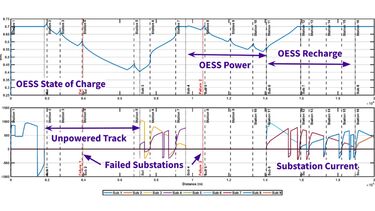
- By equipping trains with a small Onboard ESS, operators can mitigate power supply failures and prevent passengers from being stranded, trading potential service cancellations for minor delays.
- By pairing electrical grid connected energy storage systems with future railway electrification programmes, distribution and tranmission network operators can reduce grid stress while ensuring less renewable energy goes to waste.
Behind the scenes
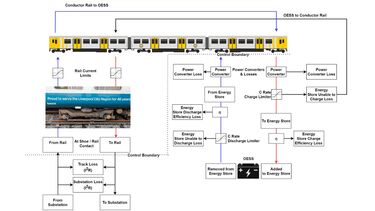
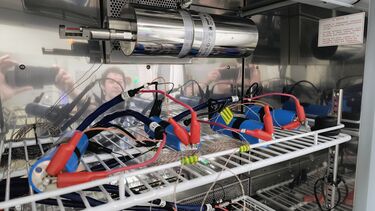
An Energy Storage System (ESS) is a term for technologies such as batteries, supercapacitors or flywheels that store electrical energy. Onboard a railway vehicle this system can capture, store and redeploy electrical energy to provide power to the traction equipment.
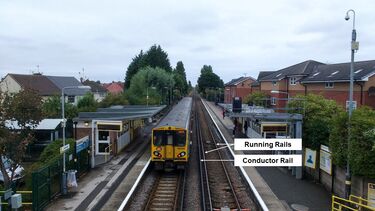
James’s research investigated using an Onboard ESS to remove exposed conductor rails that are common in UK train stations. Removing the electrified rail, trains need an onboard power source to provide their tractive power. James’ model and research has shown that relatively small Onboard ESS's such as batteries or supercapacitors can overcome these gaps in electrification in stations.
Onboard ESS’s also allow novel methods of decarbonisation allowing a train to travel through un-electrified sections without relying on diesel generators. Beyond bridging these infrastructure gaps, James’s model demonstrates that Onboard ESS deployment offers further benefits by improving network safety and resilience.
Who benefits from this work?
James’ research will safeguard passengers and railway workers whilst reducing energy consumption for the operators and improving resilience to power supply failures for the infrastructure managers and maintainers.
Research by James Scott
Aiding decarbonisation of the UK railway network by using ESS's whilst improving the safety and resilience of existing electrified railways




In James' words
The UK railway network and operators are rapidly adopting battery and energy storage technologies for use on the railways. Operators such as Merseyrail and Great Western Railway are now using Onboard ESS's for electrical power on non electrified railways. This technology can also improve the safety of top contact third rail systems by removing the conductor rail from locations with a high risk of electrocution to either passengers or railway workers. Other positive benefits of ESS for operators and infrastructure managers include improved resilience in case of power supply failures and being able to use excess renewable energy for railway traction.
James Scott
PhD Researcher
James is a PhD researcher working in both the School of Mechanical, Aerospace and Civil Engineering and the School of Electrical and Electronic Engineering and supervised across both Schools by Professor David Fletcher and Professor Dan Gladwin.
Connect with James on LinkedIn.