
Global experts gather at Sheffield workshop to address rail fatigue and wear
The MERail Group hosted the International Collaborative Research Initiative (ICRI) on Rolling Contact Fatigue (RCF) and Wear of Rails and Wheels at a three-day technical workshop last month.

The MERail Group hosted the International Collaborative Research Initiative (ICRI) on Rolling Contact Fatigue (RCF) and Wear of Rails and Wheels at a three-day technical workshop from 16th-18th September 2026 at the University of Sheffield.
The in-person event brought together leading academics, industry consultants, and railway engineers from across the world, to address critical safety, maintenance and asset management challenges facing global rail networks.
Rolling contact fatigue and wheel-rail wear remain among the most significant operational costs and safety risks across modern railway systems. The workshop provided a dedicated forum to bridge the gap between advanced research and practical engineering applications.
Organised by Professor Roger Lewis, Professor David Fletcher, Ellie Haimes and Louise Caffrey, the conference was designed for practicing engineers, researchers, and early-career students. The initial two days featured a series of technical presentations and discussions led by international experts, focussing on railway engineering challenges such as rolling contact fatigue, friction management and crack growth.
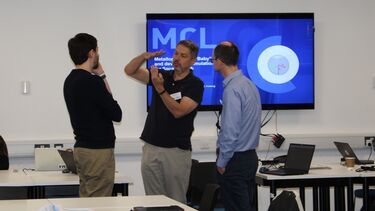
The 50+ attendees also explored specific metallurgical issues such as squat formation and the impact of wheel-rail profile accuracy on infrastructure performance. The conference concluded with guided laboratory tours of facilities at the University of Sheffield, British Steel and the Laboratory for Verification and Validation (LVV) at the Advanced Manufacturing Research Centre (AMRC).
Roger Lewis, Professor of Mechanical Engineering, said: “Events like these are essential to solidifying partnerships with industry, showing our capabilities and creating opportunities to collaborate with each other. Everyone engaged directly with our keynote speakers, reviewed current methodologies, and built professional networks across academia and industry.
We would like to thank the Rail Safety and Standards Board (RSSB) for sponsoring the event as well as supporting the rail damage workshop; to the Laboratory For Verification & Validation (LVV) and to British Steel for hosting the tour section of the event.”
Sylvie Chénier, Senior Project Manager from the National Research Council Canada, said: “The recent ICRI workshop was a great gathering of experts from across the international railway community to share their findings and discuss some of the sector’s most important challenges. The presentations highlighted advances in rail profile design, grinding optimisation, friction management, crack growth analysis, squat formation, and material degradation mechanisms. The workshop sessions enabled dialogue on both current challenges and future research priorities, building connections between those working on similar issues across the railway sector.”
About the ICRI
The ICRI on Rolling Contact Fatigue (RCF) and Wear of Rails and Wheels is an informal collection of academics, consultants, researchers, and engineers working in, or having significant involvement with, the international railway industry. The ICRI, formed in 2013, brings together roughly 475 people from over 225 organisations in 40 countries (as of 2025) to collaborate on topics of mutual interest by leveraging current or future, already funded work.
The ICRI regularly rotates its workshops across various international institutions, research centre’s, and host cities, often partnering with member organisations or major rail engineering conferences. Previous venues include Vienna, Tokyo, North America as well as mini-conferences around Europe.