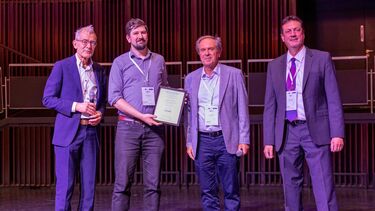
European honour for dynamics researcher
Dr Tim Rogers, Senior Lecturer in Mechanical Engineering and member of the School’s Dynamics Research Group (DRG), has been awarded a Junior Research Prize in Computational Structural Dynamics.

Dr Tim Rogers, Senior Lecturer in Mechanical Engineering and member of the School’s Dynamics Research Group (DRG), has been awarded the Junior Research Prize in Computational Structural Dynamics by the European Association for Structural Dynamics (EASD).
Presented every three years at EASD’s prestigious EURODYN conference, the prize recognises early-career researchers under the age of 40 who have made outstanding and sustained scientific contributions to the field. Peer-nominated, the award honours the breadth of Dr Rogers' work in structural health monitoring (SHM) and nonlinear system identification.
Since completing his PhD in 2019, Dr Rogers has authored over 100 papers on these topics, including more than 40 journal contributions, and delivered numerous international invited talks, including a recent research visit to Dortmund under the TU Hosts programme.
Dr Rogers said: “It is always reassuring that the contributions I have made to the field are in some way appreciated by the community. We are lucky to have a large number of excellent researchers in these areas within Europe, so to be recognised among a strong peer group is very encouraging. For me, the most beneficial thing is the positive collaborations I have been able to build across Europe.”
While the award recognises his past achievements, Dr Rogers remains focused on tackling major real-world engineering problems. He adds: “There remain a large number of pressing challenges in the UK, across Europe, and globally related to our management of infrastructure, and I hope that the topics I work on will make that task more efficient and increase safety for all of us.”
Looking ahead, the Dynamics Research Group has several major milestones on the horizon. In April, the group will host a showcase event for the ROSEHIPS programme grant, celebrating the culmination of a five-year collaborative project with Queen's University Belfast, the University of Cambridge, and the University of Exeter. The project has pioneered Population-Based Structural Health Monitoring (PBSHM), an approach now widely adopted across the research community that enables engineers to share data across similar structures to improve operations and maintenance planning.