
Health & Safety in the Lab
All health and safety documentation is kept in labelled folders within the labs (D22 & D34a) and available electronically on the facility shared drives. These are reviewed by the fly technical team.

Carbon Dioxide
If the CO2 sensor is sounding then this indicates dangerous levels of CO2. Leave the lab immediately and prop open the door.
If the carbon dioxide alarm is sounding:
Do not enter the fly lab. Wedge the door open to ventilate the lab.
If you are in the fly lab when the carbon dioxide alarm is sounding, exit the lab immediately. Wedge the door open to ventilate the lab.
In emergency, call:
4444 - from an internal phone
0114 2224444 - from an external mobile
If the alarm is flashing but not sounding the CO2 will have exceeded the 8 hour safe long term exposure limit (0.5%). Do not work in the lab for extended periods under these conditions. Do not wedge the door open as this breaches GM regulations and should only be done if the alarm is sounding.
Please remember to turn off your CO2 tap when you have finished using it. CO2 will only be directed to the fly pad when the foot pedal is pressed. This saves CO2 and reduces our environmental impact.
CO2 supplies can be turned off to each bench in the fly lab by closing the black valves underneath the benches.
Rooms with CO2 supplied
Rooms which have regulators and taps which need to be checked if there is a leak or you suspect someone might have left a tap on are:-
Tissue Culture (D32/D32a).
Prof. D. Strutt’s laboratory (D36).
Prof. D. Strutt’s microscope room (D37).
Fly lab (D22).
Dr Iwan Evans laboratory (D31).
Microscope Room (D25).
Light Microscope Facility (B51).
Dr. K. Campbell’s laboratory (D38).
- CO2 has been capped to D18 and F21.
Waste Management
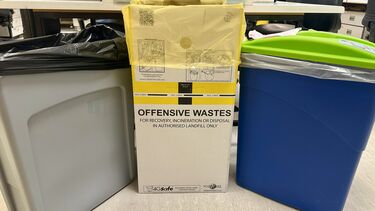
Waste must be disposed of via the appropriate route, as described in the biological waste poster by the door in D22. Waste assessments are also located by the doors in D22 and D34a, please refer to these for the appropriate disposal of your waste. These documents are reviewed routinely by the fly technical team.
Please collect vials and bottles with the reusable foam bungs in a tray after use and put them onto the trolley between the controlled temperature rooms in D22. We can then inactivate the waste by the validated freezing method, wash and reuse the bungs, vials and bottles.
Use the GM waste bins to dispose of other fly cultures, if they are not inactivated, please ensure they remain sealed with their bung or in a zip-seal bag for apple juice plates. These bins will contain an orange bag on the outside and two black bags on the inside.
Please empty your GM waste bin at least every 2 weeks and label the lid with the date you have done this. To do this, take out the bags and twist the top around ensuring to gather all 3 bag layers. Secure tightly with a long cable tie, ensuring no flies can escape. Fill out an orange label (GM/Infectious Waste) with the following information:
Department-BIS
Laboratory–D22
Date Sealed
Place the label on the bag and put it out of the way to the right of the 29C incubator, being careful not to block walkways.
Put an orange bag and then two black bags into the bin for next use.
The waste bags are collected from the fly lab on Monday, Wednesday and Friday mornings.
The sharps bin for sharps not contaminated with live GM flies/larvae/pupae is located on the long bench. Another sharps bin is located inside the “reusable” -20 freezer for broken glass vials contaminated with fly food or GM flies/larvae/pupae.
The offensive waste bin (yellow cardboard) is for laboratory waste which is not genetically modified and has a low risk of attracting live flies (such as gloves).
Use the bin with black lid for non-hazardous general waste, such as paper towels, and the bin with green lid for mixed recycling
Rinse used Fisher Winchester bottles and put the lid in the general waste bin. Deface the label with a cross and place the Winchester outside the lab for collection.