
Getting your flies
The flies used in experiments can come from many places; wild caught, our stock collections in the Fly Facility, purchased from other stock collections and more.

Our Stock Collections
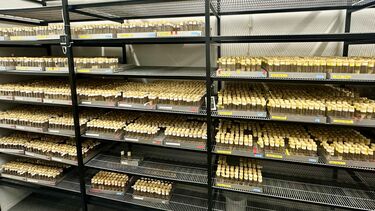
Each Principle Investigator (PI) working in the facility has a stock collection housed in the 18C culture room. Every stock vial is labelled by the technician team with the labels being colour coded by PI and containing the stock number and genotype.
The fly technicians maintain the collections. In general, the stocks are tipped onto new food every 2 weeks and each genotype is kept in triplicate for the health and safety of the stock. The youngest vial will be at the front of the row and the oldest at the back. There may be exceptions to this process if different arrangements are made between the PI and the technical team.
Fly technicians will keep the researcher stock databases up to date. These can be accessed on the C drive of the main lab computer if you need to look for a particular stock.
The fly technical team will relabel the main stock collections as need. Please ask Kath or Cherry if you need to add or dispose of main fly stocks. Any new stocks will need to be allocated a stock number unique to the stock collection before they can enter the collection.
Taking from the collections
Please remember that much of the fly stock collection is irreplaceable. It is very important to avoid contaminating or otherwise harming stocks.
If you would like to take flies from the stock collection, please always get permission from the relevant Principal Investigator before taking anything – this may also ensure you get the stock you really need!
Do not deplete the flies from a stock, to the extent that it threatens the health of the stock. In general, it is OK to take flies from the back vial, provided that the other vials are healthy. You must check that the other copies are healthy before taking any flies and only take flies from other vials with great care.
When taking flies out of the collection for your use, you are not to take the stock copies. You must tip the adult flies that you need onto new media for your use and return the stock vial immediately to its correct position in the collection. Be very sure to return stock vials to the correct position in the tray that you got them from, in order to prevent loss and contamination.
If you are ever unsure, please ask for help from the technical team. If you think you have made an error that could affect the collection, eg. contaminating a stock with a different genotype, you must report this to Kath Whitley immediately.
Quarantining outside sources
Any flies that are obtained from sources outside of the main laboratory (D22) must be quarantined before bringing them into the fly lab to make sure they are not carrying anything that can spread to other stocks.
If any flies leave the main laboratory to be used or housed elsewhere onsite, they must also be quarantined before they can return to the main lab.
You must allow them to go through 2 generations and examine the cultures carefully under a microscope to check for mites before bringing them into the fly lab or culture rooms. You must never bring a contaminated stock into the main lab.
Mites
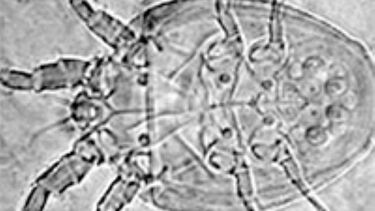
Mites can out compete weak fly stocks or even kill them so please be vigilant and tell Kath if you see old cultures that need to be dealt with or if you discover any mites. Then we can stop them from spreading.
Adult mites are smaller than fly embryos and often walk on the sides of vials and bottles around the pupae and empty pupal cases. An adult mite is shown in the image above, however, mite eggs and adults are better observed in Drosophila culture using the YouTube video below, so please take the time to watch.
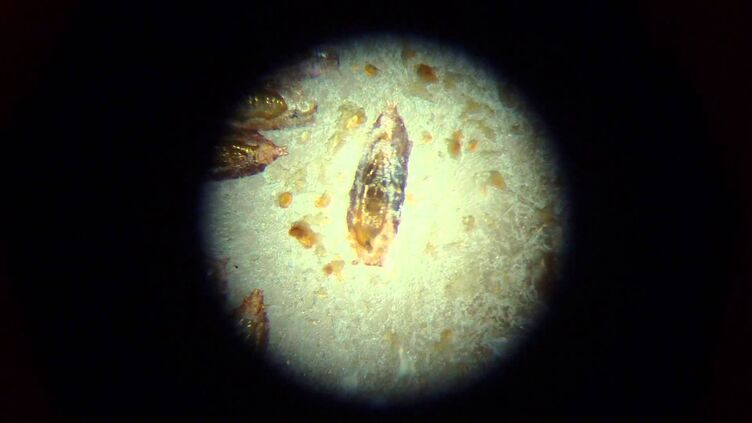
What to do if you have mites.
If you know your cultures contain mites and you don’t need them, freeze the vials overnight at -20C to kill the mites. Place the frozen cultures into an offensive waste bin.
If your culture contains mites and you wish to keep the flies, remove cultures from the fly lab immediately. Passage them three times on consecutive days onto fresh medium. Then allow the flies to go through 2 generations. Putting the tubes on a surface of glycerol makes the transfer of mites from one tube to another more difficult.
Once the culture has gone through at least 2 generations and is mite free when inspected under a microscope, you can return it to the main lab.