Caring for your Flies
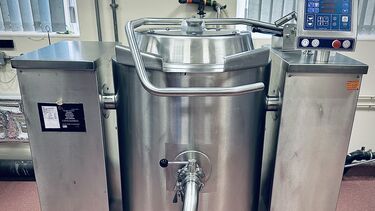
The Drosophila Technical team make all of the media necessary to care for your fly cultures on site.

How long can you keep fly cultures?
Older fly cultures can attract mite infestations that can lead to significant losses to stock collections and experiments, therefore there is a cap on how long you can keep flies in various media types. If you find any mites please tell Kath Whitley so the problem can be dealt with immediately.
Only keep fly cultures for the maximum time indicated below. It is assumed that these are kept at one temperature unless otherwise stated on the front of the tray. Cultures will be checked weekly by fly technical staff and you will be informed if items are close to the maximum times. Technical staff will contact you rather than disposing of any items that have single copies or are part of stock collections. If there is an emergency please communicate this so we can make other arrangements to flip unique fly stocks or move items to your research lab. Any remaining items will be disposed of by the date given.
Fly cultures can be kept for a maximum of:
- all bottles and vials at 29°C - 2 weeks
- all bottles and vials at 25°C - 3 weeks
- all bottles and vials at 22°C - 4 weeks
- straight sided bottles at 18/19°C - new bungs 5 weeks; old bungs 4 weeks
- ICRF bottles at 18/19°C - all bungs 5 weeks
- vials at 18/19°C - 6 weeks
What to do with expired cultures.
Please collect vials and bottles with the new style foam bungs in a cardboard tray after use and put them onto the trolley between the controlled temperature rooms in D22. The technical team can then freeze, wash and reuse the bungs to help reduce our environmental impact.
Cultures being kept outside of D22 or that are bunged with disposable bungs eg. cotton or old type straight sided bungs, should be disposed of, still tightly sealed, in the appropriate GM waste stream.
Feeding your flies.
You must keep a record of your fly food use, including any ingredients and empty vials, bottles and bungs (either individually or a whole lab record), for charging purposes.
Types of media available
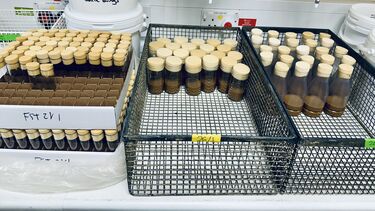
Fly food is available as follows:
- Cotton Bunged Stock vials (CST)
Single use fly food in plastic vials with cotton bungs to be used outside D22 fly lab.
- Foam bunged stock vials (FST)
Fly food in plastic vials with reusable foam bungs to be used in D22 fly lab and controlled temperature rooms D22b & D22c.
- Technician Stock vials (TST)
Fly food in plastic or glass vials with reusable foam bungs to be used by the fly technician team.
- ICRF bottles with cotton wool bungs
Single use bottles for expanding stocks to be used mainly outside D22 fly lab.
- ICRF bottles with foam bungs
Fly food in ICRF bottles with reusable foam bungs to be used in D22 fly lab and controlled temperature room D22c.
- Straight sided bottles with new style foam bungs
Fly food in straight sided bottles with reusable foam bungs to be used in D22 fly lab and controlled temperature room D22c.
- Straight sided bottles with old style foam bungs
Fly food in straight sided bottles with single use bungs for experiments outside D22 fly lab and if experiments require writing on or labelling bungs. Not allowed in the 18°C culture room, to prevent mites getting into the stock collections. Please keep cultures in these bottles for a maximum of 4 weeks in the main lab and 3 weeks at 25°C.
- Apple juice plates
Apple Juice plates are available in 60mm sizes. These are stored in the cold room, D33, and can be put into the fridge in D22 as needed. If you would like 90mm apple juice plates please ask one of the fly technicians the week before you need to use them.
Straight sided bottles can be used in the main fly room at 18-19°C and the 25°C culture room for experiments. They should not be used for maintaining expanded stocks, as this is the principal cause of mite outbreaks. Mites easily infect these bottles, so you should never passage the old generation of flies from one of these bottles into a new bottle.
Small quantities of bungs are available in D22 for researchers to switch themselves. If large numbers of old style bungs are needed these will need to be ordered separately.
Dried granulated yeast is available in D22.
Fly Media Recipe
Ingredient | Amount | Manufacturer | Supplier |
Cold tap water | 1 Litre | ||
Medium Cornmeal | 80g | Triple Lion | Lembas/Easton Enterprises |
Dried Yeast | 18g | Kerry Ingredients | BTP Drewitt |
Soya Flour | 10g | buywholefoodsonline.co.uk | |
Malt Extract | 80g | Rayner’s Essentials | Lembas |
Molasses | 40g | Rayner’s Essentials | Lembas |
Agar | 8g | BTP Drewitt | |
10% Nipagin in Absolute Ethanol | 25ml | Merck Fisher | Fisher/Merck |
Propionic Acid | 4ml | Fisher | Fisher/Merck |
Ordering your food.
Please ensure you have ordered all of your fly food on the shared spreadsheet at least a week before you need to use it. Ordering weeks run Tuesday - Monday as the technical team prepares the food every Monday.
Fly food ordering spreadsheet.
If you require molten food to add your own additives to, please co-ordinate this directly with the fly technical team via email.
Please use the earliest dated (ie oldest) food first, this helps to reduce our environmental impact and reduce waste.
If you require large amounts of media for an experiment please coordinate with Kath or Cherry at least two weeks before you wish to use it.
Fly media is stored in the cold room, D33.
If you need to use small quantities of foam stoppered vials (FST), some will be available in D22 on the long bench next to the door. If this is running out or you need larger quantities please bring more through from the cold room.
Cotton stoppered vials (CST) will be left in the cold room. Please take only what you have ordered and leave the rest in the cold room for others to use.