
Studying General Engineering prepared me well for placement because of its sheer breadth. I have studied various engineering disciplines, and seen how they connect.

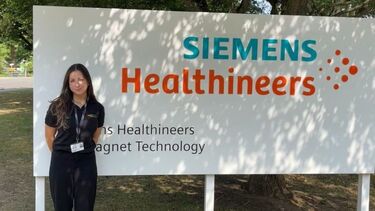
My placement at Siemens Healthineers gave me a varied, hands-on introduction to engineering in the medical technology field. My work covered planning experiments and designing test equipment, using computer models and data analysis, developing new designs, working with suppliers on new materials, and reading scientific research for new ideas.
One of my main achievements was leading an investigation into why prototype MRI systems weren't meeting their performance targets. I designed tests to find the root cause and contributed to a redesign that helped the systems meet their targets and ship without damage. I also ran testing to improve the team's computer models, built a Python tool to analyse large numbers of material samples from several suppliers, and designed a safety component that reduced the chance of assembly errors.
The most memorable moment was seeing that redesigned system meet its targets and ship, knowing my work had made a real difference. The biggest challenge along the way was communicating technical results to people outside my field. In early meetings, my presentations were too technical, so I started leading with key findings, using simpler graphs and diagrams, and asking senior engineers for feedback. It taught me that being understood matters as much as being right, which ultimately led to me presenting to senior leadership.
Working across design, analysis, and supplier communication showed me how much of engineering is collaboration, and that technical work only succeeds when it is planned and communicated well. Overall, this placement genuinely changed how I think about and approach engineering. It helped me recognise that engineering in industry goes far beyond technical knowledge; it requires initiative, adaptability, and strong communication skills.
Studying General Engineering prepared me well for this experience because of its sheer breadth. I have studied mechanical engineering, materials science, fluid dynamics, electronics, and computer science, and seen how these disciplines connect. Real engineering problems rarely sit within a single subject, and although my placement was a mechanical R&D role, I ended up drawing on knowledge from almost every area I had studied. This made me a flexible contributor across the department and led to me being trusted with interdisciplinary, business-critical projects.
Holly Morgan
MEng General Engineering
Several modules helped in specific ways. Mechanical engineering was the foundation of most of my work, from understanding force interactions in MRI systems to supporting mechanical testing and advising on material selection. Fluid dynamics principles like capillary effects helped explain trends in my data, while materials science allowed me to contribute to projects involving grain boundaries, crack propagation, and fracture mechanics equations. Additionally, taking an MRI imaging module in medical physics was what inspired me to apply for the role in the first place, giving me a fundamental understanding of MRI principles that I built on throughout the year. Even computer science proved vital: having a coding foundation meant I could volunteer to develop an in-house software tool rather than outsourcing it. Having found programming difficult at university, tackling that project showed me that academic performance doesn't always reflect practical capability.
I finished my placement with stronger technical skills, more confidence, and a solid foundation to apply directly to my final year of studies. I gained a thorough understanding of stress–strain analysis and how to assess material properties in line with ISO standards. I also learned to plan experiments, collect data carefully, and check theoretical models against physical testing. I built on these skills to self-propose a final-year project on stress–strain mapping of bone using micro-CT – something I would not have felt confident enough to do before my placement.
Just as important were the professional skills. I learned to manage my time across several projects at once, prioritise under pressure, work independently, and adapt my communication for suppliers, technicians, and engineers from other disciplines. Above all, I gained the confidence to take ownership, tackle unfamiliar problems, and give things a go even when the answer isn't obvious.
Spending a year in R&D at a company developing MRI systems completely confirmed that I want to go into medical technology after I graduate. As a general engineering student, I was interested in the field but had never seen what the work looks like day-to-day. Experiencing how engineering directly contributes to healthcare – and knowing that the products I helped develop ultimately contribute to saving lives – became a major source of motivation for me.
It also shaped the kind of role I want. I enjoyed the mix of hands-on testing, design, and data analysis, and I found solving real problems that affected whether a product could move forward to be the most rewarding part of the job. I now want a career in research and development where I can work on complex problems alongside multi-disciplinary colleagues.
For any students considering a placement year, my best piece of advice is to be curious. Ask questions, even ones that feel basic, and don't be afraid to say when you don't understand something. The people around you are usually happy to explain, and every conversation teaches you something about how the company and the wider industry work.
Holly Morgan
MEng General Engineering
Being curious also means putting your hand up. Some of my best experiences came from volunteering for tasks slightly outside my comfort zone, asking to take ownership of a problem, or learning a new skill because a project needed it. I didn't always feel ready, but I learned far more by giving things a go than by waiting until I felt confident. Finally, talk to engineers from other teams, sit in on meetings, ask about their career paths, and get involved in things beyond your role. You'll learn how different disciplines fit together, build a network, and find out what you really enjoy – which is exactly what a placement year is for.

Visit us
Discover what sets Sheffield apart at our next undergraduate open day in November.