
Blueprint for QC-ready mRNA mapping with Thermo Fisher Scientific and the University of Sheffield
Thermo Fisher has a long-standing collaboration with Professor Mark J. Dickman from the School of Chemical, Materials and Biological Engineering, where his lab is pioneering automated, high-resolution LC–MS/MS workflows for RNA sequence mapping.

The case study was written by Thermo Fisher and published on the University of Sheffield pages with their permission. You can view the case study on the Thermo Fisher webpages.
This case study showcases an automated, high-resolution approach with bespoke software visualisation tools that enable comprehensive mRNA sequence mapping and outline a QC-ready blueprint for a growing RNA therapeutics market.
The challenges of RNA therapeutics analysis via LC-MS/MS
mRNA therapeutics demand direct, high-confidence identity and impurity analyses that support development and manufacturing. Much like therapeutic antibodies, the go-to method is LC-MS-based, with enzymatic digestion of the mRNA sample into fragments that are large enough to give unique digest product coverage of the entire sequence, but manageable enough for complete sequencing via MS/MS.
Due to the nature of RNA sequences, which are composed of only four standard building blocks, the use of high-frequency enzymes, such as RNase T1 and the digestion of mRNA to completion, often results in a soup of isobaric digestion products and overlapping fragment ions.
Partial digestion could be the answer to this, but how do you make a partial digestion reproducible enough for routine analysis?
At the University of Sheffield, Professor Mark Dickman’s group set out to make direct mRNA sequence mapping fast and automatable. In a collaboration with Thermo Fisher, the Dickman lab has pioneered two methods for a controlled partial digestion strategy.
Offline digestion with automation
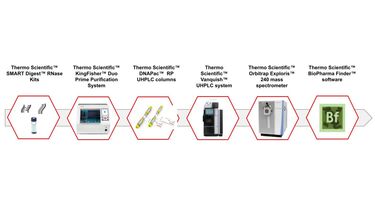
The Thermo Scientific™ KingFisher™ Duo Prime Purification System, combined with Thermo Scientific™ SMART Digest™ RNase Kits, works so well because the enzyme is immobilised on magnetic beads, so the digest stops the instant the beads are removed—simple, repeatable, and perfect for automation.
These automated digestions are fed directly into the Thermo Scientific™ Vanquish™ high-throughput LC system with a Thermo Scientific™ DNAPac™ RP Column and Thermo Scientific™ Orbitrap™ Exploris 240 and 480 Mass Spectrometer series to generate high-resolution accurate mass (HRAM) spectrometry data. Then, the data can be processed in Thermo Scientific™ BioPharma Finder™ Software1.
This single design choice—partial rather than complete digestion—changes everything. Longer and more unique oligoribonucleotides that are automatically characterised in BioPharma Finder software allow for accurate and reproducible sequence coverage in a single run, with multiple overlapping fragments providing confidence in the coverage results. Longer fragments with oligo-focused fragmentation methods also provide confident coverage with strong specificity (few or no matches to random sequence decoys).
2D LC and online digestion
In more recent publications,1, 2 the Dickman lab has pioneered a fully automated online 2D-LC setup, using Thermo Scientific™ SMART Digest™ RNase Columns that let you dial in precise and reproducible digest stringency by altering the column temperature and flow rate. Results show excellent reproducibility on a ~4.2 kb mRNA.
They also turned the platform into a multi-attribute workflow where the same LC–MS/MS session can quantify 5´ capping (e.g., ~90% efficiency) and poly(A) tail length and heterogeneity while confirming sequence identity.
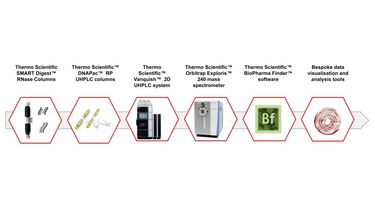
To raise sequence coverage further and cope with structured regions, the group developed data analysis visualisation tools to streamline and improve the mRNA sequence mapping workflow. These tools read BioPharma Finder software outputs and generate clean linear and spiral sequence maps2. These visualisation tools can be combined with complementary enzyme digestions and a standardised digestion protocol. This results in both reproducible and unique sequence coverage. The same toolkit can also combine under- and over-digest injections to tailor the coverage to difficult constructs. These tools and techniques turn a day of manual data analysis into less than 10 minutes per visualisation.
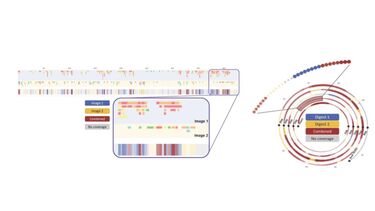
Novel online 2DLC methods allow for reproducible sequence mapping with 98% sequence coverage in less than 60 mins per run.”
Professor Mark Dickman
Professor in Bioanalytical Science and Engineering, University of Sheffield
A methodology that’s ready for QC
Hardware and software matter here, and the University of Sheffield–Thermo Fisher collaboration shows a single vendor path from R&D to QC, with proven parameters (ppm windows, confidence thresholds, ASR limits, MS2-only IDs, and random-sequence decoys) that encourage standard operating procedures and method transfers. Add in unique visual tools, and you get sequence maps that explain themselves. This entire workflow is fully automated and can be routinely performed in a high-throughput setting, which is a big deal for QA review and batch release.
Most importantly, the methodology is QC-ready. The online method can hit ~98% unique-fragment coverage in < 60 min, and reproducibility overlays show tight retention and response across many runs. These attributes, paired with direct MS readouts for identity, capping, and poly(A), point to a viable path for QC labs as mRNA pipelines scale.
Fully automated partial and full RNase T1 digests enable multi-attribute monitoring of mRNA identity, including poly(A) tail length, heterogeneity, and 5´ capping efficiency.”
Professor Mark Dickman
Professor in Bioanalytical Science and Engineering, University of Sheffield
The Dickman Lab is showing the field how to automate sequence mapping, scale it, and defend it with visual, MS/MS-backed evidence that’s exactly what regulators and QC teams need. Thermo Fisher instruments, columns, enzymes, and software aren’t just the toolkit—they’re the products that enable this mRNA MAM-style work at pace and at scale.
Professor Mark Dickman is a Professor of Bioanalytical Science and Engineering at the University of Sheffield. His research focuses on advanced analytical methods for studying biomolecules, such as oligonucleotide therapeutics and mRNA vaccines. With a background in biochemistry and a PhD from the University of Sheffield, he has worked in both academia and industry, collaborating with partners like Thermo Fisher Scientific and AstraZeneca.
References
1. Vanhinsbergh CJ, Criscuolo A, Sutton JN, Murphy K, Williamson AJK, Cook K, Dickman MJ. Characterization and Sequence Mapping of Large RNA and mRNA Therapeutics Using Mass Spectrometry. Anal Chem. 2022 May
24;94(20):7339-7349. doi: 10.1021/acs.analchem.2c00765. Epub 2022 May 12. PMID: 35549087; PMCID: PMC9134182.
2. Welbourne EN, Copley RJ, Owen GR, Evans CA, Isoko K, Cook K, Cordiner J, Kis Z, Moghadam PZ, Dickman MJ.
Mass spectrometry-based mRNA sequence mapping via complementary RNase digests and bespoke visualisation tools. Analyst. 2025 Feb 24;150(5):1012-1021. doi: 10.1039/ d5an00033e. PMID: 39928146; PMCID: PMC11809621.