
Student blog post: industry visits
MEng Chemical Engineering and MSc Pharmaceutical Engineering students take part in industrial visits to Almac and AstraZeneca

This blog post was written by MSc students: Andrew D. Robinson (MSc Pharmaceutical Engineering) and Duncan Williamson (MEng Chemical Engineering).
The visit to Almac was organised by the MSc Pharmaceutical Engineering students in collaboration with Sander van den Ban, the Head of Technical Operations at Almac, who led the entire visit on the site.
The Almac Group is a global leader in contract pharmaceutical development and manufacturing, providing integrated services across the drug development lifecycle, from R&D and biomarker discovery to commercial-scale production. The Charnwood facility in Loughborough serves as a centre within the group’s global network, specifically dedicated to the development and GMP manufacture of solid oral dose drug products. The facility is equipped to handle both non-potent and high-potency compounds, offering scalable solutions for clinical trial materials and small-scale commercial volumes.
Students were initially welcomed with a presentation on the history of Almac and the current global operations of the company. It was inspiring to follow Almac’s journey to global leadership and to learn about the company’s charitable contributions through the McClay Foundation.
The tour provided students with a firsthand look at the lifecycle of a drug, beginning in the clinical trial laboratories where experimental formulations are meticulously tested. The group then transitioned to the commercial manufacturing suites to observe the industrial-scale unit operations used for the production of solid oral dosage forms.
By witnessing live demonstrations of rigorous cleaning protocols and regulatory workflows, the students gained a clear understanding of the stringent quality controls Almac employs to meet global pharmaceutical standards.
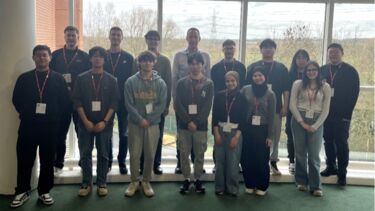
The cohort of MEng Chemical Engineering students on the Continuous Manufacturing Technology – PAT and Process Optimisation course was lucky enough to be invited for an industrial visit to AstraZeneca’s Macclesfield site last semester. The visit at the site was organised with the help of a group of alumni from the University of Sheffield who are currently working as engineers for AstraZeneca: Lois Stahler, Emma Stanton, Hashini Gunawardena, Rhiannah Beattie and Kate Ireland.
AstraZeneca is a global pharmaceutical company that became a household name for their work developing the technologies used to manufacturing the Covid-19 vaccine. They are a global company with a major UK presence and are committed to accelerating the position of the UK as a global centre for excellence in life sciences. They seek to transform health care through fast, equitable access to effective medicines and high-quality care, and they aim to deliver sustainable leadership that prioritises healthy people, society, and planet.
The first stage in the production process is their formulation laboratories where their researchers work closely with manufacturers of active pharmaceutical ingredients to conduct initial small-scale studies of potential drug products. These include stability testing, and studies to work out which type of formulation is most appropriate for each therapeutic, whether that be oral dosages, slow releases, topical creams or intravenous applications to name a few.
Next comes scale up studies, where the small-scale chemistry of the previous stage (usually producing less than a litre) is increased to anything from tens of litres to a couple hundred litres. This stage is vital because scaling up any chemical process comes with challenges around heat transfer and residence times and is never as simple as just increase the size of the reactor vessel and putting more reactants in. There are special considerations that need to be made when working at high pressure or with large quantities of highly toxic or harmful solvents.
The final stage in conventional batch manufacturing came next. This moves away from the glass reactor vessels and piping of the previous stage and into the serious heavy-duty engineering. The equipment for batch manufacturing is of an impressive scale and can producing anywhere from a few hundred to a couple thousand litres. Safety is paramount here, anything that may cause a spark is not permitted within these buildings including cell phones and smart watches. The production needs to be monitored constantly. A typical drug product can require upwards of twenty different chemical reaction steps and a slight error in any one of these steps can lead to a whole batch being wasted and potentially millions of pounds being lost.
The last thing we got to see was their state-of-the-art modular continuous manufacturing line. AstraZeneca and the rest of the industry is pushing toward this new method of drug production due to its impressive benefits over conventional batch manufacturing. With a continuous process, reactants are constantly being fed in and products are constantly being removed from the process. This means that reactor vessels and other unit operations can be much smaller in size and handling of harmful intermediates and solvents are greatly reduced. The week before our visit AstraZeneca successfully completed a GMP run of a drug product of this line, an industry first.
Everyone we met highlighted the high standards the company hold themselves to and exemplified a culture of hard work and pride in what they do. As students looking to enter the workforce soon, it was invaluable to see the standard set by AstraZeneca and we all left saying it would be a privilege to work there. We are incredibly grateful to the people who helped organise this, showed us around their departments and answered all our questions.

Masters study discovery afternoon
Become part of our community of talented postgraduate taught students. Register now to join us at masters study discovery afternoon on Tuesday 20 October.