Spinout spotlight: Xerode
Xerode, a spinout from the University of Sheffield’s School of Chemical, Materials and Biological Engineering, is developing a solvent-free, dry digital printing process for coating battery electrodes.

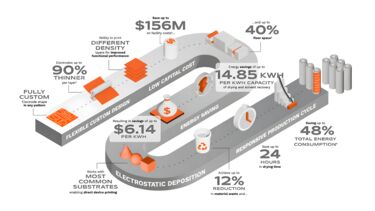
Xerode’s dry electrode manufacturing process turns battery materials into toner-like particles that can be printed directly onto substrates using electrophotographic methods. The process is designed to cut manufacturing complexity and cost while unlocking custom geometries and advanced electrode architectures that conventional wet coating cannot deliver.
Core Value Proposition & Impact
- Cost and footprint efficiency: Reduces CapEx and factory footprint by 32% and 34% respectively
- Energy savings: Cuts energy consumption by up to 45% by removing solvent use
- OpEx impact: Delivers over $45M in annual OpEx savings for a standard 10 GWh factory
- Manufacturing flexibility: Enables particle-level microstructural control, precise 3D (XYZ) spatial placement, and advanced electrode architectures
The founding team is made up of academics from the School of Chemical, Materials and Biological Engineering (CMBE) and the School of Electrical and Electronic Engineering (EEE): Dr Yufeng Lai (CEO), Professor Rachel Smith (CSO), Dr Denis Cumming (CTO), and Dr Guo Jung Lian (Technical Lead).
Rachel, can you tell me about the research which underpins Xerode?
The research behind Xerode grew out of a fundamental problem I kept seeing in traditional battery manufacturing: the sheer inefficiency of wet slurry processing. Standard methods mix active materials with solvents to coat the current collector, only to spend massive amounts of energy and factory floor space evaporating and recovering those same solvents. They serve no final purpose in the battery—they're just an expensive logistical step.
To solve this, Dr. Denis Cumming and I led a Faraday Institution Industry Sprint to rethink the process from scratch. We developed a solvent-free method using electrostatic deposition, printing dry, formulated electrode materials directly onto a moving current collector. This patent-filed technology gives us precise, particle-level positional and compositional control, meaning we can create tailored XYZ-controlled 3D architectures and ultra-thin layers down to 15 µm, which are exceptionally hard to achieve with other dry methods.
Guo Jung, what real-world problem are you solving and when was your ‘Ah-ha!’ moment - when you realised your discovery could solve these problems being faced by industry?
We are addressing the inefficiency and environmental burden of conventional battery electrode manufacturing. By adapting a mature, highly scalable technology from the printing industry, we can deposit functional battery materials without solvents. This eliminates costly and energy-intensive drying and solvent recovery stages, simplifying the manufacturing process and reducing cost and emissions. Our approach also opens up new possibilities for modular, flexible production while retaining the cost advantages typically associated with gigafactory-scale manufacturing.
Rather than asking how we could improve traditional slurry coating, we began exploring whether we could bypass it entirely. The turning point came when we successfully demonstrated controlled deposition with printing-level precision. That high level of spatial control made us realise we were not just improving manufacturing efficiency, we were unlocking design freedoms that traditional methods simply cannot offer. At that moment, it became clear that we could fundamentally rethink how electrodes are made.
Denis, what do you consider is Xerode’s most important milestone to date, and what is your long-term vision for the company?
Xerode has gone from a relatively simple concept - ‘can we digitally print battery electrodes in a fast and scalable way without solvents?’ to a reality where we can now routinely print common cathode materials with relative ease. The most important milestone has been printing a working battery electrode! We’ve shown it works, now we just need to make it better.
Long term, I want to see Xerode technology crack open the battery manufacturing market so that new entrants can make their own battery designs quickly and easily, close to their (or inside) their existing manufacturing sites. There is an opportunity for companies who need battery energy storage, at any scale or size of cell, to create enormous value by taking this process out of the hands of the big battery players and being allowed to innovate rapidly for themselves. I firmly believe Xerode process technology is the key to this happening across the globe.
Yufeng and Guo, have you gained any new skills from commercialising your research and how have you found the process of working with the Commercialisation Team?
Guo: Commercialising our research has pushed us to step well beyond the laboratory. As academic researchers, our focus was naturally on technical performance. Through the Commercialisation Journey, we have developed a broader perspective, focused on real-world impact. We have learned how to communicate and pitch our technology around its cost scalability and industrial value. Engaging with the key players in the battery industry has strengthened our understanding of market needs and customer discovery.
The Commercialisation Team has been instrumental throughout our journey. They have provided structured guidance on business model development, intellectual property strategy and company incorporation. Their support has led to a strategic transition from research to spinout.
Yufeng: Commercialising Xerode has pushed me to develop a very different skill set beyond academic research. As the CEO, I need to think strategically across multiple dimensions — market, product, fundraising, and people. At this early stage, that means constantly looking at the bigger picture while rapidly iterating the plan to refine the roadmap. As the commercialisation lead, I have to translate market needs into technical targets, and turn technical features into benefits that customers genuinely care about. As a co-founder, I have had to build new skills in leadership, negotiation, and project management. All of this has been new for me, but I have been very fortunate to receive excellent mentoring from the Commercialisation Team and other organisations throughout the journey. Their support has helped me navigate what has been a challenging but very rewarding transition.
Yufeng, what advice would you give to someone who is thinking about commercialising their research?
Commercialising research can be exciting, but it can also be very hard and sometimes lonely. There will be setbacks, delays, and moments of uncertainty. There is a lot of practical advice and many skills needed for the journey, but if I had to give just one piece of advice, it would be this: believe in your technology, believe in what you are building, and believe in your vision. A venture only has a real chance of succeeding when the founders genuinely believe in it and have the resilience to keep going through difficult moments. When challenges come, do not lose faith in what you are doing — stay committed and keep moving forward.
Xerode is looking to work with battery manufacturers and battery developers seeking custom electrode formats, rapid iteration, and lower-capital production routes. If you’re working in the battery space or want to explore where our tech fits with your use case, please reach out via LinkedIn or our website.