
Environmental Science BSc
Discover how cutting-edge research tackles real-world environmental challenges - from climate change to biodiversity loss - using the latest tech and data-driven insights. Gain the skills employers value and prepare for exciting careers in environmental consultancy or sustainability leadership.
-
A Levels
ABB -
UCAS code
F900 -
Duration
3 years -
Start date
September -
Attendance
Full-time
- Accredited
- Course fee
- Funding available
- Optional placement year
- Study abroad option
- FY Foundation year entry for mature students
Explore this course:
Course description
Why study this course?
We cover field trip costs
Fieldwork should be open to everyone - that's why we’ll cover the cost of travel, accommodation and food for all field classes. You’ll be free to focus on exploring new environments and developing new skills, without worrying about extra expenses.
Fully accredited
CDHE accredited means your course meets the highest standards in environmental science education - combining practical fieldwork, lab research and theoretical study. You’ll benefit from strong professional links, work experience opportunities and free student membership of the Institution of Environmental Sciences (IES), with a fast-track route to full membership after graduation.
Top 5 in the Russell Group for student voice in the subject of environmental sciences
National Student Survey (NSS) 2026
Top 10 for Geography and Environmental Science
Complete University Guide 2027
Top 10 for Geography
Guardian University Guide 2027

Become a specialist in this vital, globally relevant discipline and use your expertise to tackle the environmental crisis head-on.
Our Environmental Science course is one of the first of its kind and remains at the forefront of the field, offering research-led teaching that brings the lab, the classroom and the natural world together.
Start with the essentials in geography, earth science and biology before shaping your own path in years two and three. Explore cutting-edge specialisms such as climate change, conservation, sustainability and environmental quality, while developing skills in earth observation and geospatial data analysis.
Practical work and field classes are at the heart of the course, and in your third year, you’ll carry out an independent dissertation, applying your skills to real-world questions. Many students undertake fieldwork or lab research, with scholarships available to support these exciting opportunities.
You’ll develop highly specialist sought-after skills, including a range of technical skills and an understanding of specialist techniques, coupled with a strong understanding of environmental issues. You may also have the opportunity to do an industry placement as part of your degree.
You’ll be taught by experts - we’ve been at the forefront of geographical teaching and research for over 100 years. From removing Arsenic from the food chain to using past environmental changes to understand the climate crisis, explore how we’re making an impact.
As a rapidly evolving, in-demand discipline, environmental science opens doors to a wide range of careers in industry, research, conservation, ecology and sustainability – giving you the tools to make a real impact in the world.
Beyond your studies, you can join the Geography Society or Environmental Science Society. Take part in socials, volunteering, field trips and networking opportunities that enrich your university experience and build a sense of belonging.
Accreditation
This programme is accredited by the Community for Environmental Disciplines in Higher Education (CEDHE), the education committee of the Institution of Environmental Sciences (IES).
CEDHE is the collective voice of the environmental sciences academic community and serves to enhance the quality of environmental education worldwide. A programme accredited by CEDHE is assured to meet high standards, contain a strong component of practical, field and theoretical activities, and has excellent opportunities for training, work experience and links to the professional environmental sector.Students enrolled on CEDHE-accredited programmes can apply for free Student Membership of the IES and for a fast-track route to membership once they graduate.
This programme is aligned with the academic requirements for Registered Environmental Practitioner (REnvP) and starts graduates on a route towards becoming a Chartered Environmentalist (CEnv) or Chartered Scientist (CSci).

Modules
A selection of modules are available each year - some examples are below. There may be changes before you begin your studies. As you progress through your course, we’ll confirm additional details for the core and optional modules available to you.
Choose a year to see modules for a level of study:
UCAS code: F900
Years: 2026, 2027
In your first year, you will cover a range of core topics including conservation, ecology, environmental sustainability, biogeochemical cycles and the general principles of physical geography. You will also begin to develop key environmental and research skills through tutorials, fieldwork, and laboratory and computer practicals.
Core modules:
Core modules:
- Earth, Wind, Ice and Fire
-
This module introduces the general principles of physical geography for students with diverse backgrounds. Through a mixture of lectures and lab-work you will be able to develop a holistic understanding of how the Earth functions as a system across a range of spatial scales, focusing in particular on the functioning of key elements of this system - notably the operation of the geosphere, atmosphere, and cryosphere - and how these elements interact to influence the evolution of the system as a whole. Your assessment for this module will develop your skills in communicating and explaining complex scientific concepts.
20 credits - Biodiversity, Climate and Conservation
-
Humanity is facing inter-related crises of biodiversity decline and climate change. This module will give you an understanding of the anthropogenic and natural factors that determine the distribution of biodiversity, species' interactions and population sizes, and key biological-geochemical cycles that regulate environmental conditions on our planet.
20 credits
You'll explore links between biodiversity decline, climate change and ecosystem function, before discussing the consequences for nature's ability to provide benefits to people and sustainability, and the solutions that can mitigate these impacts.
During this module, you'll also take part in field-based training to develop practical skills for identifying and measuring biodiversity and carbon storage. - Global Biogeochemical Cycles
-
This module provides fundamentals of environmental sciences with an emphasis on biogeochemical cycling. You will be able to learn about how challenges including loss of biodiversity, access to clean water, climate change and provision of food for a quickly growing population may best be approached and centred in sustainability (recycling, reducing consumption) and citizen engagement. The module aims to cover the main earth system approaches that underpin our understanding of environmental challenges using a systems approach. The contents focus heavily on global environmental cycles including climate, air and water resources, pollution, biological communities, geology and energy. This will provide you with skills to engage with the foundations of scientific knowledge and understanding that you will develop further during the rest of the programme.
20 credits - Critical Inquiry
-
This module introduces the core academic skills and critical thinking techniques essential for undertaking rigorous scholarship and research at university. Lectures will focus on fundamental concepts and research methodologies using case studies and examples relevant to human geography, physical geography, and environmental science. A key focus will be dedicated to the principles of academic integrity, ethical data handling, and conducting robust, reliable research that meets scholarly standards.
20 credits
In small group tutorials you will work with discipline experts to understand their cutting-edge research, allowing you to understand how theoretical concepts are applied to real-world geographical and environmental challenges. Alongside a workshop, these tutorials also provide an environment for developing practical skills in academic writing and sourcing and evaluating literature. Assessments include an annotated bibliography and essay to introduce you to academic writing and a quiz covering the fundamentals of research integrity.
Beyond the academic context, this module highlights the transferable professional value of critical inquiry as you gain an understanding of evidence evaluation, logical argumentation, and effective communication. - Physical Geography and Environmental Science in the Field
-
Fieldwork and lab-work are an integral part of geographers' and environmental scientists' skillsets. The ability to design and carry out effective field research and to analyse data in a lab setting are useful and transferable skills.
20 credits
In this module you will undertake fieldwork in the local region beyond campus and lab work. You will be set tasks which will require you to conduct your own fieldwork. This module will teach you the core geographical skills of data design, data collection, data exploration and analysis, and presenting your research outcomes and findings from a field-based project. Through this you will be able to develop your academic writings, analysis and presentation skills. - Maps and Stats
-
Geographers and Environmental Scientists are well-known for having a versatile set of practical and transferable skills. This module guides you to develop key research and software methods from across the discipline, in a lecture and practical format. Lectures introduce you to research methods and skills, such as Geographical Information Systems (GIS), Earth Observation (EO), statistics, and surveys. Practical sessions provide you with the exposure to industry-standard software, enabling you to develop sought after geographical and environmental employability skills.
20 credits
In your second year you will hone your research skills and learn more about observing, monitoring and analysing varied environments. You will also have the opportunity to tailor your degree to your interests by taking a range of optional modules across physical and human geography and bioscience.
Core modules:
Core modules:
- Environmental Pollution and Quality
-
This module explores the fundamental principles of water and soil quality, highlighting their critical roles in sustaining life, ensuring food security, and supporting ecosystem functions and climate regulation. You will delve into the global challenges posed by resource degradation, unsustainable human activities, pollution, and climate change. The interconnected nature of water and soil health will be a key focus, examining how the decline of one can intensify issues in the other.
20 credits
Through comprehensive lectures, you will gain a robust understanding of core concepts, alongside the development of transferable skills such as academic writing, research methodologies, and critical thinking. Practical laboratory sessions will equip you with essential analytical techniques to assess common water and soil quality parameters. Additionally, the course fosters collaborative and work-related skills, encouraging you to apply your knowledge effectively in team environments and how to design a professional CV for work in the environmental science sector. - Geographical Information Systems, Earth Observation and Data Analysis
-
In our digital world, data are everywhere, so it is important for us to understand how such data are generated, what data we can trust, and how we can analyse and visualise data to understand our changing environment. This module provides you with a theoretical framework and hands-on experience of Earth Observation (EO), Geographic Information Systems (GIS) and Data Analysis. You will hone your problem solving skills by, for example, using satellite images to map environmental change, analysing geospatial patterns in GIS, and applying statistical analysis to complex environmental datasets using industry standard software, thus improving your digital fluency and capability.
20 credits - Environmental Science Research Design and Fieldwork
-
The ability to design, conduct, analyse and present meaningful findings from fieldwork is an essential part of degree-level Environmental Science, and enhances employability. This module builds on your learning from 'Physical Geography and Environmental Science in the Field' in the first year, addressing the philosophical background to, and the process of, designing and conducting fieldwork. The module introduces the principles of research design and provides practical experience of fieldwork to facilitate immersive learning and engagement with earth surface and environmental processes. You will go on residential fieldclass, with learning supported by lectures and small-group teaching. The assessments provide you with experience of designing, conducting and reflecting upon the research journey, culminating in a dissertation proposal. This will enable you to demonstrate numerous employable skills around project planning.
20 credits - Principles of Ecology and Conservation
-
In this module you will develop an advanced understanding of the fundamental principles that explain the abundance and distribution of species on earth. You will examine how biotic and abiotic factors shape ecological interactions across scales, from individual organisms, to populations and ecosystems. You will learn how to use models and empirical evidence to analyse species coexistence and the structure and function of communities over time and space. You'll apply ecological insights to explore the principles and objectives of conservation biology, learning about key interdisciplinary approaches that can reduce the adverse impacts of human activity on biodiversity. Throughout the module, you'll use case studies to bring these topics to life, covering freshwater, marine and terrestrial communities across a wide range of ecosystems in tropical and temperate environments.
20 credits
Optional modules:
Optional modules:
- Sustainable Development and Global Justice
-
Sustainable Development is a major challenge for countries around the globe. This module guides you to explore contemporary development issues their historical trajectories, diverging narratives and their embeddedness in current geopolitics. It examines the contribution that geographers, and geographical thought, can make towards understanding questions of environmental justice, inequality, poverty and socio-cultural change. The module encourages a critical discussion and intercultural dialogue about comment concepts like 'justice', 'nature' and 'development', reflecting on the framing power of words and narratives. In a time of rising nationalism, the module examines the potential and limitations of multi-country collaboration to address global challenges. It explores the roles of various actors, including the United Nations, bilateral donors, NGOs, governments and the private sector. Further, it invites students to reflect on the role of social innovation, digital technologies and co-design practices with marginalised groups in making progress towards sustainable development. This module addresses diverse theories, paradigms, approaches and contemporary critiques of development, and explores some of the central issues affecting processes of development. Case examples are drawn from Latin America, Africa and South-East Asia.
20 credits - Understanding the Climate System
-
In order to understand global climate change, we first have to understand how the climate system works. This module will give you a strong understanding of the global climate system, focusing on the atmosphere, the oceans, and their interaction. The first part of the module will consider the main characteristics of, and processes behind, climate from the global to the local scale. The second part of the module will examine the physical characteristics of the oceans and their geographical variation, and the role of the oceans in the climate system.
20 credits
In this module you will learn how to interpret information from a range of sources (e.g. weather charts, weather stations and your own observations) and apply these to real-world problems through a practical write-up and an exam.
The module is taught through a combination of lectures, and practical sessions that consolidate the lecture content and provide an opportunity for feedback on your understanding. - Understanding Dynamic Landscapes
-
Earth's landscapes are a unique and dynamic record of landform history from recent decades through to deep geological time. Understanding the processes that sculpt our physical world and how they evolve is a key aspect in environmental management, climate reconstruction, and hazard mitigation. With climate change accelerating surface processes and growing human populations expanding into geomorphologically active terrain, it is imperative that we are able to interpret the landforms around us and forecast future landscape change.
20 credits
Through lectures and practicals this module focuses on the diverse range of landscapes and landforms we have on our planet. We initially cover core geomorphological concepts such as magnitude and frequency before embarking on a journey through a range of major controlling processes: tectonics, volcanoes, glaciers, fluvial, and aeolian. We will also cover key dating techniques we use to place date ranges on a range of global landforms.
Assessments include a written practical portfolio where you will be tasked with critically interpreting landscapes, alongside an exam. Throughout you will develop core knowledge in key areas of physical geography ahead of future modules and will prepare you for future environmental employment pathways. - Ecosystems and Sustainability in a Changing World
-
Human impacts on the world's ecosystems are profound and without precedent in Earth's history. The urgent need to understand the impacts of anthropogenic climate change, land-use change and overexploitation has meant that ecosystem science has become one of the most important biological disciplines. Knowledge developed within this discipline has also become vital for devising strategies in sustainable agriculture. This module will build on the L1 module 'Biodiversity, Climate and Conservation' by exploring human impacts on ecosystems, and their feedback on climate change, including those in natural and agricultural ecosystems. It will cover the world's and the UK's major ecosystems, considering fundamental processes operating in the present and the past. In doing so, it will consider the interacting roles of carbon cycling, climate, soils, nutrients, fire and biodiversity. Teaching methods include lectures and discussion sessions, alongside a field excursion and practical sessions that develop skills in the ecological analysis of plants and soils, and will reinforce some of the key concepts taught in lectures.
20 credits - Social Justice and Environmental Challenges
-
Environmental issues continue to be a key area of contemporary public concern and current political debate. They raise fundamental ethical questions about the relationship between society and environment, and the politics and equity of that relationship. This module provides a geographical introduction to these issues and debates with examples from a range of scales, from the global to the local. You will be able to understand and critique core ideas, further developing comprehension through inter-related explorations covering debates focused on different real world themes and their potential solutions. Alongside an essay, a creative assessment will develop skills in visual presentation and communication through the creation of a zine for a public audience.
20 credits - Unlocking Past Environmental Changes
-
The landscape we live in is a dynamic place and has been in the past as well. Huge changes at a global, regional and local scale have occurred in the last 2.6 million years of the earth's history (Quaternary period). These changes are ongoing with implications for both present and future environments. You will learn about methods and techniques to investigate past environmental changes, and these are illustrated using a variety of proxy data and records of the past. You will also look at how environments have responded to past climate changes, thereby putting a context for present day climate changes and predicting future changes. Through the module you will be able to develop your academic writing, study, numeracy and data handling skills. It will also help you to be able to critically evaluate issues and problems as well as think about sustainability.
20 credits - Glacial Processes and Hazards
-
In this module we will introduce you to how glaciers and ice sheets work and the connection of many glacial processes to local, regional and global hazards. We examine how glaciers and ice sheets come into existence through an understanding of climate and the concept of glacier mass balance. We then consider how glacier systems function, covering topics that include the processes of ice flow, the drainage of glacial meltwater, and the behaviour of ice streams and ice shelves. You will develop your skills in examining how glaciers modify the landscape through processes of erosion and sediment transport and deposition. Hazards are explored in relation to each key area of glacier system function, from localised flood events associated with glacier-lake drainages to global sea level changes arising from past and potential future ice sheet instability.
20 credits
In your third year, you will continue to develop your professional skills and undertake independent research for a dissertation on a specialist topic of your choice, and further tailor your degree through a range of relevant optional modules.
Core modules:
Core modules:
- Professional Skills for Environmental Science
-
Environmental science graduates require an appreciation of the big contemporary environmental issues. Graduate employers appreciate the study and transferable skills developed at university but want graduates who understand the tools used by environmental science practitioners. In this module you are guided through producing an environmental consultancy report using site investigation and lab work. The module will help you identify and discuss contemporary environmental issues and further develop your communication skills, both written and verbal.
20 credits - Dissertation
-
In this module you will be able to gain experience in leading and managing your own independent research project. You will be expected to prepare, organise, research and report a piece of original work under guidance through regular meetings with an academic supervisor. Building on your research proposal in second year, you will shape the topic and will either be expected to collect original material in order to investigate it, or to perform secondary analysis on information drawn from existing sources. The finished product is presented in the style, and at the length, associated with academic journal articles. The management and completion of this project will develop your skills in academic analysis as well as crucial professional skills related to time-management and organisation.
40 credits
Optional modules:
Optional modules:
- Environmental Justice at a Time of Crisis
-
This module works with critical debates and approaches in Environmental Geographies to help understand a range of environmental crises (such as climate change, sustainability, waste and pollution, consumption, extinction) in front of us. You will be able to examine histories, causes and solutions for these environmental crises while drawing connections between global South and North.
20 credits
The module will cover a range of scales and actors from individual behaviours to community actions, analysing case studies of local bodies and global organisations and their negotiations. The module will leverage conceptual and political tools provided by environmental geographies and enable you to consider ways to tackle these multiple and co-constituted crises in socially just ways. A creative assessment builds on communication and analytical skills through the production of a Manifesto for Praxis and Action. - Geoscientific Data Analysis using MATLAB
-
Matlab® is a computing environment and programming language with over one million users worldwide. It is used to process, analyse and visualise geoscientific data, and is more widely used across science (e.g. in engineering, physics, economics). In lectures and computer classes this module introduces you to Matlab® by way of specific real-world examples taken from Geoscience topics using freely-available data. Initially the module will introduce you to the basics of using Matlab® before focussing on topics important to Geoscience (spatial data, image processing, textual analysis, statistics, and time series analysis). At each stage, theory is illustrated by easy to understand practical problem-solving examples, with the code used for the examples made available. Assessment focuses on computer practicals and on a data analysis project, the focus of which will be chosen by you from a range of topics, but which must use Matlab® to analyse and present data. This module gives you the opportunity to develop a valuable transferable skill - the ability to use a programming language to obtain/generate, analyse and present geoscientific data, thus improving your digital fluency and capability.
20 credits - Advanced Geospatial Analysis
-
This module will give you the opportunity to extend your knowledge of geospatial systems and software through detailed instruction and targeted case studies. The module is taught in three parts, (theory, practice and independent work), and will involve a mixture of lab-work and lectures. The two key work areas explored in this module are: (a) The generation of Digital Surface Models (DSM) from Unmanned Aerial Vehicles (UAV) and Structure from Motion (SfM) Photogrammetry, (b) Mapping of glacial bedforms from DSM data. Lab sessions will enhance software, coding and quantitative skills. Where possible, sessions will include student-led components and formative peer-peer assessment elements.
20 credits
In taking this module you will be able to further develop your problem solving skills and develop further resilience through tackling a specific practical application of geospatial analysis that is relevant to research and industry, assessed via a report. - The Changing Climate System
-
Climate change and global warming are accelerating at unprecedented rates. This affects different aspects of human lives, livelihoods, and the built and natural environment, posing significant challenges to global sustainable development. In this research-led module, you will gain understanding of how climate change is not just manifesting through rising temperatures, but also how it is changing global circulations in complex ways with far-reaching impacts. You will explore important themes, such as:
20 credits
- Fundamentals of the changing climate including the Earth's energy balance, causes of climate change and the greenhouse effect.
- How the global circulation works to form the climate as we experience on earth.
- How climate change has changed, and is projected to change these important circulations and the impacts on regional climate over key geographical regions.
This module will provide you with the opportunity to develop a strong understanding of current and likely future global and regional changes to the climate system. You will also be introduced to the tools and data used by scientists to understand and project these changes.
You will develop research skills through the process of analysing and interpreting information from diverse sources (lecture contents, literature , research-based articles and videos), and using the information to present arguments (through presentation and essay assessments and during practical sessions).
This module will be taught through a combination of lectures and practical sessions. The practical sessions will consolidate your learning from the lecture content and provide an opportunity for you to ask questions and to gain feedback on your understanding. - Human Planet
-
This course examines the historical, social, cultural and political dimensions of sustainability, focusing on food production and natural resource management on the land and in the oceans. Students will learn how key historical developments led to sustainability issues, how geopolitics perpetuates these in the modern world, and how an understanding of these issues can help us to develop more sustainable ways to live in future. Learning will be achieved through lectures and videos, independent study and classroom discussion sessions.
10 credits - Applied Volcanology
-
Volcanoes are an enigmatic force of nature and an exciting topic to study. Understanding the way global volcanic systems behave and how they are monitored is a key aspect in hazard assessment and eruption forecasting. With almost a billion people living at risk of volcanic hazards it is imperative that we are able to provide effective warning of impending eruptions. This module uses diverse teaching methods to supplement lectures: including virtual reality, lab practicals, scientific movie reviews, card games, and an interactive volcano challenge week simulating a fictitious volcanic crisis.
20 credits
Content is structured into three broad areas: volcanic science, volcano monitoring, and crisis response. In volcanic science we will cover underpinning core concepts from creating a magma, where and how it is stored, and the crucial role of gas in generating a wide range of explosive activity styles. We then progress into how we monitor volcanoes including ground deformation, seismicity, and a particular focus on our specialty at Sheffield that of gas release. The module finishes by considering the more social aspects of volcanology, asking the question; what happens when unrest is detected?
Assessment is through the production of a science communication piece where students demonstrate their ability to communicate complex scientific topics to a general audience with a particular focus on visual and creative media. The second assessment is a professional risk report, the culmination of the volcano challenge week, which balances data interpretation with efficient written communication to assess and communicate potential hazards to decision makers.
Throughout you will strengthen key employment skills in data analysis, science communication, and real-world problem solving. At the end of the module you will be well versed in what makes volcanoes tick, and will be able to critically appraise volcanic unrest around the world. - Living with our changing Coasts
-
Coasts are settings in which natural processes and human activities are dynamically linked. Whilst they only represent a small fraction of the physical space on our planet, they are exceptionally important places due to so much societal activity being associated with them. This module explores a variety of coastal environments and associated uses of coastal space. We will focus on processes occurring within coastal environments both off-shore and on-shore and how they have and are responding to climate change. Through this, you will be able to explore how coastal change is affecting coastal societies as well as how these same societies are impacting on coastlines in terms of their processes, resilience and sustainability. We will cover debates surrounding coastal flood protection, coastal management and coastal energy production and its security, highlighting often diverse perspectives from individuals, communities, local authorities and national and global organisations. The module will be taught by a mixture of lectures, hands-on practicals (data and/or field-based) and discursive seminars. In taking this module you will further develop your problem solving skills, how you apply knowledge and communicate it to different audiences. It will also help further develop your team working and interpersonal skills.
20 credits - Conservation Issues and Management
-
Human activities strongly shape the abundance and occurrence of species across the Earth. The populations and distributions of some are drastically reduced, often bringing them to the brink of extinction or pushing them over. Others are expanding rapidly, including outside of native ranges.
20 credits
This module will introduce you to a range of topical issues in the field of conservation science, using examples drawn from terrestrial and marine systems, and from a wide diversity of organisms.
You'll learn about the interplay between natural and social systems in conservation science, with a strong focus on the political, cultural, and economic drivers of conservation issues. As part of this, we'll also consider possible management strategies to address conservation issues, as well as evaluation of these strategies. - Sustainable Agricultural and Urban Ecosystems
-
The future of humanity critically depends on whether our global population can live sustainably on Earth - and for us to understand and implement the changes that are needed to achieve this.
20 credits
This module will take a critical look at the impacts of the current unsustainability of agricultural and urban ecosystems - on soils, biodiversity, nutrients, water, air pollution, greenhouse gases, people's health and wellbeing, and the wider landscape - and evaluates solutions to these problems. Data evidence is used to objectively assess both the scale of the problems and the relative effectiveness of solutions to them, providing you with the knowledge and skills needed to evaluate alternative pathways to a more sustainable future.
We'll take a whole-landscape perspective that considers how to: reduce impacts of agriculture, forestry production and urbanisation on natural ecosystems; increase agricultural sustainability; change to healthier diets; and enhance urban ecosystem benefits. These include providing food, nature connections, and more healthy environments, helping to improve our overall health and wellbeing.
Improving the sustainability of agricultural and urban ecosystems is a challenge that requires interdisciplinary thinking to solve complex problems. You'll gain insights into economic, social, ethical, political and religious beliefs that have driven unsustainable agricultural and urbanisation practices and led to exploitation of both people and the planet. This will give you knowledge and insights into the convergence of world views that put sustainability of people and the planet at their core.
By the end of the module, you'll be ready to apply what you've learned to develop more sustainable agricultural and urban systems, live more sustainably and help others do the same. - Advanced Studies in Population and Community Ecology
-
This module takes you to the forefront of population and community ecology, where ecologists tackle complex questions about how natural systems work and how we can draw robust conclusions from imperfect evidence.
20 credits
Rather than covering a wide range of topics superficially, you'll explore a small number of advanced ecological questions in depth, using real data, models, and research papers to understand how ecological knowledge is developed and tested.
Teaching is organised around themed topic blocks, which may vary from year to year, but always focus on how to frame ecological problems, evaluate evidence, and interpret results critically.
Throughout this module, you'll learn how to analyse ecological data, question assumptions, and judge the strengths and limitations of different approaches.
The ideas and approaches you'll study underpin many areas of modern ecology, including biodiversity science, wildlife conservation and environmental management. By the end of the module, you'll be able to think like a professional ecologist - constructing clear, evidence-based arguments and communicating complex ideas.
The content of our courses is reviewed annually to make sure it's up-to-date and relevant. Individual modules are occasionally updated or withdrawn. This is in response to discoveries through our world-leading research; funding changes; professional accreditation requirements; student or employer feedback; outcomes of reviews; and variations in staff or student numbers. In the event of any change we will inform students and take reasonable steps to minimise disruption.
Learning and assessment
Learning
Learn through a dynamic mix of lectures, seminars, hands-on labs and fieldwork, gaining the knowledge and skills to tackle real-world environmental challenges. Study alongside internationally recognised researchers and benefit from the school’s strong links with policy makers and industry professionals, who bring cutting-edge insights directly to your learning.
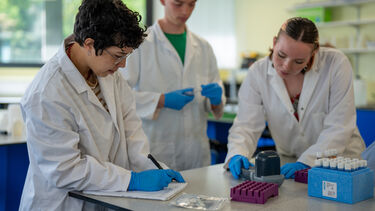
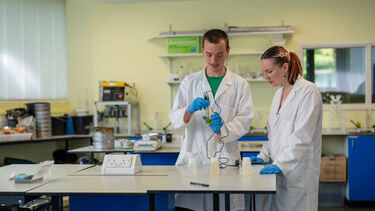
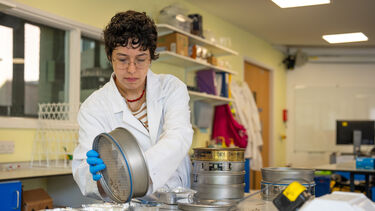
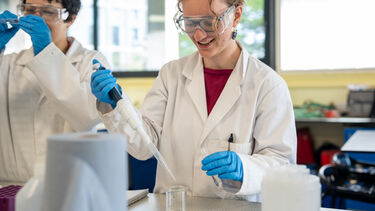
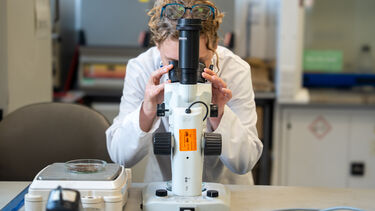
Our teaching laboratory houses all of our undergraduate teaching and laboratory-based dissertation projects - subject areas taught include: physical and chemical analysis of water and soils, glaciology and rocks and minerals.

BSc Environmental Science - Lab Work
Learn a range of specialist skills using our laboratory, including laser particle size analysis, water sample analysis & soil aggregate stability.
Assessment
You’ll be assessed through a mix of coursework and exams, with the balance varying depending on your chosen modules. Coursework includes essays, reports, policy briefs, stakeholder analyses and creative science communication projects such as podcasts, blogs and vlogs.
This diverse range of assessments helps you build transferable skills that employers value, preparing you to confidently analyse, interpret and communicate complex environmental information to a variety of audiences.
You’ll graduate ready to think critically, present ideas effectively and make an impact in your future career.
Entry requirements
With Access Sheffield, you could qualify for additional consideration or a contextual offer - find out if you're eligible.
The A Level entry requirements for this course are:
ABB
including a science subject
- A Levels + a fourth Level 3 qualification
- BBB including a science subject + B in the EPQ; BBB including a science subject + B in Core Maths
- International Baccalaureate
- 33, with 5 in a Higher Level science subject; 32, with 5 in a Higher Level science subject, and B in the extended essay
- BTEC Extended Diploma
- DDD in Engineering or Applied Science (including Biomedical Science, Analytical & Forensic Science and Physical Science streams)
- BTEC Diploma
- DD + B in an A Level science subject
- Scottish Highers + Advanced Higher/s
- AABBB + B in a science subject
- Welsh Baccalaureate + 2 A Levels
- B + AB including a science subject
- Access to HE Diploma
- The award of the Access to HE Diploma in a relevant subject, with 45 credits at Level 3, including 30 at Distinction (to include units in science) and 15 at Merit
-
Science subjects include Geography, Biology/Human Biology, Chemistry, Environmental Science, Further Maths, Geology, Maths, Physics, or Statistics
-
GCSE Maths grade 4/C
The A Level entry requirements for this course are:
BBB
including a science subject
- A Levels + a fourth Level 3 qualification
- BBB including a science subject + B in the EPQ; BBB including a science subject + B in Core Maths
- International Baccalaureate
- 32, with 5 in a Higher Level science subject
- BTEC Extended Diploma
- DDM in Engineering or Applied Science (including Biomedical Science, Analytical & Forensic Science and Physical Science streams)
- BTEC Diploma
- DD + B in an A Level science subject
- Scottish Highers + Advanced Higher/s
- ABBBB + B in a science subject
- Welsh Baccalaureate + 2 A Levels
- B + BB including a science subject
- Access to HE Diploma
- The award of the Access to HE Diploma in a relevant subject, with 45 credits at Level 3, including 24 at Distinction (to include units in science) and 21 at Merit
-
Science subjects include Geography, Biology/Human Biology, Chemistry, Environmental Science, Further Maths, Geology, Maths, Physics, or Statistics
-
GCSE Maths grade 4/C
You must demonstrate that your English is good enough for you to successfully complete your course. For this course we require: GCSE English Language at grade 4/C; IELTS grade of 6.5 with a minimum of 6.0 in each component; or an alternative acceptable English language qualification
Equivalent English language qualifications
Visa and immigration requirements
Other qualifications | UK and EU/international
If you have any questions about entry requirements, please contact the school.
Graduate careers
The course is highly skills based and employability focused. Graduates of our BSc Environmental Science degree are highly sought after for their specialist skills and deep understanding of environmental issues. They go on to make an impact across environmental consultancy, policy, sustainable energy, land remediation and conservation, as well as in wider sectors such as tech, business, finance and government.
Our alumni work for leading scientific and conservation organisations, including Cancer Research, GSK, RSPB, Kew Gardens, the Environment Agency and the Natural History Museum, as well as prestigious graduate schemes at Google, PwC, Deloitte, the BBC, the UK Civil Service, Aldi and the NHS.
Throughout your degree, you’ll develop the ability to analyse environmental problems from multiple perspectives and at different scales, while building the Sheffield Graduate Attributes — skills, personal qualities and approaches to wellbeing that enhance employability and personal development.
You’ll also have the opportunity to undertake a specialist placement year, gaining real-world experience, confidence and practical skills to give your graduate career a head start.
Learn more about careers in the School of Geography and Planning, including support around work placements and career development.
School of Geography and Planning
Department statistics

At the School of Geography and Planning we explore how people, places and environments shape the world. We collaborate with professional bodies, alumni, policy makers, practitioners and communities, together contributing towards creating a more just and sustainable future.
We’re internationally recognised for our expertise in tackling the global challenges of climate and environmental change, urbanisation, sustainability and social justice. Our teaching and research connect the human and physical processes that are woven through natural and built environments, helping to build understanding and knowledge, and to respond to the complex relationships between society, nature and the built environment.
You will join a vibrant, supportive community of scholars and practitioners committed to making a real difference.
Teaching at Sheffield is research-led and practice-informed, drawing on our world-leading work across multiple subject areas. Our courses focus on developing your analytical, ethical, professional and wider employability skills. We'll help you engage critically with the most pressing issues of our time - from managing and developing our urban and natural landscapes, to environmental governance, climate resilience and global development.
We place our students at the centre of everything we do. You’ll be supported by dedicated staff, benefit from excellent fieldwork opportunities, and have your voice heard in shaping your experience. Our inclusive culture ensures that everyone can thrive academically and personally.
Graduates from our courses go on to careers that make a positive social and environmental impact. They work in government, international organisations, consultancy, NGOs and research. If your interests are in managing and developing our natural and built environments, by studying with us you’ll gain the knowledge and confidence to shape more sustainable, equitable and resilient futures.
Join us at Sheffield - where geography and planning come together to help us understand the world and change it for the better.
Facilities
The School of Geography and Planning has its own dedicated school building, where you will spend time with other students, meet your tutors and have some of your classes. You’ll have access to flexible study areas and your own common room, shared by our community of undergraduate, postgraduate and research students.
University rankings
A world top-100 university
QS World University Rankings 2027 (82nd)
Number one in the Russell Group for student voice
National Student Survey 2026
92 per cent of our research is rated as world-leading or internationally excellent
Research Excellence Framework 2021
University of the Year for Student Experience
The Times and The Sunday Times Good University Guide 2026
Number one Students' Union in the UK
Whatuni Student Choice Awards 2024, 2023, 2022, 2020, 2019, 2018, 2017
Number one for Students' Union
StudentCrowd 2025 University Awards
7th best University for Work Experience
Higherin 2026-27
Student profiles

After graduating, I began my career as an Environmental Consultant - conducting Environmental Impact Assessments to evaluate project impacts and recommending sustainable solutions.
Supervisor - Private Hospital, Hong Kong,
BSc Environmental Science Alumni

I feel more prepared to enter the world as a graduate
Placement at the Game and Wildlife Conservation Trust,
BSc Environmental Science

The community of people who come to Sheffield to study and never leave speaks volumes about the place
BSc student,
Environmental Science
Fees and funding
Fees
Additional costs
The annual fee for your undergraduate course includes a number of items in addition to your tuition. If an item or activity is classed as a compulsory element for your course, it will normally be included in your tuition fee. There are also other costs which you may need to consider. These costs may increase due to price increases outside of the University’s control, if you defer entry or if you choose to change course.
Examples of what’s included and excluded in undergraduate fees
Funding your study
Depending on your circumstances, you may qualify for a bursary, scholarship or loan to help fund your study and enhance your learning experience.
Use our Student Funding Calculator to work out what you’re eligible for.
Placements, field trips and study abroad
Placement
Field trips
Fieldwork is embedded throughout our programmes, helping you connect theory with real-world challenges. From day trips exploring Sheffield and the Peak District to residential visits further afield, you’ll gain hands-on experience in diverse environments.
We are committed to making fieldwork financially inclusive: all costs for all field classes in years 1, 2 and 3 - including travel, accommodation and food - are fully covered by the school.
In your first year, you’ll typically take a residential field class in the Peak District, helping you get to know staff and fellow students. In your second year, our residential field class in Scotland allows you to develop research skills while exploring topics like microclimates, soil and water quality, and coastal environments. Your third year could include local field trips. Previously, students have visited the National Coal Mining Museum in Wakefield to assess the feasibility of using a former mining site for housing.
Many students undertake fieldwork as part of their third-year dissertations, with scholarships available to support ambitious independent projects. Recent recipients have researched glaciology in the Swiss Alps, beaver reintroduction in the Scottish Highlands, and the links between migration and music in Morocco.
Our field classes provide essential practical experience and professional training in diverse environments. We take an ethical and sustainable approach to all fieldwork, ensuring our trips are inclusive, environmentally responsible and beneficial to local communities.
Find out more about fieldwork experiences
Study abroad
Visit
University open days
We host five open days each year, usually in June, July, September, October and November. You can talk to staff and students, tour the campus and see inside the accommodation.
Online events
Join our online information sessions to find out more about different aspects of University life.
Subject tasters
If you’re considering your post-16 options, our interactive subject tasters are for you. There are a wide range of subjects to choose from and you can attend sessions online or on campus.
Offer holder days
If you've received an offer to study with us, we'll invite you to one of our offer holder days, which take place between February and April. These open days have a strong school focus and give you the chance to really explore student life here, even if you've visited us before.
Campus tours
Our weekly guided tours show you what Sheffield has to offer - both on campus and beyond. You can extend your visit with tours of our city, accommodation or sport facilities.
Events for mature students
Mature students can apply directly to our courses. We also offer degrees with a foundation year for mature students who are returning to education. We'd love to meet you at one of our events, open days, taster workshops or other events.
Apply
The awarding body for this course is the University of Sheffield.
Recognition of professional qualifications: from 1 January 2021, in order to have any UK professional qualifications recognised for work in an EU country across a number of regulated and other professions you need to apply to the host country for recognition. Read information from the UK government and the EU Regulated Professions Database.
Any supervisors and research areas listed are indicative and may change before the start of the course.