
Research and innovation roundup 2025
A selection of research features and news stories that capture our values and excellence as a University.

Introduction from Professor Sue Hartley, Vice-President for Research & Innovation
It has been another busy and successful year for research and innovation at Sheffield, and I’d like to celebrate the impact of all your hard work by sharing some of the stories that illustrate how we continue to make a positive difference to communities locally, nationally and beyond.
Among our research achievements, this past year has seen us develop an AI-driven approach that could transform the way proteins are designed for new medicines, as well as pioneering new tools and technologies that support people living with dementia to remain independent in their own homes for longer. I am also immensely proud that Sheffield neurologist, Dr Johnathan Cooper-Knock, has been appointed as the first-ever Motor Neuron Disease (MND) Association Rob Burrow Professor, a role that will help pave new pathways towards promising treatments for MND.
Our innovation continues to drive the transition to a low-carbon future, from speeding up the production of sustainable aviation fuel and bringing passengers a step closer to greener flights, to partnering with Rolls-Royce SMR to build Britain’s next generation of nuclear power. With sustainability at the heart of our work, our experts have also developed a new satellite-based tool that helps protect the world’s most precious rainforests, safeguarding biodiversity and carbon stores in the Amazon.
Our position within the top 100 universities worldwide in the QS World University Rankings 2026 has reaffirmed our place as a leading global institution for teaching and research excellence. This achievement is a testament to the exceptional accomplishments of our diverse research community.
Professor Sue Hartley
Vice-President for Research & Innovation
Beyond the lab, I’m pleased to share that our work remains dedicated to enriching local communities, inspiring young people through programmes that foster intercultural belonging, and developing immersive technologies that uncover the city’s hidden history, creating a stronger sense of place here in Sheffield.
Our position within the top 100 universities worldwide in the QS World University Rankings 2026 has reaffirmed our place as a leading global institution for teaching and research excellence. This achievement is a testament to the exceptional accomplishments of our diverse research community.
Here are some examples that showcase the breadth of the work we do - you can explore more of our impact and news stories. I hope that the coming year will offer even more opportunities for transformational research and innovation to take place at Sheffield.
Sheffield neurologist becomes first MND Association Rob Burrow Professor

Dr Johnathan Cooper-Knock, based at the University’s internationally renowned Sheffield Institute For Translational Neuroscience (SITraN), has been appointed to the first Rob Burrow Professorship in Translational Neurobiology named after the late rugby league legend Rob Burrow CBE, who sadly passed away from Motor Neuron Disease (MND) last year.
Funded by the MND Association in honour of its late patron, the award will help Dr Cooper-Knock accelerate his research hunting for genes underpinning MND, helping to open new pathways toward promising treatments.
Mapping a city's hidden history

Dr Carmen Levick from the University’s School of English has developed an immersive walking app which aims to uncover and celebrate the unique stories and music of Sheffield’s Jewish communities, whose influence on the city dates back to the 18th century.
The app draws on Dr Levick’s research into the ways official histories shape individual identities and how a community's legacy can be found in a city's built environment, even when the community itself is no longer prominent.
University of Sheffield to speed up sustainable aviation fuel production

Earlier this year, the University was awarded UK government funding to accelerate the production of Sustainable Aviation Fuel (SAF), bringing passengers a step closer to greener flights.
Announced during a visit to the University by Aviation Minister Mike Kane MP, Sheffield will lead a £1.5 million project to commercialise its innovative SAF production technology. The project will attract investment for new SAF plants and increase the supply of cleaner aviation fuel using renewable energy and next-generation carbon capture technologies.
Decarbonising the aviation industry
The invisible power of infrared sensor technology
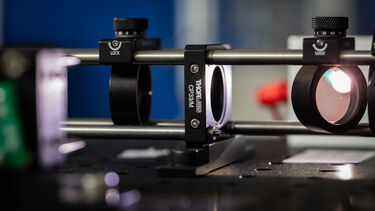
From self-driving cars to facial recognition, infrared sensors are all around us. At Sheffield, our world-leading photonics researchers are taking this technology to the next level by exploring novel semiconductor materials that significantly improve existing sensor performance.
Recognising the commercial potential of this research, Professor Chee Hing Tan, Dr Ben White and Professor Jo Shien Ng founded the Sheffield spinout company, Phlux Technology, which is bringing next-generation infrared sensor technology to market for use across industries worldwide.
Harnessing technology to help people with dementia remain at home

A survey by Alzheimer’s Society revealed 85 per cent of people would want to stay at home if diagnosed with dementia. To meet this need, the University is leading one of four new networks which will boost the use and development of novel tools and technologies enabling people with dementia to remain independent at home for longer.
With nearly £2 million in funding, Sheffield researchers will co-develop adaptive technologies that respond to the evolving needs of people living with dementia and their families, ranging from communication aids to speech support, placing lived experience at the centre of innovation to enhance quality of life and independence.
Supporting people living with dementia
Empowering youth through martial arts and filmmaking

Creative projects, like film making and martial arts, have the ability to bring people together, build connections, and foster a deeper cultural understanding between communities. At the University, East Asian studies researchers are using their knowledge on the role of media, sound, and text to help people in the UK better understand everyday life and culture in East Asia.
Led by Dr Wayne Wong, Project Sifu is a pilot merging martial arts and action filmmaking in Sheffield. The innovative project empowers young people by combining physical training, discipline, and East Asian culture with cinematic storytelling to boost wellbeing and confidence.
University of Sheffield AMRC partner Rolls-Royce SMR will build Britain’s next generation of nuclear power plants

In June, the University welcomed news that Rolls-Royce SMR has been chosen as the preferred bidder to partner with Great British Energy – Nuclear to develop small modular reactors for the UK.
Our Advanced Manufacturing Research Centre (AMRC) will play a key role in supporting Rolls-Royce SMR develop a factory-manufactured nuclear power station, using its research expertise to create an advanced manufacturing process for mechanical, electrical, and plumbing (MEP) modules, incorporating Industry 4.0 technologies.
Powering Britain’s Nuclear Future
Potentially life-saving MRI breakthrough raises hopes for cost effective and more widely accessible lung scans

Respiratory disease is the UK’s fourth biggest killer, yet among the most neglected conditions in terms of advanced diagnostics and effective treatments.
A pioneering collaboration between the University of Sheffield and GE HealthCare has developed a revolutionary Low-Field Magnetic Resonance Imaging (MRI) Scanner that could make MRI technology more cost-effective and widely available - improving health outcomes for patients.
Using a novel hyperpolarised xenon gas imaging technique, the scanner is designed to diagnose respiratory conditions such as COPD and asthma, which together impact the lives of millions and cost the NHS over £6 billion annually.
Advancing affordable MRI technology
Protecting individuals at risk of human trafficking

The use of adult service websites by criminal networks is a growing challenge in the fight against human trafficking. That's why Dr Xavier L'Hoiry from the University’s School of Sociological Studies, Politics and International Relations has collaborated with global partners to develop the Sexual Trafficking Identification Matrix (STIM).
The STIM helps practitioners risk-assess adult service website adverts by analysing elements like photographs and language used. This tool is already proving to be vital for organisations like the Thames Valley Police, enabling them to proactively identify individuals at the greatest risk of exploitation.
New technology helps turn the tide against illegal logging in Peru

Peru’s rainforests, one of the most biodiverse regions of the planet, face significant threat from illegal selective tree logging.
However, a powerful new tool developed by a team of researchers from the University of Sheffield’s Grantham Centre for Sustainable Futures now enables near real-time detection of individual tree removal, strengthening the fight against deforestation.
The team worked with the World Resources Institute, a world leader in global forest monitoring, to develop the tools for use by the government of Peru to extend its protection and management of the country’s rainforest.
AI could accelerate protein engineering – key for developing new medicines

Scientists from the University of Sheffield and AstraZeneca have created an AI approach that could make designing proteins for new medicines easier. The method outperforms current techniques for "inverse protein folding" – a critical part of the process of creating new proteins with specific functions.
Inverse protein folding is important but difficult because small changes in protein sequences can cause unpredictable effects on the protein's structure. But, this new approach works like a guide that predicts the most important folds in the protein structure, making the design process more accurate.
Transforming the way proteins are designed for new medicines
Protecting the UK's marine ecosystem

The ocean is vast and unpredictable, making it crucial to understand how fishing and other human activities affect interconnected fish populations.
To support effective management of these marine ecosystems, Professor Paul Blackwell from the University’s School of Mathematical and Physical Sciences is combining multiple computer models to produce clearer, more reliable forecasts.
This approach reduces uncertainty in predictions and provides vital evidence for sustainable management decisions, informing policies aimed at protecting key species and promoting long-term conservation.