
Co-designing the future of music technology for people living with dementia
For those living with dementia, music is not just therapy - it’s a right. That’s why Dr Jennifer MacRitchie and her team are working alongside the dementia community to co-design new music technologies that meet their needs and embed lived experience at every stage of the development process.

Dementia is an umbrella term for a group of progressive neurological conditions that affect memory, thinking and the ability to perform everyday tasks. Around 57 million people are currently living with dementia globally, and this figure is set to more than triple by 2050.
It continues to be one of the greatest challenges of our time, and as the number of people living with dementia rises, so does the need for more accessible and meaningful forms of support.
According to Dementia UK, music can play a powerful role in the lives of those affected through improving cognitive function, as well as positively influencing mood and behaviour. The act of making music can also help some individuals maintain their sense of identity, foster relationships, and ease feelings of isolation.
Despite its potential benefits, many still face barriers to accessing music or music-based interventions, as most existing technologies are not designed with the cognitive or physical needs of individuals with dementia in mind, and often require support from trained professionals. Moreover, music should not be viewed solely as a therapeutic tool, but as a fundamental right, enabling everyone to engage with it and participate fully in cultural life.
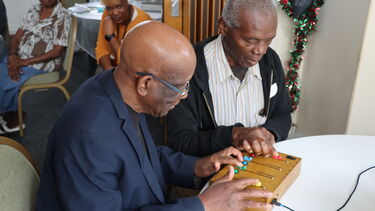
At the University of Sheffield, Dr Jennifer MacRitchie’s research is exploring how music and engineering can work together to support agency, skill and independence for people living with dementia. Central to this work is the belief that research should be done with people, not to them.
By involving people living with dementia as active co-designers, Dr MacRitchie and her team are ensuring that the next generation of assistive technology is shaped by those who will use it. This approach aims to redefine our understanding of innovation, showing what is possible when we build upon lived experience and value the right to creative expression.
Co-designing the future of assistive technology
Dr Jennifer MacRitchie is a Senior Research Fellow in the School of Languages, Arts, and Societies at the University of Sheffield, and Co-Director of Muses Mind Machine. With a background in electrical engineering, music, and cognitive science, her research looks at how people learn and develop motor skills when playing musical instruments, and how these skills can be used to promote health and wellbeing. One of the ways she is doing this is by working directly with people living with dementia, involving them in the co-design of new music technologies that meet their needs.
This model is providing a blueprint for how technology can be designed to place the person living with dementia in control of how they interact with arts, rather than arts being ‘done to them’.
“In my previous research, I’ve explored how engaging with music can benefit cognitive health, especially in older adulthood. I’ve long been struck by how few opportunities there are for older adults or people living with dementia to experience music if they haven’t been part of that world before” explains Dr MacRitchie.
People living with dementia have a right to take part in things that they enjoy. The challenge is creating platforms that make everyday participation in music possible, both for enjoyment and for the wellbeing benefits it brings, just as it does for anyone else. With emerging technologies, there’s now real potential to make music more accessible, engaging, and inclusive, allowing people with different skills and abilities to create and enjoy music together.
Dr Jennifer MacRitchie
Senior Research Fellow
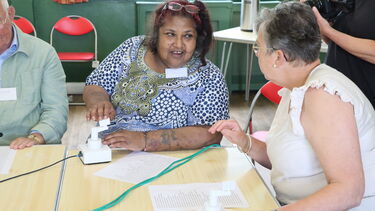
Dr MacRitchie and her team have been working alongside people with lived experience of dementia to test music devices that are engaging and easy to use, without being infantilising or child-like. The devices are intuitive to interact with, but the music produced is rich, sophisticated, and mature. Each device aims to promote a unique experience for the user, so no two people will use it in exactly the same way. Even though the music is pre-programmed, there is plenty of room for personal expression through moving sliders, pressing buttons, and exploring the sounds in their own way.
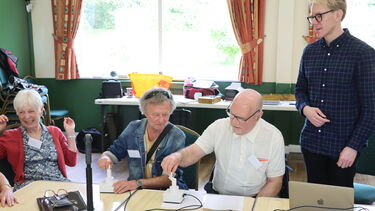
“We could easily focus on just making a ‘cool’ musical instrument - there are plenty of ways to do that. What makes this research unique is that it focuses on designing tools from the perspective of people with lived experience. So, challenging assumptions about music, technology, and dementia. The goal is not just to create new devices, but to rethink how we design and study them. To design a musical tool, you need to have an understanding of the entire ecosystem in which it needs to exist - so how someone gets their hands on it, who supports its use, and how easy it is to use” explains Dr MacRitchie.
Throughout the project, Dr MacRitchie and her colleagues have explored a variety of ways to connect with people living with dementia, from informal one-to-one conversations to group discussions at memory cafés across Sheffield. She has also partnered with local residential care homes to find out how the devices might be used in a real-world setting.
"We have a lot of people who are committed to co-design and co-production. But it’s not just the University - our community partners and the supportive network in Sheffield are equally important. Together, they bring a huge strength in developing innovative ways to support people living with dementia” explains Dr MacRitchie.
“Sheffield has a strong reputation in music psychology and inclusive approaches to music, supported by a culture of innovation that enables new technologies to be developed and applied in the real-world” adds Dr MacRitchie.
BRIDGES for Dementia Network+
Dr MacRitchie's work has led to the creation of the BRIDGES for Dementia Network+, a national initiative led by the University of Sheffield in collaboration with colleagues from Lancaster, Leicester, Portsmouth, Cambridge, London, and Kent. Under Dr MacRitchie’s leadership, the network brings together researchers, innovators, charities, and local authorities to break down barriers to arts, sports, and culture, developing technologies that enable people with dementia to live on their own terms.
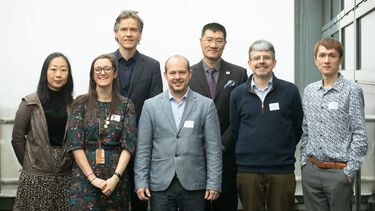
The network has recently received £1.97 million in funding from the UKRI Engineering and Physical Sciences Research Council (EPSRC) to rethink how technology can support people living with dementia in leading full, connected, and independent lives. Central to its mission is co-design, embedding lived experience throughout the development process rather than leaving decisions solely to academics.
“One thing we hear a lot from our lived experience collaborators is that post-diagnosis support is inconsistent at best and virtually absent at worst. We need research and tools that provide meaningful support after diagnosis, and ideally, even before, so people can live well with dementia. The goal isn’t just to build the best tool, but to reshape the entire ecosystem to better support people living with dementia” explains Dr MacRitchie.
“The idea behind the network is that it's not simply for academics to talk about how technology should be decided in the future but it is about incorporating that lived experience into how we conceptualise and eventually design technologies to help support independent living” adds Dr MacRitchie.
“It’s also about challenging the perspective and perception of what living with dementia really is and the stereotypes that we make around what someone can or can’t do. There are over 100 different diseases that cause dementia which creates different types of experiences and symptoms for the affected individual. So, when we think about living with dementia and technology, how do we broaden that out so that we don't end up putting people into a box of what they can and can't do?” explains Dr MacRitchie.
The BRIDGES network+ will run an Early Career training programme in the summer supported by network partner and community interest company, Innovations in Dementia. This will provide an opportunity for people living with dementia to deliver masterclasses to Early Career researchers, helping them shape their ideas and meaningfully incorporate lived experience in their work.
Improving care for people living with dementia
Since 2021, Dr MacRitchie’s co-design work with community groups and residential care has improved care for around 1,000 people living with dementia.
More recently, Muses Mind Machine at the University co-hosted an industry round table with the charity, Music for Dementia. This brought together leaders from broadcasting, retail, and the music industry to tackle the shared challenge of making music more accessible for older adults and people living with dementia, extending the project’s impact beyond individual devices to wider sector-level change. Following the round table, the Music Made Easy Taskforce has been created that will continue to drive industry-wide improvements through co-production.
“The idea for the future is to get to a place where there are a variety of different ways that we can interact with music. It’s not based on training in a particular instrument. It prioritises musical culture and experience that many of us have implicitly. The goal is to provide platforms where people can interact musically on a level playing field, and in diverse and inclusive ways” explains Dr MacRitchie.
“We want to create a lasting legacy, not just a series of technology projects, but a richer understanding of what it means to live with dementia. Through co-generation events, we are producing outputs that will give anyone entering this design or technology space a deeper understanding, moving beyond a single-line specification to convey the full lived experience of dementia” adds Dr MacRitchie.


Written by Anna Blagg (Marketing and Communications Officer, Research)
For further information please contact: mediateam@sheffield.ac.uk.