From flight to furnace: testing the fuels that will power net zero
Our researchers are de-risking the future of flight and heavy industry by proving that sustainable fuels work. Find out how we're bridging the gap between lab research, flight, and heavy industry.

Industries across the world are under growing pressure to reduce their carbon emissions, but both aviation and heavy industries present a particularly difficult challenge.
The aviation challenge
While cars and buses gradually become electrified, commercial aircraft still rely on highly energy-dense fossil fuels to get off the ground. For aviation, there is no straightforward route to decarbonisation.
Sustainable Aviation Fuel (SAF) is widely seen as one of the most promising solutions for decarbonising the aviation sector. But moving a new fuel from laboratory research to commercial use is a long and complex process. It requires significant investment, compliance with strict international safety standards, and confidence that the fuel will perform reliably in some of the most demanding operating conditions imaginable.
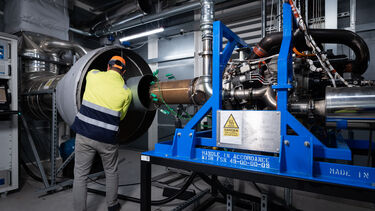
At the University of Sheffield's Energy Innovation Centre (EIC), Dr Karen Finney and the team are working to reduce some of that uncertainty. The world-leading facility allows researchers and industry partners to develop, test and certify sustainable fuels at pilot-scale before they are demonstrated in commercial aircraft, key to bringing new fuels to the commercial market.
"An industrial-scale trial, an actual flight, is so expensive, and to go to that from bench-scale research, it's going to be very difficult to scale up," says Dr Finney, Senior Research Fellow and Research Theme Manager for Low Carbon Sustainable Energy. “Supporting industry to achieve progress in this area is critical."
An integrated approach to fuel testing
What makes the EIC unique is its ability to support the entire fuel journey in one place—testing and evaluating full-chain SAF production and utilisation. Rather than examining individual parts of the process in isolation, researchers can produce the feedstocks onsite (capturing CO2 and generating hydrogen), synthesise the fuel, assess its properties against international standards, and then test it in a full-scale jet engine.
"There'll be places that do maybe one or two of these things," Dr Finney says.
"But to have it all in the same place, to have the people with the expertise on how to make the fuel and feedstocks, do the characterisation and how to use the fuel, I think that's a really unique and exciting thing."
From ground testing to the skies
The facility's capabilities were recently demonstrated during preparations for the historic Flight 100, the first transatlantic flight powered entirely by sustainable aviation fuel, which flew from London to New York in 2023.
Before the aircraft could leave the runway, the fuel first had to prove itself on the ground. The EIC team carried out extensive testing, including complete lab characterisation and trials in a full-scale aeroengine.
"While it's still expensive to do all this, it's much cheaper to test here at pilot-scale and iron out problems on the ground, because you really don't want to have problems when you're up there," she says.
The subsequent flight helped validate those results, with data collected during the journey indicating clearly improved performance. This included a 70% reduction in net CO2 emissions compared to traditional jet fuel and a marked decrease in particulates that contribute to heat-trapping contrail formation, all while also demonstrating that the fuel contained more energy than conventional jet fuel.
"It was about a 1.5% reduction in the amount of fuel that you'd need," Dr Finney explains.
"Which doesn't sound like very much, but when you take into consideration every single flight, every single day, you're talking about millions of tonnes of fuel and therefore considerable emissions that could be saved. That's the real-world impact of this work."
Decarbonising heavy industry
The implications extend beyond aviation. Dr Finney's team has also been working with a range of manufacturers and foundation industries exploring the switch from natural gas to hydrogen. For many businesses, concerns centre on whether an alternative fuel can deliver the same performance without disrupting production, whilst still meeting crucial decarbonisation targets.
Through testing at the EIC, researchers have shown that, with targeted modifications, hydrogen can generate the same temperatures and equivalent heat flux required for industrial processes and maintain high efficiencies. The findings can help derisk investment and provide confidence in decision-making for industries through sector engagement – whether with a small, local SME or a large multinational corporation.
The research outcomes have helped inform plans by manufacturers including Sheffield Forgemasters, which is exploring wider changes to reduce its reliance on natural gas. Karen is also working with Toyota Motors UK, who have now sponsored a CDT PhD student in our Centre for Doctoral Training in Green Industrial Futures that she supervises to conduct vital research in this area, looking at fuel switching to hydrogen on their paint lines.
Beyond engineering
For Dr Finney, the significance of the work is not measured solely by published research but by the scale of what has been built.
Knowing that there aren't many others who get to come and work somewhere like this, to run facilities of this size with such a fantastically knowledgeable group of people, it is amazingly special."
Dr Karen Finney
"To have been here from its inception and to now work on these facilities, it's really something to be proud of."
As the EIC develops its next generation of research projects, Dr Finney is increasingly focused on questions that extend beyond technology alone. Future funding proposals are bringing together engineers, social scientists and economists to better understand how new technologies are adopted in practice.
"Of course, I can go out there and run an engine and prove that the technologies, the fuels, and their integration work," Dr Finney says.
"But if the person that's going to be living next door to that site doesn't understand why it's so important to be deployed there, that's a problem. Commercial projects have been shut down because the public have just said, 'Yeah, that's not happening on my doorstep.'"
For Dr Finney, successful decarbonisation depends on more than technical performance. It requires an understanding of environmental impacts, economic realities and social support and approval – and therefore needs collaborations between academia, industry and policy makers, plus engagement with the public.
"It's about ensuring multidisciplinarity – the work needs to, of course, include the engineering and technological innovation by me and others in our team but also the research on the life cycle analysis, supply/value chain, systems regulation and social impacts.
If we all continue to work together to make our contributions in our individual research areas, then collectively we can make a lasting impact to achieve full societal decarbonisation to deliver a greener, cleaner future for everyone."