
Economics MSc
School of Economics,
Faculty of Social Sciences
-
Start date
September 2027 -
Duration
1 year 2 years -
Attendance
Full-time Part-time
Explore this course:
Apply now for 2027 entry or register your interest to find out about postgraduate study and events at the University of Sheffield.

Course description
How does economics impact strategic decision making? Can governments achieve more efficient policy outcomes in times of global uncertainty? How can advanced economic and statistical tools solve the most pressing challenges of our time? In an increasingly complex global landscape, the ability to decode and navigate economic shifts is not just an asset - it is a necessity for driving meaningful change in business and policy.
On our flagship masters course, you'll learn to bridge the gap between high-level theory and real-world impact. You will master advanced theoretical frameworks and cutting-edge quantitative techniques, translating abstract models into actionable, data-driven solutions. By applying rigorous economic analysis to contemporary issues, you will develop the practical insights required to advise governments, guide corporate strategy, and influence global policy.
Designed with flexibility in mind, we encourage you to tailor the degree to match your interests and career aspirations. Explore high-demand specialisms taught by our research-active academic experts, including:
- Microeconomic Analysis: dissect how individuals, firms and institutions make decisions, evaluate the impacts of public policies and learn to design optimal economic strategies.
- Time Series Econometrics: harness complex data to predict market trends and model financial volatility.
- Corporate Finance: investigate and critique investment strategies, corporate governance, and capital structures.
Towards the end of the course, you'll complete an independent research dissertation that gives you the opportunity to tackle a complex, real-world economic challenge of your choice. You'll be supported by one of our academics with relevant expertise to help guide you through the process.
Upon graduation, you will have developed an advanced portfolio of technical and analytical skills that will support you in securing a career in industry or further research.
Modules
Core modules:
Core modules:
- Microeconomic Analysis
-
Microeconomics is concerned with the behaviour of individuals, households and firms, and their interactions. This module aims to develop the skills you will require to analyse microeconomic problems and theories and to introduce advanced microeconomics. You will use mathematical and quantitative analysis to analyse topics such as consumer theory, behavioural economics, risk and uncertainty, production, and general equilibrium. In addition, this module will further develop your skills of critical evaluation and appraisal in the context of advanced microeconomic theory.
15 credits - Macroeconomic Analysis
-
Macroeconomics concerns the behaviour of the economy as a whole. In this module you will develop a coherent framework for understanding macroeconomics building on microeconomic foundations. The module will analyse the source of business cycle fluctuations, the aims of monetary policy in advanced economies, including the design of optimal monetary policy. It will also provide an advanced understanding of fiscal policy and debt dynamics. You will be introduced to the concept of financial frictions in the context of the last financial crisis, and gain an understanding of the aims and challenges faced by monetary policy makers.
15 credits - Econometric Methods
-
This module will develop your core econometrics skills. The first half of the module provides a grounding in key econometric techniques covering elements such as the classical linear regression model, hypothesis testing and problems of non-spherical disturbances. More advanced topics are then introduced in the second half of the module. Specifically you will focus upon topics in microeconometrics: including modelling discrete binary variables; censoring and sample selection, and then topics in macroeconometrics including: economic forecasting; stationarity; and cointegration. You will also develop a knowledge of using econometric software Stata.
15 credits
Optional modules - one from:
Optional modules - one from:
- Corporate Finance
-
This module will aim to equip you with a comprehensive foundation of the core theoretical principles of corporate finance, along with practical insights into how these principles are applied when formulating investment analysis and financial strategy. You will be provided with a deeper understanding of key financial decisions faced by firms, with a particular focus on investment appraisal methods; risk management techniques; valuation techniques for stocks and bonds; financial statement analysis and modelling; the cost of capital and the capital structure decision. Additionally, the module will explore both the theoretical and empirical aspects of these topics, equipping you to tackle real-world financial challenges.
15 credits - Behavioural Finance
-
This module explores the principles of Behavioural Finance, which integrates psychological insights into financial decision-making. Traditional finance models assume rationality, but Behavioural Finance recognizes the role of cognitive biases, emotions, and psychological factors in shaping market outcomes and individual decisions. The module aims to provide you with a deep understanding of how human behaviour impacts financial markets, asset pricing, corporate decision-making, and personal investing.
15 credits
The following key topics will be covered: Expected Utility Theory; Asset Pricing, Market Efficiency, and Agency Relationships; Prospect Theory, Framing and Mental Accounting; Challenges to Market Efficiency; Heuristics and Biases; Overconfidence; Emotional Foundations; Experimental Behavioural Finance; Behavioural Corporate Finance; Investor Behaviour: The application of Behavioural Finance in Financial Planning and Investing.
This module will equip you with a comprehensive understanding of how psychological factors influence financial markets and investor behaviour, helping them apply these insights to real-world financial problems.
Core modules - one from:
Core modules - one from:
- Applied Econometrics: Cross-sectional and Panel Data Approaches
-
You will gain practical experience applying standard microeconometric techniques to large datasets and learn how to estimate and interpret results from a range of models commonly used in applied economic research. Through lectures and computer labs, you will study modern methods, including limited dependent variable models, instrumental variables, and panel data techniques, and learn how to implement them using statistical software. Working with real microdata will provide invaluable hands-on experience that prepares you for future empirical work in the private, non-profit, and public sectors.
15 credits - Applied Econometrics: Time Series Approaches
-
How can we extract insights from economic data to understand and forecast macroeconomic and financial dynamics? This module introduces you to the advanced time series methods essential for understanding modern research in macroeconomics and finance. You will explore fundamental concepts including stationarity, unit roots, and cointegration to model and analyse short- and long-run relationships. Through hands-on application with Stata software, you will learn to implement Autoregressive (AR) and Moving Average (MA) models, alongside Vector Autoregressions (VAR) to analyse how variables interact dynamically over time. By mastering these sophisticated econometric techniques, you will develop the specialised technical and research skills required to interpret empirical literature and conduct your own independent analysis. These competencies will empower you to contribute effectively to professional roles in economic forecasting, policy analysis, and financial research.
15 credits
Optional modules - three from:
Optional modules - three from:
- Derivatives, Options, and Securities
-
The aim of this module is to introduce you to advanced principles of asset pricing, focusing on financial derivative instruments. You will gain knowledge of how important derivatives are traded, the pricing models for derivatives, and the principles of risk management using derivatives. This is an analytical module, which reflects the quantitative nature of the subject. The module will cover both the theoretical foundations of asset pricing, and the issues that arise in the practical use of these models and their limitations.
15 credits - Applied Econometrics: Cross-sectional and Panel Data Approaches
-
You will gain practical experience applying standard microeconometric techniques to large datasets and learn how to estimate and interpret results from a range of models commonly used in applied economic research. Through lectures and computer labs, you will study modern methods, including limited dependent variable models, instrumental variables, and panel data techniques, and learn how to implement them using statistical software. Working with real microdata will provide invaluable hands-on experience that prepares you for future empirical work in the private, non-profit, and public sectors.
15 credits - Applied Econometrics: Time Series Approaches
-
How can we extract insights from economic data to understand and forecast macroeconomic and financial dynamics? This module introduces you to the advanced time series methods essential for understanding modern research in macroeconomics and finance. You will explore fundamental concepts including stationarity, unit roots, and cointegration to model and analyse short- and long-run relationships. Through hands-on application with Stata software, you will learn to implement Autoregressive (AR) and Moving Average (MA) models, alongside Vector Autoregressions (VAR) to analyse how variables interact dynamically over time. By mastering these sophisticated econometric techniques, you will develop the specialised technical and research skills required to interpret empirical literature and conduct your own independent analysis. These competencies will empower you to contribute effectively to professional roles in economic forecasting, policy analysis, and financial research.
15 credits - Public Economics
-
In this module you will further your understanding of public economics by exploring a number of topics. The course material will be predominately theoretical, but includes empirics and evaluation of empirical evidence. Indicative topics include: collective decision-making and voting; inequality and social mobility; taxation; public goods; externalities; imperfect competition; asymmetric information; cost-benefit analysis; economics of environmental policy.
15 credits - Theory of Banking
-
This is an advanced module that provides a comprehensive examination of contemporary banking practices and challenges. This module covers both on balance sheet and off balance sheet operations with an emphasis on identifying and managing the main banking risks. You will examine the nuances of financial crises and the workings of bank funding schemes. Important facets of contemporary bank regulation are also covered in the module.
15 credits - International Money and Finance
-
In ECN6620 you will examine the modern theory of international money and finance and its use in analysing key economic challenges facing policymakers and society. You will examine dynamic general equilibrium (DGE) tradition that underpins much contemporary research and policy work, providing a coherent framework for understanding international macroeconomic interactions and policy design.
15 credits
You will begin by building a benchmark DGE model of international money and finance, using it as a laboratory to learn how such models are constructed, solved, and interpreted. You will then extend this framework to study a range of topical issues, including balance of payments dynamics, determinants of international capital flows, emerging market finance and development, financial crises and policy intervention, currency crises, the 2008-09 global financial crisis, and sovereign default. Along the way, you will develop both theoretical insight and practical solution techniques.
By the end of the module, you will be able to work with frontier models of international money and finance, critically assess policy debates, and translate theory into policy-relevant conclusions. The module strengthens analytical, quantitative, and technical communication skills valued in policy institutions, international organisations, and the private sector, while also providing a solid foundation for postgraduate study and independent research in international macroeconomics. - Industrial Organisation
-
This module will introduce you to contemporary topics in industrial organisation with a particular emphasis on the role of economic analysis of strategic decision making. You will learn to use and appraise a range of economic techniques to make better strategic decisions. In this module you will build on and expand on your knowledge of microeconomics related to market structure; such as competition in oligopolistic industries. You will also become familiar with further oligopoly models (product differentiation, collusion, mergers) as well as behaviour in platform markets. We will also consider market implications when consumers are imperfectly informed (or naive) about prices or product characteristics.
15 credits - Monetary Economics
-
In this module, you will explore contemporary frameworks for designing and implementing monetary policy. You will begin with a three-equation model mirroring the tools used by central banks to simulate policy rate adjustments in response to demand, supply, and inflation shocks. A central theme is the formation of inflation expectations, where you will evaluate how rational versus adaptive expectations alter policy conduct.The second half shifts toward structural foundations via a fully micro-founded New Keynesian framework. You will derive the economic intuition behind the model's key equations while developing the technical proficiency to solve them. The module concludes by applying this rigorous framework to analyse optimal monetary policy and contemporary challenges, such as navigating uncertainty in a global economy.
15 credits
- MSc Dissertation
-
In this module students will complete an extended piece of written work on a topic of their choice. The dissertation will demonstrate their ability to carry out independent research and make an original contribution to the discipline.
60 credits
The content of our courses is reviewed annually to make sure it's up-to-date and relevant. Individual modules are occasionally updated or withdrawn. This is in response to discoveries through our world-leading research; funding changes; professional accreditation requirements; student or employer feedback; outcomes of reviews; and variations in staff or student numbers. In the event of any change we will inform students and take reasonable steps to minimise disruption.
Open days
Interested in postgraduate taught study? Book your place on our postgraduate online open day on Wednesday 25 November 2026.
Duration
- 1 year full-time
- 2 years part-time
Your career
Whether you're interested in a career as an economist in the public or private sector, commerce, finance or academia, you will be supported by our expert team to develop key employable skills such as critical thinking, mathematics, analysis and quantitative research.
Economics postgraduates earn the second highest salaries in the UK, five years after graduation (LEO Graduate and Postgraduate Outcomes 2025). Our students are highly sought after by companies around the world and have gone on to work at:
- Bank of England
- PwC
- IBM
- Deloitte
- KPMG
- Bloomberg
- EY
- Bank of China
- China Construction Bank
Our students have also secured places at other top institutions, such as London Business School, to complete further education in research.
School
School of Economics
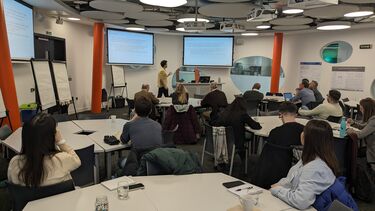
We have a global reputation for our expertise in practical and real-world economics. You'll learn from some of the top experts in economics who provide cutting-edge teaching based on their research.
Our academics play an active role in shaping policy, advising UK government departments such as the Department for Work and Pensions and the Department of Education. They also work with influential bodies such as the Low Pay Commission. The research we produce directly influences government policy and aims to improve lives. This is what informs the content of your modules.
As a result, our graduates are highly sought after by some of the country's leading employers, including the Bank of England, PwC, IBM and HM Treasury.
Student profiles


Entry requirements
Minimum 2:1 undergraduate honours degree in economics or a degree which meets the module requirements below.
Module requirements
You should have studied one module from each of the following four module areas:
- Macroeconomics
- Microeconomics
- Mathematics
- Statistics or Econometrics
English language requirements
IELTS 6.5 (with 6 in each component) or University equivalent
Other requirements
If you have any questions about entry requirements, please contact the school.
Fees and funding
Additional costs
The annual fee for your postgraduate taught course may not include the costs for all compulsory elements. There are also other costs which you may need to consider. These costs may increase due to price increases outside of the University’s control and if you defer entry or change course.
Examples of what's included and excluded in postgraduate taught fees
Save on your course fees
Scholarships for international students
We offer scholarship opportunities worth up to £7,000 for international students from selected regions with excellent academic results and potential.
Alumni discount
As a Sheffield graduate, you’re entitled to a discount on your tuition fees worth up to £2,500.
Apply
You can apply now using our Postgraduate Online Application Form. It's a quick and easy process.
Contact
Any supervisors and research areas listed are indicative and may change before the start of the course.
Recognition of professional qualifications: from 1 January 2021, in order to have any UK professional qualifications recognised for work in an EU country across a number of regulated and other professions you need to apply to the host country for recognition. Read information from the UK government and the EU Regulated Professions Database.
