
Business Finance and Economics MSc
School of Economics,
Faculty of Social Sciences
-
Start date
September 2027 -
Duration
1 year -
Attendance
Full-time
Explore this course:
Apply now for 2027 entry or register your interest to find out about postgraduate study and events at the University of Sheffield.

Course description
Our MSc Business Finance and Economics will develop your knowledge of advanced theoretical principles and teach you how to apply them to contemporary challenges.
You don't need to have studied economics previously as we will introduce you to key core concepts, including:
- Microeconomics: explore how consumers and firms make decisions in competitive markets, and evaluate how different market structures impact social welfare.
- Macroeconomics: investigate key aggregate objectives - such as growth, inflation and unemployment -alongside the strategic design of monetary and fiscal policies.
- Corporate finance: investigate and critique investment strategies, corporate governance, and capital structures.
During your course you will complete an extended research project that gives you the opportunity to tackle a complex, real-world economic challenge of your choice. You’ll be supported by one of our academics with relevant expertise to help guide you through the process.
By the end of your degree, you will have developed an advanced portfolio of technical and analytical skills that will help you secure a career in industry, or support you in undertaking further research.
Modules
Core modules:
Core modules:
- Econometric Methods
-
This module will develop your core econometrics skills. The first half of the module provides a grounding in key econometric techniques covering elements such as the classical linear regression model, hypothesis testing and problems of non-spherical disturbances. More advanced topics are then introduced in the second half of the module. Specifically you will focus upon topics in microeconometrics: including modelling discrete binary variables; censoring and sample selection, and then topics in macroeconometrics including: economic forecasting; stationarity; and cointegration. You will also develop a knowledge of using econometric software Stata.
15 credits - Business Economics
-
The module will provide you with a comprehensive understanding of microeconomic concepts and their application to macroeconomic phenomena, focusing on decision making by consumers and firms, markets structures, and economic concepts like growth, inflation, and business cycle fluctuations. The course will cover a range of topics, including: functioning of competitive markets (e.g., how consumers allocate their budgets and how producers determine price and output), different market structures (e.g., monopolies, oligopolies) and their impact on social welfare and the overall economic system; government's macroeconomic objectives, including how they address issues like unemployment, inflation, and economic growth; design of optimal monetary policy, and an understanding of fiscal policy and debt dynamics.
30 credits - Corporate Finance
-
This module will aim to equip you with a comprehensive foundation of the core theoretical principles of corporate finance, along with practical insights into how these principles are applied when formulating investment analysis and financial strategy. You will be provided with a deeper understanding of key financial decisions faced by firms, with a particular focus on investment appraisal methods; risk management techniques; valuation techniques for stocks and bonds; financial statement analysis and modelling; the cost of capital and the capital structure decision. Additionally, the module will explore both the theoretical and empirical aspects of these topics, equipping you to tackle real-world financial challenges.
15 credits
Core modules:
Core modules:
- Industrial Organisation
-
This module will introduce you to contemporary topics in industrial organisation with a particular emphasis on the role of economic analysis of strategic decision making. You will learn to use and appraise a range of economic techniques to make better strategic decisions. In this module you will build on and expand on your knowledge of microeconomics related to market structure; such as competition in oligopolistic industries. You will also become familiar with further oligopoly models (product differentiation, collusion, mergers) as well as behaviour in platform markets. We will also consider market implications when consumers are imperfectly informed (or naive) about prices or product characteristics.
15 credits - Theory of Banking
-
This is an advanced module that provides a comprehensive examination of contemporary banking practices and challenges. This module covers both on balance sheet and off balance sheet operations with an emphasis on identifying and managing the main banking risks. You will examine the nuances of financial crises and the workings of bank funding schemes. Important facets of contemporary bank regulation are also covered in the module.
15 credits
Plus one from:
Plus one from:
- Applied Econometrics: Cross-sectional and Panel Data Approaches
-
You will gain practical experience applying standard microeconometric techniques to large datasets and learn how to estimate and interpret results from a range of models commonly used in applied economic research. Through lectures and computer labs, you will study modern methods, including limited dependent variable models, instrumental variables, and panel data techniques, and learn how to implement them using statistical software. Working with real microdata will provide invaluable hands-on experience that prepares you for future empirical work in the private, non-profit, and public sectors.
15 credits - Applied Econometrics: Time Series Approaches
-
How can we extract insights from economic data to understand and forecast macroeconomic and financial dynamics? This module introduces you to the advanced time series methods essential for understanding modern research in macroeconomics and finance. You will explore fundamental concepts including stationarity, unit roots, and cointegration to model and analyse short- and long-run relationships. Through hands-on application with Stata software, you will learn to implement Autoregressive (AR) and Moving Average (MA) models, alongside Vector Autoregressions (VAR) to analyse how variables interact dynamically over time. By mastering these sophisticated econometric techniques, you will develop the specialised technical and research skills required to interpret empirical literature and conduct your own independent analysis. These competencies will empower you to contribute effectively to professional roles in economic forecasting, policy analysis, and financial research.
15 credits
Optional modules - one from:
Optional modules - one from:
- Applied Econometrics: Cross-sectional and Panel Data Approaches
-
You will gain practical experience applying standard microeconometric techniques to large datasets and learn how to estimate and interpret results from a range of models commonly used in applied economic research. Through lectures and computer labs, you will study modern methods, including limited dependent variable models, instrumental variables, and panel data techniques, and learn how to implement them using statistical software. Working with real microdata will provide invaluable hands-on experience that prepares you for future empirical work in the private, non-profit, and public sectors.
15 credits - Applied Econometrics: Time Series Approaches
-
How can we extract insights from economic data to understand and forecast macroeconomic and financial dynamics? This module introduces you to the advanced time series methods essential for understanding modern research in macroeconomics and finance. You will explore fundamental concepts including stationarity, unit roots, and cointegration to model and analyse short- and long-run relationships. Through hands-on application with Stata software, you will learn to implement Autoregressive (AR) and Moving Average (MA) models, alongside Vector Autoregressions (VAR) to analyse how variables interact dynamically over time. By mastering these sophisticated econometric techniques, you will develop the specialised technical and research skills required to interpret empirical literature and conduct your own independent analysis. These competencies will empower you to contribute effectively to professional roles in economic forecasting, policy analysis, and financial research.
15 credits - Derivatives, Options, and Securities
-
The aim of this module is to introduce you to advanced principles of asset pricing, focusing on financial derivative instruments. You will gain knowledge of how important derivatives are traded, the pricing models for derivatives, and the principles of risk management using derivatives. This is an analytical module, which reflects the quantitative nature of the subject. The module will cover both the theoretical foundations of asset pricing, and the issues that arise in the practical use of these models and their limitations.
15 credits - Public Economics
-
In this module you will further your understanding of public economics by exploring a number of topics. The course material will be predominately theoretical, but includes empirics and evaluation of empirical evidence. Indicative topics include: collective decision-making and voting; inequality and social mobility; taxation; public goods; externalities; imperfect competition; asymmetric information; cost-benefit analysis; economics of environmental policy.
15 credits - International Money and Finance
-
In ECN6620 you will examine the modern theory of international money and finance and its use in analysing key economic challenges facing policymakers and society. You will examine dynamic general equilibrium (DGE) tradition that underpins much contemporary research and policy work, providing a coherent framework for understanding international macroeconomic interactions and policy design.
15 credits
You will begin by building a benchmark DGE model of international money and finance, using it as a laboratory to learn how such models are constructed, solved, and interpreted. You will then extend this framework to study a range of topical issues, including balance of payments dynamics, determinants of international capital flows, emerging market finance and development, financial crises and policy intervention, currency crises, the 2008-09 global financial crisis, and sovereign default. Along the way, you will develop both theoretical insight and practical solution techniques.
By the end of the module, you will be able to work with frontier models of international money and finance, critically assess policy debates, and translate theory into policy-relevant conclusions. The module strengthens analytical, quantitative, and technical communication skills valued in policy institutions, international organisations, and the private sector, while also providing a solid foundation for postgraduate study and independent research in international macroeconomics.
- Extended Research Project
-
The Extended Research Project will allow students to demonstrate a strong understanding of a particular topic through research and analysis. The topic students investigate will be linked to their specific degree programme. The research project will involve applying existing knowledge to a new situation or testing a hypothesis that the students have learned in the taught modules.
60 credits
The content of our courses is reviewed annually to make sure it's up-to-date and relevant. Individual modules are occasionally updated or withdrawn. This is in response to discoveries through our world-leading research; funding changes; professional accreditation requirements; student or employer feedback; outcomes of reviews; and variations in staff or student numbers. In the event of any change we will inform students and take reasonable steps to minimise disruption.
Open days
Interested in postgraduate taught study? Book your place on our postgraduate online open day on Wednesday 25 November 2026.
Your career
Whether you’re interested in a career as an economist in the public or private sector, commerce, finance or academia, you'll be supported by our expert team to develop key skills to enhance your employability, such as critical thinking, mathematics, analysis and quantitative research.
Economics postgraduates earn the second highest salaries in the UK, five years after graduation (LEO Graduate and Postgraduate Outcomes 2025). Our students are highly sought after by employers around the world and have gone on to work at some of the following businesses:
- Bank of England
- PwC
- IBM
- Deloitte
- KPMG
- Bloomberg
- EY
- Bank of China
- China Construction Bank
Our students have also secured places at other top institutions, such as London Business School, to complete further education in research.
School
School of Economics
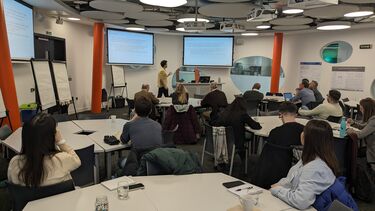
We have a global reputation for our expertise in practical and real-world economics. You'll learn from some of the top experts in economics who provide cutting-edge teaching based on their research.
Our academics play an active role in shaping policy, advising UK government departments such as the Department for Work and Pensions and the Department of Education. They also work with influential bodies such as the Low Pay Commission. The research we produce directly influences government policy and aims to improve lives. This is what informs the content of your modules.
As a result, our graduates are highly sought after by some of the country's leading employers, including the Bank of England, PwC, IBM and HM Treasury.
Student profiles

Proud to call myself an alumna of The University of Sheffield
Masters student,
MSc Business Finance and Economics
Entry requirements
Minimum 2:1 undergraduate honours degree in either Economics, Engineering or Computer Science or a degree which meets the module requirements below.
Module requirements
You should have studied one module from each of the following two module areas:
- Mathematics
- Statistics or Econometrics
English language requirements
IELTS 6.5 (with 6 in each component) or University equivalent
Other requirements
If you have any questions about entry requirements, please contact the school.
Fees and funding
Additional costs
The annual fee for your postgraduate taught course may not include the costs for all compulsory elements. There are also other costs which you may need to consider. These costs may increase due to price increases outside of the University’s control and if you defer entry or change course.
Examples of what's included and excluded in postgraduate taught fees
Save on your course fees
Scholarships for international students
We offer scholarship opportunities worth up to £7,000 for international students from selected regions with excellent academic results and potential.
Alumni discount
As a Sheffield graduate, you’re entitled to a discount on your tuition fees worth up to £2,500.
Apply
You can apply now using our Postgraduate Online Application Form. It's a quick and easy process.
Contact
Any supervisors and research areas listed are indicative and may change before the start of the course.
Recognition of professional qualifications: from 1 January 2021, in order to have any UK professional qualifications recognised for work in an EU country across a number of regulated and other professions you need to apply to the host country for recognition. Read information from the UK government and the EU Regulated Professions Database.