
Landscape Architecture MA
School of Architecture and Landscape,
Faculty of Social Sciences
-
Start date
September 2027 -
Duration
2 years -
Attendance
Full-time
Explore this course:
Apply now for 2027 entry or register your interest to find out about postgraduate study and events at the University of Sheffield.

Course description
This is a two-year conversion course for graduates who want to qualify and work as professional landscape architects. Whether you have a background in design or not, if you have a passion for landscape it will help you develop the skills you need for modern landscape architectural practice.
The first year provides a thorough grounding in the design, social, technical and scientific aspects of the profession. You’ll learn about the history and theory of landscapes, develop visual and IT skills and tackle a broad range of design projects.
The second year gives you the opportunity to specialise in landscape planning, design or management, or to take a cross-cutting approach combining more than one aspect. During the Final Landscape Project, you’ll work on a landscape architecture solution for a real-world site of your choice.
Do you have a question? Talk to us
Book a 15-minute meeting online with the course lead to find out more information and ask further questions.
Book an appointment with Laurence Pattacini
We are not able to answer questions around scholarships. These sessions will focus on answering questions and providing insight into the course and learning experience.
If you have any questions around scholarships, fees, funding and applications, visit our postgraduate study page or get in touch.
Accreditation
This course is accredited by the Landscape Institute (LI).


Modules
Core modules:
Place, Advocacy and Communication (15 credits)
Core modules:
Place, Advocacy and Communication (15 credits)
- Landscape Humanities 1 - History and Practice of Landscape Architecture
-
This module focuses on the cultural and social dimensions of the design of exterior spaces through lecture series. Understanding the human needs and aspirations associated with the shaping of exterior space is of particular importance for landscape architects. The lectures will explore issues such as the development of landscape design over the course of human history and contemporary, social issues of landscape design practice.
15 credits
Students will explore specific topics related to cultural and social issues which historically and currently underlie landscape through a research paper relating to the human dimension of landscape architectural design. - Biodiversity, Climate and Environment
-
This module provides cutting-edge teaching in social science and landscape ecology, addressing the urgent global challenges of biodiversity, pollution and climate change. These topics are vital to student understanding in training future professionals and advocates wanting to make a difference in the world, through practical action, with a global sustainability outlook and strengthened international networks. The module provides training for future landscape practitioners in substantive technical knowledge and a firm grasp of vocabulary, core concepts and global contexts as embedded in UK policy/legislative frameworks and practices, including for communicating with other professionals. The resulting skills, including a deep working knowledge of definitions, theories and tools are invaluable to both UK and international students, as will be the access to influential international networks of practitioners and policy makers.
15 credits - Landscape Humanities 2 - History and Practice of Landscape and Urban Planning
-
This module examines the cultural, social and historical aspects of landscape design and planning at the macro-scales of landscape planning and urban design, including how the larger landscape, communities and whole cities have been conceived, planned and managed.
15 credits
These issues will be addressed through lectures exploring the historical development of the larger landscape - both rural and urban - as both a planned and unplanned artefact of human activity. Sociological and demographic questions will also be addressed with the aim of seeing how individuals and groups can react to larger trends to create more just and sustainable communities. - Studio Project 1 - Fundamentals of Landscape Design
-
This module introduces the practice of landscape design. Through a site based project, it introduces methods and procedures of landscape architectural design by taking students through the typical 'design process'. It explores analytical and creative approaches to design and introduces how the fundamental components of landscape design-landform, vegetation, water and hard material-are used to create places that benefit both people and nature. Landscape media, tools and sources are introduced and applied, and lectures on design theory and the materials of landscape support the project. Assessment is through a portfolio that demonstrates the student's design process and resolved design proposals.
30 credits - Studio Project 2 - Fundamentals of Landscape Planning and Urban Design
-
This module serves as an introduction to and exploration of several core methods, concepts and contexts for contemporary landscape architectural planning and urban design, and more advanced studies in strategic large scale design. Through an integrated project, the use of methods and approaches to strategic landscape planning applied in the first half of the project inform an urban landscape design proposal developed in the second half, relating landscape space to existing and proposed architectural and built form to create a climate resilient urban public realm. The studio project will include research, survey and analysis used to inform creative strategic and design processes. The studio work is complemented by lectures, workshops, and seminars.
30 credits
Core modules:
Advanced Landscape Specialisms (30 credits)
Core modules:
Advanced Landscape Specialisms (30 credits)
- Professional Practice of Landscape Architecture
-
This module provides students with an introduction to elements of the landscape profession that they are required to understand in order to become practising landscape architects and, in time, Chartered Members of the Landscape Institute. Three broad subject areas are covered: Professional Practice, Landscape and Environmental Law, and Landscape Contracts. These will touch upon issues related to working as a professional landscape architect, relevant landscape and environmental law and contract law as it applies to the practice of landscape architecture and the nature, forms and use of contracts in the landscape profession.
15 credits - Landscape Research as Creative Practice
-
This module will introduce students to landscape research as a creative practice in order to address questions and challenges relating to current landscape practice, setting the stage and supporting preparation for further research through the Final Landscape Project in the Spring semester and, for MA students, through the Landscape Dissertation. Students will learn how to find sources of information, how to critically review and analyse this information and how to use and present the findings from this research. They will understand the relevance of research to their own project outputs and how research and evidence-based practice can underpin the planning, design and management of the landscape more generally. They will appreciate how research enables them to critically appraise a project and how they can inform, inspire and enrich their own work with the knowledge and insights gained from their research.
15 credits - Advanced Landscape Research and Dissertation Preparation
-
This module will build on students' learning in 'Landscape Research as Creative Practice', undertaken in the Autumn semester. It will support students in the exploration of independent research topics in preparation for their dissertation, potentially aligned with and growing out of their Final Landscape Project, undertaken concurrently. The module will provide opportunities for students to identify their area of research, key literature and appropriate methods of inquiry including research ethics, and will prepare them to undertake original research over the summer through the Landscape Dissertation.
15 credits - Professional Skills and Technologies
-
This module offers intermediate or advanced level training in a variety of specific skills sought by contemporary landscape practices and responds to the requirements of the professional accreditation body (Landscape Institute). It also draws from current professional practice requirements in liaison with alumni and professional practitioners to develop a suite of training workshops to ensure that students are well equipped to respond to the needs of the profession and for finding employment.
15 credits
Recognising the diverse backgrounds and interests of students on the programme, a suite of options is offered and students will select the options which align most closely with their interests or which fill gaps in their prior training. The outputs of these workshops, as well as work undertaken in previous semesters and/or in previous employment, are arranged into a personalised portfolio of work suitable for employment applications. - Final Landscape Project
-
The Final Landscape Project aims to develop students' readiness to enter the profession by completing a largely independent project from start to finish to a professional standard. Through close collaboration with academic tutors and in parallel with a defined tutorial group, the final project aligns with a chosen design, planning, or management 'agenda' put forth by department tutors. This therefore aims to push the boundaries of the landscape disciplines through research design. As such, the final project undertaken in the Spring semester grows out of focused research into a specific topic already undertaken in the Autumn semester.
30 credits
The aim of the project is to demonstrate the ability to integrate the knowledge and skills acquired in the programme and to apply these in an appropriate way to address the issues posed by the chosen project. Aligned with their tutors' agenda or research question, with the tutor acting as a client or consultant, students will manage their time and develop their required tasks and outputs independently. - Landscape Research Dissertation
-
This module provides students studying for their MA Dissertation with the experience of undertaking research into an issue of significance to landscape architecture. It builds on the skills and knowledge students develop in the 'Advanced Landscape Research and Dissertation Preparation' module and requires the investigation of a selected topic using appropriate research methods and the production of a 12,000 word dissertation. For certain types of dissertation a reduction in word length may be offset by the use of other media. Students receive tutorial support from an academic advisor.
60 credits
The content of our courses is reviewed annually to make sure it's up-to-date and relevant. Individual modules are occasionally updated or withdrawn. This is in response to discoveries through our world-leading research; funding changes; professional accreditation requirements; student or employer feedback; outcomes of reviews; and variations in staff or student numbers. In the event of any change we will inform students and take reasonable steps to minimise disruption.
Open days
- Interested in postgraduate taught study? Our autumn discovery afternoon takes place on Tuesday 20 October 2026.
- You can also attend our postgraduate online open day on Wednesday 25 November 2026.
Teaching
There are lectures, seminars, workshops, tutorials, critical feedback sessions, site visits and practicals.
Teaching and learning take place in the studio and on site.
Assessment
You’re assessed on coursework assignments, dissertation, oral presentation and examination.
Your career
Our graduates go on to have varied and rewarding careers all around the world. We have alumni working in over 70 countries; both in the private sector, running their own companies and for public and voluntary organisations, helping to improve local communities.
Our alumni include those who have achieved the highest levels of recognition within the Landscape profession, including a former President of the Landscape Institute and President of the International Federation of Landscape Architects.
Whether or not you take up a further career in landscape, the course will enhance your employability. By developing valuable transferable skills like graphic design, project management and communication, you’ll be able to make a lasting and positive impact wherever your career takes you.
Our students are also encouraged to build their own industry networks through our annual summer exhibition employer’s event, where final year students meet landscape professionals who are looking to employ our graduates.
School
School of Architecture and Landscape
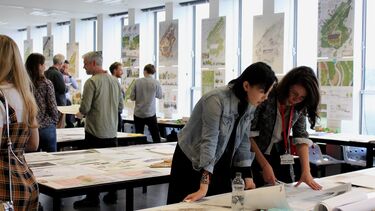
Landscape architecture is about the design, planning and management of places that benefit people and nature. Landscape architects create spaces between buildings that are both inspirational and functional.
If you have a flair for creativity and a passion for improving the environment and people's lives, then landscape architecture could be for you.
You'll learn from experts who are involved in some of the most exciting landscape design work in the world today.
Sheffield is a dynamic city and an ideal place in which to study landscape architecture. Its changing face has been shaped by school-led initiatives like Grey to Green and Love Square, which give students the chance to be involved with live projects and see the difference landscape architecture can make.
Sheffield combines the urban with awe-inspiring views of the neighbouring Peak District, making it a rich learning and research environment.


Entry requirements
Minimum 2:1 undergraduate degree in any subject.
English language requirements
IELTS 6.5 (with 6 in each component) or University equivalent.
Other requirements
You will be asked to submit an electronic portfolio to support your application in addition to other materials such as a supporting statement.
If you have any questions about entry requirements, please contact the school.
Fees and funding
Additional costs
The annual fee for your postgraduate taught course may not include the costs for all compulsory elements. There are also other costs which you may need to consider. These costs may increase due to price increases outside of the University’s control and if you defer entry or change course.
Examples of what's included and excluded in postgraduate taught fees
Save on your course fees
Scholarships for international students
We offer scholarship opportunities worth up to £7,000 for international students from selected regions with excellent academic results and potential.
Alumni discount
As a Sheffield graduate, you’re entitled to a discount on your tuition fees worth up to £2,500.
Apply
You can apply now using our Postgraduate Online Application Form. It's a quick and easy process.
Contact
Any supervisors and research areas listed are indicative and may change before the start of the course.
Recognition of professional qualifications: from 1 January 2021, in order to have any UK professional qualifications recognised for work in an EU country across a number of regulated and other professions you need to apply to the host country for recognition. Read information from the UK government and the EU Regulated Professions Database.
