
Putting the 'human' back in person-robot collaboration
Early Career Researcher, Sharanjeet Kaur, uses AI and digital modeling to transform robots from isolated machines into adaptive partners that prioritise human health and ergonomic performance.

Sharanjeet's research challenge
How to achieve effective human to robot collaboration within a lab setting, which adapts to the needs of individual workers.
The top results
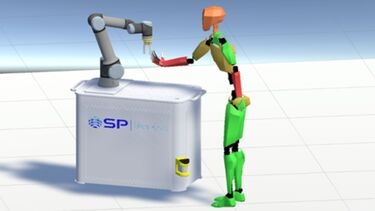
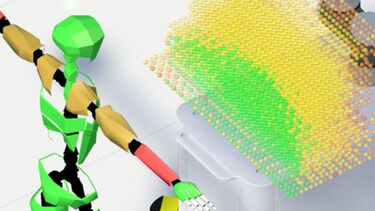
- Developed a novel method using motion capture to build ergonomic work envelopes for human-robot handover tasks. Unlike standard simulations that assume perfect symmetry this approach accounts for real mobility and captures the natural differences between left and right sides
- Used Artificial Intelligence to predict a personal ergonomic score based on the handover position of the robot
- Established zones for robot path planning instead of fixed set points. Relying on exact set points can cause repetitive strain for workers repeating identical movements even if those initial movements are ergonomic
Behind the scenes
During Sharanjeet’s six years in the robotics and automation industry prior to pursuing a PhD, she noticed a persistent flaw in modern manufacturing: despite being called "collaborative," humans and robots still operated in functional isolation. This observed lack of genuine teamwork became the catalyst for her current research.
Traditional robotic systems are designed for efficiency, but they often treat human workers as static, generic variables. This "one-size-fits-all" approach makes true collaboration impossible and frequently overlooks the critical aspect of personal worker health.
The research involves digitalising the human worker through integrated physical and cognitive modeling:
- Physical Modeling: Tracking movement and strain to understand ergonomic limits
- Cognitive Modeling: Measuring cognitive demand and internal states
By leveraging Artificial Intelligence (AI) and Machine Learning (ML) to create these personalised human models, the research flicks the switch so instead of the person adapting to the machine, the robot adapts to the individual's unique ergonomic needs and cognitive pace.
Who benefits from this work?
Anyone working with digital systems benefits from this research. Although the primary focus is robotics, these digitalised human models evaluate both physical and cognitive ergonomics to determine how healthy any manual process is for an individual. The ultimate goal is to improve overall wellbeing and increase accessibility for everyone.
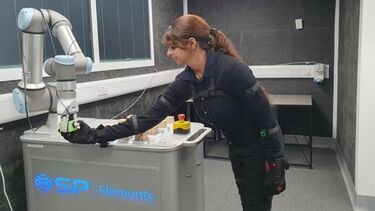
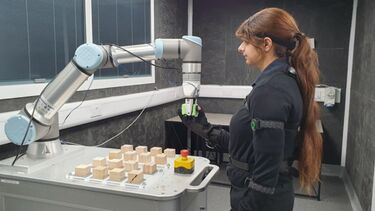
Research by Sharanjeet Kaur
Using AI and Machine Learning to create human model robots that adapt to individual ergonomic needs so humans and machines can work together as a team
In Sharanjeet's words
Social sustainability and job design are highly important. As robots take on the physical aspects of a job it can result in cognitive overload for humans who are left focusing solely on mental tasks. At the same time, if people use AI to handle mental tasks it may leave humans with undesirable jobs that are not physically or mentally balanced or stimulating. Using digitalised human states to analyse both physical and cognitive ergonomics can help make jobs healthier. This ultimately prevents serious health conditions for workers in later life.
Mrs Sharanjeet Kaur
PhD Researcher
Sharanjeet is a Mechanical Engineering PhD researcher based in both the SoMAC and at the AMRC and you can view the research paper here.
Due to her PhD research, Sharan was offered the role of Chairperson on the BSI committee on immersive technology and will be representing the UK in July at the annual ISO plenary in Seoul.
Learn more about Sharanjeet.