I've enjoyed the opportunity to run data science projects, build my own portfolio, and come out of the degree with a personal brand

What made you want to study your course and why did you decide to study at Sheffield?
I decided to study data science because I had had a couple of work experiences already with data science which really opened my eyes to a skill that I didn't know I had before and I wanted to foster, and also a work environment that I really enjoyed.
I applied for data science courses at various universities, but the data science course at Sheffield was the one that stood out the most to me, especially because it had the name properly defined and the the modules seemed really attractive, particularly the practical aspect.
I wanted to get going with practical stuff instead of just theoretical topics. The other courses didn't really have that stamp that Sheffield has in terms of what a data science course was for them. So, that made it really appealing to me. Plus, the fact that Sheffield itself has a great reputation for university life was something that I really valued and wanted to be a part of.
I am happy with the course I picked and the people that I've met as well. Everybody was genuinely passionate about learning more and that's also shaped the curriculum.
What have you enjoyed most about your course?
In terms of academic content, what I've enjoyed the most has been the opportunity to run data science projects and data science research. We have had multiple opportunities to build our own portfolio and develop our skills. So, we'll come out of the degree with a bit of a personal brand, and that's something I've really appreciated from the modules we've had.
The teachers that we have are really really passionate about data science technically and data science socially. So, you really have a very varied perspective on what is being done in the field, but also you have varied commentary in the way lecturers speak and in the way that then you can take that and express yourself, which I think is very unique for a technical subject.
What skills and knowledge have you developed on your course?
One skill is discernment when it comes to utilising data science tools, generally now referred to as AI tools. We're aware of the impact of, for example, the hours of training that a model could take, and also being ethically responsible with the decisions that you make when conducting these experiments. The social impact of your projects and the way that you present your data will influence other people's decisions and perspective of the world.
Those are some of the soft skills you develop, but then you also learn a set of hard skills, like the programming aspect either in Python or SQL. We utilise the libraries that come within Python pretty much in every single aspect of the course, such as data preparation, model evaluation, and data modelling. I've become really well acquainted with platforms like Kaggle, Hugging Face and GitHub.
Skills like research, the way that we have to reference things, presenting and organisation have also been drilled into us!
What are your future career aspirations, and how do you think that your degree will help you achieve those aspirations?
I would like to always work with technology and be responsible for digital transformation, handle strategy and business development. These roles are now very data driven, and so my degree as a data scientist would be really helpful in the sense that an employer can see that my data literacy is up to date. My philosophy when it comes to making decisions is data driven, which I think is important as well and I'm glad to have that in my portfolio.
I think my degree has opened me lots and lots of doors. It's set me up really well for analyst and entry-level positions, a masters or even a PhD, because data science is a very specialised field. Internally, I can say it has prepared me really well for any number related role.
Can you tell us about your internship?
I spent a summer with IBM down in London, where I was a Customer Success Solutions Architect Intern. I really enjoyed it, and learnt a lot from different people in different roles across the company. Even if a sales environment doesn't really yell data science, the amount of programming and preparation of say workshops or demonstrations was really data heavy, and I think my data science degree really helped me navigate this world right. I really engaged with many areas, and have seen the parallels between my degree and the workplace.
What are you enjoying most about the university and the city?
Societies have been a huge part of my Sheffield experience. As a data science student on a new course, there wasn't such a thing as a data science society. I was willing to create one and by the end of my first year I approached the students' union with some friends and we registered as a small committee. Now, more and more people are joining the society from the data science course and outside of it.
It's been such a journey - it started off from a vision, an idea, and me just chasing after a lot of people and going 'Hey, we are not a big society, but this is how we can do big things' It's been so rewarding to create the society and leave it behind for cohorts that will stay there when I'm gone.
Other technology societies were also really eager to share resources, so we created what now is referred to as the Sheffield Technology Group, which includes different societies like the Sheffield Ethical Student Hacking Society, Computer Science Society, Women in Computer Science and more. We had an awards ceremony for the group and worked together to help with the making of the Hack Sheffield event, which has been going on for years now and is huge. Because of our collaboration, we also earned an award for the best collaborative initiative among societies. So, in the same year the data science society was founded, it was already on the podium of an award ceremony which was amazing.
I also wanted to join a sports society when I came to Sheffield. I tried out a couple and the one that I stayed in was rowing, which is also really cool and really different for somebody like me coming from Lima, where rowing is a thing, but it's seaside rowing more than river rowing. The culture of rowing here is really well known and I was taken in by everybody who was really passionate for it. They taught me a lot of discipline as well, so I think it's helped me a lot in my latter years.
Outside of societies and my course, I've also been a Digital Transformation Adviser at the Siemens Digital Innovation Zone and taken part in Italian courses the university offers. It's something I really appreciated from my degree, that I had time to engage in these other activities and having time for social life and enjoying university.
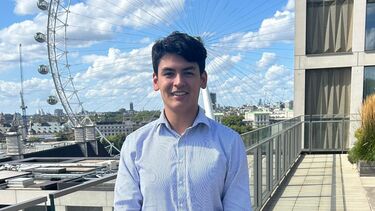
Joaquin J Villar Urrutia

Visit us
Discover what sets Sheffield apart at our next undergraduate open day in November.