
International Journalism Week - student stories
Read the headline coverage from this year's International Journalism Week, as reported by our own students Lixia Wu and Tess Winter.

BBC-style warzone brings students face to face with the realities of reporting
by Lixia Wu
A realistic conflict-reporting simulation enabled students to see how drone-era threats shape life-or-death decisions, as part of the University of Sheffield’s International Journalism Week.
The simulation formed the centrepiece of a three-part programme led by the BBC High Risk and News Safety Team, who challenged students - including me - to analyse shifting threats, plan safe movement and deliver rapid Go/No-Go decisions under pressure.
We were divided into small teams and placed in a scenario set just kilometres from an active frontline.
Each group was tasked with identifying the most immediate threats—ranging from FPV drones and artillery strikes to GPS jamming and communication failures—before drafting a safety, communications and medical plan.
BBC team members guided students to swiftly gather information and adjust their assessments when confronted with ‘immediate contingencies’ – such as vehicle breakdowns or shifting frontline positions – and emphasised the need to rapidly deliver Go/No-Go decisions.
One representative reminded us: “Risk can be managed, but never eliminated,” underscoring the critical judgment required for reporting in real conflict situations.
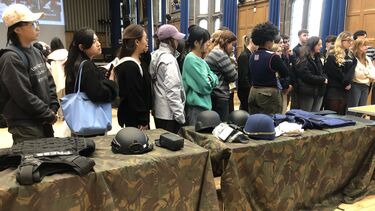
The course concluded with a practical demonstration session, during which the instructor explained the equipment carried by BBC war correspondents in high-risk zones.
This included trauma first-aid kits, encrypted communication devices, PRESS-marked helmets, and body armour, with explanations of their field applications.
Many of us tried on the protective vests, with several astonished by the weight.
When I first put on the vest, I not only felt its heaviness but also realised the hardship of being a war correspondent — a role that demands both mental focus and physical endurance.
One of the BBC team members recalled surviving a near-miss incident in Lebanon when a shell tore through his hotel room while he was out.
His story, told with calm understatement, made the dangers of frontline reporting feel strikingly real. The experience brought home the physical strain and vulnerability inherent in frontline reporting.
And the equipment demonstration added a tangible authenticity to the training, transforming earlier decision-making simulations into first-hand experience.
The BBC team started the day's session by outlining how drone warfare is reshaping conflict reporting.
They highlighted that FPV drones, long-range reconnaissance and AI-assisted strikes have imposed greater restrictions on frontline access, compelling journalists to rethink operational routes, duration of stays and methods for verifying footage.
The team members also emphasised that processing unedited battlefield footage imposes significant psychological strain, making mental resilience an indispensable skill within the journalism profession.
The session offered one of the most practical and immersive experiences of International Journalism Week, giving us the chance to step briefly into the world of conflict reporting.
For me, this experience carried a special meaning. Having studied journalism at the undergraduate level, most of my past learning focused on theory, yet this was the first time I had come face to face with the physical realities of war reporting, touching real equipment and hearing first hand stories from those who have been there.
The session strengthened my determination to pursue a career that bridges safety awareness with truthful storytelling.
The future of journalism in a time of unprecedented change
by Tess Winter
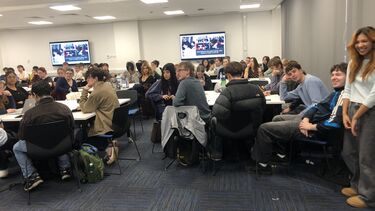
Journalists, academics and students explored how drone warfare and democratic decline are reshaping the future of reporting during the University of Sheffield’s 2025 International Journalism Week.
The week-long series of talks and workshops examined how technology, censorship and artificial intelligence are redefining journalistic safety and truth-telling worldwide.
Organised by the School of Information, Journalism and Communication, the event welcomed representatives from different areas of the media to discuss issues affecting reporters today.
Award-winning broadcaster Anne Koch gave students an exclusive look into The Ukraine Archive, highlighting how truth becomes a casualty in war reporting.
She later joined a discussion Journalists at Risk: Keeping Reporters Safe at Home and Abroad during which panel moderator Tim Hopkinson warned: "If our journalists aren’t safe, our democracy isn’t safe."
The panel also included CNN’s Michael Pratt who urged reporters to “take risks, not chances,” while Reach Plc’s Dr Rebecca Whittington discussed newsroom safety protocols. As someone with an interest in pursuing photojournalism, I found it to be a comforting insight into the thought behind keeping journalists safe whilst they work - no matter what the environment.
The second day welcomed members of the BBC High Risk and News Safety Team who taught students that the use of drones blurs the line between observer and target, and whoever controls the sky controls the story.
During a risk assessment workshop and exhibition for reporting in hostile environments participants discussed how risk cannot be eliminated but can be managed, the real-life footage and equipment brought an eye-opening realism to the dangers journalists face. Students were taught to balance risk versus reward and that no story is worth a life.
Day three began with a student debate on whether Article 79 of the Geneva Conventions is obsolete amid democratic decline and multi-front warfare, leading into the day’s talks.
The first, Covering Asia in times of war and democratic decline, featured Prof Edson Tandoc Jnr on the weaponisation of disinformation and Prof Yvonne Chua on fact-checking in Southeast Asia’s crises.
The second, Covering Africa in times of war and democratic decline included Armel Gilbert Bukeyeneza, on the government and rebels pressuring journalists to align with their narratives, and Muthoki Mumo (CPJ Africa) on transnational attacks on journalists.
The week concluded with a farewell lecture by William Horsley, Co- founder and International Director of the Centre for the Freedom of the Media entitled A life in journalism and its death foretold. Whilst the title was somewhat startling to the aspiring journalists in the room it gave an understanding into how far the media has come, and how far it still has to go to diminish censorship. This was followed by a panel on Journalism and the Defence of Truth in an AI-Shaped World.
Tami Hoffman, Director of Public Policy at The Guardian, spoke about AI’s existential challenges to traditional journalism, while Ross Higgins, head of Bellingcat’s Financial Investigations Team, discussed using open-source techniques to investigate abuses of power and corporate violence.
It was sobering to discuss how AI, whilst usually a helpful tool, was not only killing the hard work of journalists but also the journalists themselves. Thankfully we found comfort in the experience of our guest speakers and their experiences, inspiring us to pursue the truth.
The lessons we learnt will stay with us through our future careers, especially due to how applicable they are to modern day journalism. Documenting the events on social media allowed me to showcase my photography skills, whilst practising writing to a word limit and enhancing audience engagement.
A closing reception - with delicious food and great company - celebrated a week that challenged students to consider the future of journalism in an era of unprecedented technological and political change.
Related information

Visit us
Discover what sets Sheffield apart at our next undergraduate open day in November.