Aphasia Centre harnesses AI to transform communication for people with aphasia
The University of Sheffield’s Aphasia Centre is harnessing AI in therapy to help people with aphasia regain confidence, improve written communication, and reconnect with work, healthcare, and everyday life.

People living with aphasia are being supported to rebuild their confidence and independence through the innovative use of artificial intelligence (AI) at the University of Sheffield’s Aphasia Centre.
Based in the School of Allied Health Professions, Pharmacy, Nursing and Midwifery, the Aphasia Centre is led by Specialist Aphasia Speech and Language Therapist and Senior University Teacher Janet Walmsley and delivered by students training in Speech and Language Therapy who are supervised by qualified Speech and Language Therapists (SLTs). The centre provides communication support in a welcoming, real-world environment that includes a café space, small group work and one-to-one therapy sessions.
Aphasia is a condition resulting from damage to the parts of the brain that deal with language, most commonly caused by stroke or brain injury. It can affect speaking, understanding, reading and writing, making everyday activities such as sending emails, replying to messages or contacting healthcare professionals significantly more challenging.
To help address these barriers, the centre has begun integrating AI into some therapy sessions to support functional communication goals. Under supervision from clinical educators, and where a client has set a goal to work on an area of language which is amenable to using AI, students are working with clients to use AI tools to enhance their written communication, particularly for emails and text-based interactions.
The approach combines impairment-based therapy with practical application. Clients draft short phrases or sentences, which are then input into an AI tool with clear instructions to expand and refine the text into a complete, well-structured message. To support this process, the team developed a visual and audio “AI walkthrough guide” to help clients use the technology as independently as possible. Janet, with the help of colleagues, has also developed a guide to using AI safely, which students share with clients who are using AI in their therapy.
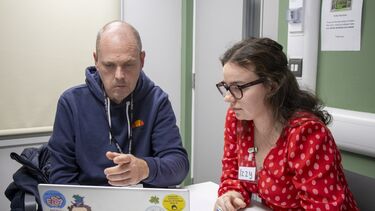
Ian Thompson, who recently returned to work in an administrative role, has been working with Speech and Language Therapy student Isobel Wright to improve the clarity and efficiency of his emails. By drafting short sentences and using AI to expand them into complete, grammatically accurate messages, Ian has been able to communicate more confidently at work.
Isobel Wright said: “Our focus is always on Ian’s own words and intentions. AI isn’t writing for him, it’s helping him build on what he’s already produced. We practise taking a sentence Ian has written and using the tool to expand it into a clear, well-formed version that he can then adapt and use independently in his workplace.”
Ian said: “Really good because before it's hard to talk and write but using AI and speech to text is good, better and easy.”
Peter Wheelhouse, who is living with aphasia following a stroke, wanted to write more structured emails to professionals such as doctors. Working with Speech and Language Therapy student Isabelle Thompson, he has used simple prompts to transform key words into clear, organised emails.
Isabelle Thompson, Speech and Language Therapy student, said: “For Peter, the goal was to send short but structured emails to professionals. Using prompts like ‘help email’ or ‘help reply’, he can turn his key words into a full message. It means he can communicate what he wants to say more clearly, while still being in control of the content.”
Peter said: “Writing, talking hard. But computer, like it. Long ago nothing, but now email.”
While AI can occasionally generate inaccuracies, sessions include discussion about reviewing and editing outputs carefully, and clinicians emphasise the importance of continuing to develop underlying language skills. The technology is positioned as a supportive tool that enhances therapy rather than replaces it.
The initiative reflects the commitment at the University of Sheffield to combining research, education and clinical practice to improve patient outcomes. By thoughtfully integrating emerging technologies into rehabilitation, the Aphasia Centre is helping people with aphasia reconnect with work, services and social networks, demonstrating how innovation can translate into meaningful real-world impact.