
From Serra Gaúcha to Spitalfields: NETWINE takes wine sustainability data to industry
What sustainability means, and how it is measured, differs sharply from one country to the next. NETWINE set out to understand those differences and what they mean for growers.

Sustainability is a word every wine business now uses. What it means, and how it is measured, differs sharply from one country to the next. NETWINE, a project supported by the Grantham Centre's GO Fund and by Brazil's National Council for Scientific and Technological Development (CNPq), set out to understand those differences and what they mean for growers. Working with colleagues in Brazil, the project collected data across six wine-producing countries and has now shared the results with industry in both Brazil and the UK.
From Serra Gaúcha, Brazil to Spitalfields, UK
NETWINE is an international research network linking the Federal University of Rio Grande do Sul (UFRGS), the University of Sheffield, KEDGE Business School, Stellenbosch University, the University of Alicante and Embrapa. Data collection was carried out jointly with Brazilian colleagues, including a wine cluster in Serra Gaúcha surveyed twice.
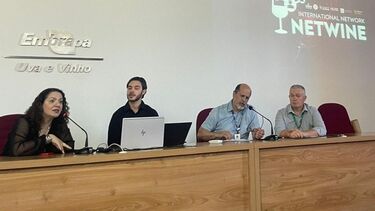
In 2025, the first findings were presented to winemakers at an Embrapa seminar led by Dr Aurora Zen of UFRGS.
This year, on 20 October, Dr Olga Cam of Sheffield University Management School took the research to the Sustainability in Drinks (SID) Conference 2026 at Christ Church Spitalfields, London.
Researchers and growers on one panel
Olga spoke in the session SID Science & Data in Practice, led by Becky Sykes of the Regenerative Viticulture Foundation. She was joined by Dr Florian Payen and Tom Griffin of HESTIA, University of Oxford, Ian Beecher-Jones of JoJo's Vineyard, and Dr Andrew Wood, author of Noble Nine. Placing research alongside growers' experience allowed the evidence to be tested against everyday practice.
What NETWINE found
The study draws on 28 interviews with owners, growers, cooperative directors, consultants, researchers and association staff in the UK, France, Italy, Spain, South Africa and Brazil, held between June 2024 and September 2025.
The first finding is that sustainability is one word with six answers. In Brazil, economic viability comes first: without income, nothing else survives, so measures are cheap and practical, such as sprayer calibration, water reuse and composting. In Spain, the denomination calculates one carbon footprint for all its members, because no single winery could build one alone. In the UK, growers measure in detail, from soil tests to earthworm counts.
The second finding is that the biggest problems sit beyond the data. In the UK, only about one grower in five joins the sustainability scheme. The largest impact is packaging, above all the glass bottle: no UK glassmaker can produce a sparkling-wine bottle that holds 13 bar, so every one is imported. Counting harder solves neither problem.
The third finding concerns governance. A review of 403 articles by the team (Mendes et al., 2026, Business Strategy and the Environment) shows research on environmental, economic and social measurement rising steeply, while research on governance stays flat. Governance asks who owns each number, who acts when it moves the wrong way, and who outside the business can see it. Tools for carbon and water keep arriving; tools for accountability are not being built.
Evidence from the wider panel
The other speakers added complementary evidence. Dr Payen's global meta-analysis found that every alternative vineyard practice studied, from cover crops to organic amendments, was associated with more soil carbon than conventional management. Tom Griffin's survey of 40 English vineyards found that grapes are, on average, a net emitter, yet 13 of the 40 vineyards were carbon-negative, with prior land use the deciding factor. Ian Beecher-Jones made the case for grower-owned vineyard data that works with any technology provider.
Solutions on the conference floor
Practitioner-led conferences show researchers both the problems and the solutions now reaching the market. At SID 2026, packaging was a clear focus: lighter bottles, alternative formats, and labels and closures moving away from plastic. Exhibitors also showed better water management and stronger social practices.
Producers are working with drinkers' preferences too, moving past long-held expectations about colour, clarity and packaging. Cloudy, unrefined wine is one example now reaching the market.
What comes next
The sustainability story for the wine industry has not been written yet, and whoever writes it decides what counts. Next, NETWINE will grow and formalise the network, building on partnerships across six countries. The evidence base will keep expanding, with findings feeding into a practitioner e-book chapter on measuring sustainability in wine.
Thanks go to the Grantham Centre for Sustainable Futures' Go Fund and CNPq for funding; to Dr Aurora Zen (UFRGS), Embrapa and colleagues in Brazil; and to the Sustainability in Drinks organisers and fellow panellists.