
Seeing something I created being genuinely useful to the team, and helping move maintenance practices towards a more digital future, has been extremely rewarding.

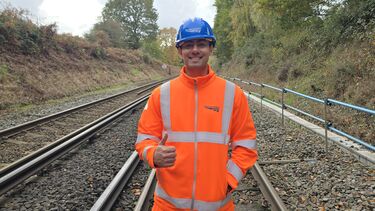
Since graduating, I joined Network Rail as part of the graduate engineering scheme. Before starting my role, I took the opportunity to travel across Europe with friends, backpacking from Helsinki to Budapest over three weeks. This allowed me to reset after university and return motivated to begin my professional career.
Since joining Network Rail, my career path has focused on building a broad understanding of the railway and the different engineering and operational functions that support it. I have spent time working with and shadowing a range of teams, while also actively building professional relationships, seeking advice from experienced engineers and managers, and using these conversations to better understand potential long-term career paths within the business.
The nature of the role has been varied and often spontaneous, which has been a valuable learning experience. On some days this has involved being based in offices supporting engineering teams, while on others it has included time at locations such as Victoria Station, learning how station staff manage safety and passenger flow. I have also been involved in discussions around incident response and safety management, including how teams address potential safety breaches and infrastructure defects.
Looking ahead, I will complete further structured placements in maintenance, projects, and asset management before moving into a permanent engineering role within the organisation.
What is the most rewarding aspect of your current role so far?
The most rewarding aspect of my role so far has been developing a systems engineering tool that helps transform how maintenance teams visualise and manage railway assets. This project has allowed me to apply automation and data-driven thinking to a real operational challenge, which I believe is increasingly important as the industry moves towards more modern, efficient ways of working.
The system I designed takes data collected from annual engineering track walks and consolidates it into an interactive digital interface. It maps an entire railway line and displays key information such as the year and type of rail installed, asset locations, special rail sections, and recent defects. Instead of relying on spreadsheets or physical posters, engineers can now scroll along a digital representation of the route and quickly identify areas of concern.
This tool directly supports several important team objectives, including identifying all pre-1979 rail and tracking special rail types and their age so they can be systematically removed and renewed. By making this information clearer and more accessible, it helps prioritise maintenance and investment decisions and improves how asset condition is communicated to others.
Seeing something I created being genuinely useful to the team, and helping move maintenance practices towards a more digital future, has been extremely rewarding.
Were you in any student societies? How did this experience prepare you for your career path?
Being involved in engineering societies was a key reason I chose the University of Sheffield, and these experiences played a significant role in preparing me for my current career path. They allowed me to apply engineering theory in practical settings while developing leadership, teamwork, and communication skills that are essential in industry.
My most influential experience was with Project Falcon, where I acted as a Project Lead. In this role, I managed a multidisciplinary team, coordinated workloads, and ensured technical outputs were delivered on time. This gave me early exposure to leadership, stakeholder communication, and decision-making under pressure, which closely mirrors how engineering projects are delivered in industry today.
Alongside this, my involvement in SheffHEPP and SunrIde reflected my curiosity and desire to learn beyond the curriculum. These projects allowed me to develop hands-on technical skills, collaborate within specialist teams, and manage time effectively while working towards shared engineering goals.
Beyond technical societies, my roles as a Student Ambassador, Academic Representative, and International Engineering Student Ambassador strengthened my communication skills and confidence when engaging with a wide range of people. Working on the DiCE project also gave me insight into the importance of inclusive engineering cultures and collaboration across diverse teams.
Together, these experiences helped prepare me for a career in engineering by developing not only my technical ability, but also the interpersonal and organisational skills that are critical in a professional environment.
What advice would you give to younger students interested in studying engineering at Sheffield?
My first piece of advice would be to spend time understanding what type of engineering interests you, while not feeling pressured to specialise too early. If you want to keep your graduate options open, General Engineering is an excellent choice, as it provides a broad foundation across multiple disciplines. At Sheffield, the course is well supported by a strong leadership team who actively listen to student feedback and guide you throughout your studies. The first two years in particular give you a comprehensive grounding that prepares you well for a wide range of engineering careers.
Alongside your degree, I would strongly encourage gaining as much practical experience as possible. While the course teaches essential fundamentals, extracurricular activities and engineering societies are where you develop teamwork, leadership, and hands-on problem-solving skills. Getting involved in student-led projects such as Formula Student or Engineers Without Borders, or any society that genuinely interests you, makes a huge difference. Choosing modules based on what excites you, rather than what seems easiest, also helps keep you motivated and engaged.
Sheffield offers outstanding facilities, from the state-of-the-art labs in The Diamond to excellent study spaces across campus, including the Engineering Heartspace, Western Bank Library, and the Information Commons. Early career-focused activities such as Engineering Challenge Week and “Engineering You’re Hired” also provide valuable exposure in the first two years.
From a career perspective, engineering is becoming increasingly competitive, so it’s important to find ways to stand out. This could be through placements, internships, personal projects, or developing skills in emerging areas such as AI and automation. Building your network, seeking advice from academics and peers, and using university careers resources can all give you a significant advantage.
Finally, enjoy your time at university. Get involved, challenge yourself, try new things, and make the most of the social side as well. University is a unique experience, and balancing hard work with enjoying the journey is just as important as the end result.