
Are rising commodity export prices good for an economy?

Two thirds of developing countries are commodity-dependent, where primary commodities account for over 60 percent of these countries' exports. As a result, swings in commodity prices are a major source of economic instability. While an increase in the price of a commodity export makes a country wealthier, and can cause an economic boom, it also affects the composition of what the country produces and the country's long-run growth prospects.
In previous research, Dr. Juan Paez-Farrell found that increases in commodity export prices lead to increases in GDP, lower unemployment and increased inflation, typical signs of an economic expansion. However, the resulting rise in foreign currency earnings leads to an exchange rate appreciation, thereby causing a contraction in the manufacturing sector as goods have become more expensive.
Consequently, there is a concern among policy makers that while booms in commodity prices make a country wealthier in the short term, these gains mask later longer-lasting costs if the contraction in the manufacturing sector leads to de-industrialisation, since this sector is a key driver of knowledge spillovers. In addition, as commodity prices are notoriously highly volatile, there is a risk that the resulting variability in GDP will cause reductions in investment and thus economic growth.
About our work
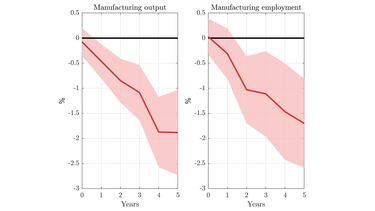
Dr. Juan Paez-Farrell has received a Leverhulme Research Fellowship to address these issues. In particular, the research uses empirical methods to quantify the contractionary effects on the manufacturing sector of an increase in commodity export prices in Latin American as well as Sub-Saharan African economies. The figure plots the evolution over time (in years) of an unexpected ten percent increase in the commodity export price for a typical developing economy on the relative size of the manufacturing sector (left) and on the proportion of manufacturing in total employment (right), with the shaded pink areas representing the plausible range of values. While in the year of the price increase the effects are negligible, these rapidly build up, with the output share of the manufacturing sector falling by two percentage points after five years.
A key part of the research consists of complementing the empirical findings with a theoretical model, which is essential if one seeks to understand the underlying mechanisms driving the results as well as analysing how these economies would have fared under alternative policy frameworks.