
'Speaking Dutch every single day for two weeks'
A Summer School is an excellent opportunity to boost your language learning in different setting. Three Sheffield students of Dutch, Dan Dimmock, Áine Cronelly and Erin Molyneux, travelled to the Flemish city of Ghent for the Taalunie Zomerschool.

For two weeks, Dan, Áine and Erin lived and studied alongside students from all over the world on Taalunie zomercursus Nederlands , putting their Dutch into practice outside the classroom. Here is Dan’s report.
There we were! Three English students walking the cobblestone streets and canal-lined quays of Graslei and Korenlei, ready for two weeks of improving our Dutch.
At Ghent University, we followed an extensive program that included literary translation, interpreting, and business communication. There were lectures and workshops by various guest speakers from the Dutch and Flemish cultural and media sectors, and famous Dutch author Lisa Weeda spoke about her new work, Mooi boek over Oekraïne (Beautiful Book About Ukraine), excerpts of which we had translated into our own languages for the course. VRT journalist Majd Khalifeh discussed international journalism, identity, and the relationship between language and connectedness with us. Topics such as diplomacy, literature, and the daily life of translators were also covered.
Choose your own track
An important part of the Taalunie Zomercursus consisted of various tracks we chose in advance and in which we worked on diverse projects in smaller, international groups and engaged with experts in the field. I researched the Bibliography of Dutch Linguistics and Literary Studies (BNTL) with my group. We interviewed staff members about the use and future of the database and presented our findings to the other students.
Erin looked at the use of translation apps alongside students from Germany, Hungary, and Poland. They compared tools including DeepL, Google Translate, ChatGPT, Microsoft Translate, and iTranslate, and spoke with Dries Debackere from De Taalsector about the role of this technology in translators' work. Their findings were compiled into a poster.
Áine and her group researched historical names for the Dutch language between the sixteenth and eighteenth centuries. They examined both ‘endonymous’ terms within Dutch itself and ‘exonymous’ terms for Dutch in other languages, as well as how these changed over the centuries.
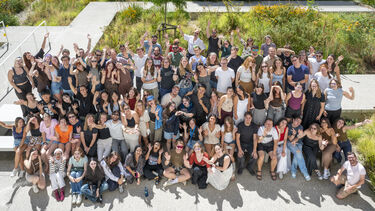
An evening with our host families
Yes, at a Summer School there is work to be done, but we did far more than just sit in a classroom. We lived together in student accommodation and used Dutch in our daily lives: while cooking, grocery shopping, on day trips, and of course during numerous evenings in Ghent's cafés.
We also had the opportunity to discover Flemish culture. In Ghent, we explored the historic city center and went to see the famous Adoration of the Mystic Lamb (the Ghent Altarpiece) by the Van Eyck brothers at St. Bavo's Cathedral. During the heatwave, we even took a kayak trip through Ghent, paddling past the Gravensteen castle.
A personal highlight was an evening spent with a Flemish host family. Together with a student from Spain and a student from Poland, we enjoyed a typical Belgian meal (meatballs in tomato sauce with fries) and had the chance to practice our Dutch in a completely different setting.
Additionally, we tried to see as much of Belgium outside Ghent as possible. Together with new friends from the course, we visited cities like Brussels, Antwerp, and Bruges, and spent an afternoon by the sea in Ostend. Naturally, that also included a few Belgian beers!
Speaking Dutch every single day for two weeks!
Perhaps the most important outcome of the summer course wasn't even on the official program. Speaking Dutch every single day for two weeks gave all three of us far more confidence to actually use the language. After two weeks, we returned with improved language skills, greater confidence in our Dutch, and new friends from various countries.
For all three of us, the summer course was a fantastic opportunity to discover where studying Dutch in Sheffield can lead. We would recommend it to all of you!
Related information

Visit us
Discover what sets Sheffield apart at an undergraduate open day in October or November.