
Scaling up our research over seven orders of magnitude
When research outgrows the laboratory, the transition to industrial infrastructure marks a pivotal shift from theoretical discovery to practical application.

Professor Jagroop Pandhal and his research team have begun to scale up their findings from a £1.6 million EPSRC project, in the final work package of a three year project. The highly anticipated 1,500 L algal photobioreactor was commissioned this month, and will allow researchers to test cultivation at a scale, seven orders of magnitude higher than their current laboratory setup. They are effectively going from screening at the microlitre scale, to thousands of litres. The project involved developing a novel algae-bacteria screening technology using a lab-based plate reader, to enable use of an industrial co-product as a new feedstock. A key aspect of the project is that this feedstock, produced daily in megalitres volumes, is unable to support the growth of the algae and bacteria alone, and hence, a co-culture is needed. The bonus is it enables the biomanufacture of two biopolymers, one from the algae and the other from the bacterium. These are being converted into products by collaborators at Imperial College London and the University of Warwick.
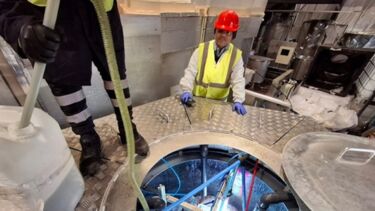
The new installation will test whether their research can be successfully translated to a large-scale environment. The photobioreactor is highly automated, rife with bespoke sensor technologies to monitor essential co-culture growth parameters. It has also been designed with the feedstock in mind. The work is being directly translated into techno economic models, also being conducted in Sheffield. If these experiments prove successful, the screening technology will have huge implications in biotechnology, whether it's for biomanufacturing sustainable materials at reduced costs, or focussing on recovering resources from co-product or waste streams.
The reactor from Reepel Ltd. (DZ NRV Grade F) is provided for data gathering and as an onsite facility. The Sheffield-based specialist bioreactor company has proprietary unit operations for production, disinfection, pre-treatment, product extraction and downstream separations. Novel IoT control and monitoring has been added by another Sheffield based company, Terabithia Ltd.
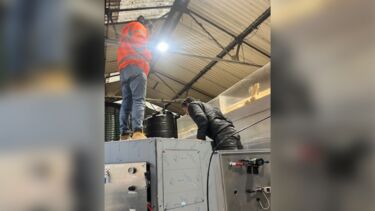
Professor Pandhal said: “This is a really exciting step for us. It's fine to develop screening technologies in a research lab at minute scale, but can we develop screening “scores” that tell us that these co-cultures also grow well at scale? So far, it’s very encouraging- we have tested them at 150 L scale in our research lab at the University, but now we are going into large-scale engineering. Setting up this photobioreactor on-site represents the bridge between science-in-the-lab and its industrial application. I’ll be ecstatic if we can prove that the efficiencies we saw at the microlitre scale can be maintained in a real-world environment."
Dr Desai (Reepel Ltd) said: “It’s a very interesting project fitting into our research approaches by following a cascading circular economy approach and as a research-intensive organisation, we are really pleased working with avant garde researchers such as Professor Pandhal and the University of Sheffield”.