
‘Water Blew Up Everything’: An Urban History of Climate Disasters in Buenos Aires’ Informal Settlements
This project seeks to understand the ways in which urban poverty and ecological vulnerability intersect in cities from the vantage point of urban environmental history.

Focusing on local experience, the project addresses a specific event — the 1967 flood — and an area strongly affected by it — the informal settlement Villa Jardín and surrounding areas in the Buenos Aires floodplains, Argentina — to carefully reconstruct the intertwined narratives that emerge from residents’ accounts in contrast to official discourse.
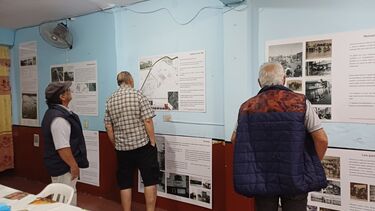
‘Water Blew Up Everything’
A selection of historic photos of flooding, along with exhibition photos


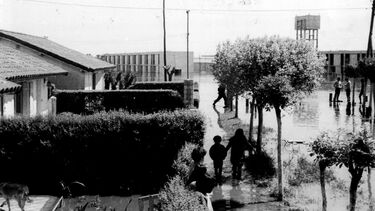


We engage with a wide array of sources – including oral history, press coverage, government documents and grassroots photography repositories – and structure the analysis around three inter-related questions:
- Why did Villa Jardín and the surrounding areas flood in 1967?
- How did residents’ experience of the flood affect their lives and the collective imaginary of the area?
- What does the flood tell us about wider issues of urban environmental justice?
Our analysis is structured across key themes that emerge from these sources. We pay particular attention to the testimonies of those who lived through the flood and its aftermath, where residents’ voices articulate some possible responses to these questions.
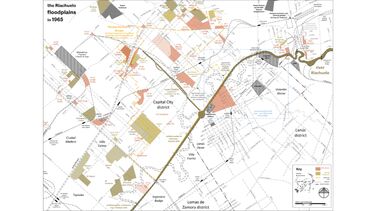
The 1967 flood in Buenos Aires is still an open wound for affected residents, yet there is no research on it nor wider public knowledge about it. The flood lasted over two weeks and left tens of people dead, thousands displaced and millions who suffered material losses. Those affected were among the poorest in the city, and many of them took over a decade to recover. For this reason, the research project has been incredibly successful in the reception it elicited in the field as well academically and with the general public.
Beyond academic writings, the project produced a co-designed itinerant exhibition which allows us to give back to local residents, celebrate their knowledge and promote critical understandings of environmental vulnerability at a time of climate emergency and climate denial, so it is ever more urgent to discuss it.
View the exhibition catalogue >
- Project team
Principal Investigator: Adriana Laura Massidda (University of Sheffield)
Collaborators: Carla Fainstein (CONICET/Universidad de San Martín), Valeria Laura Snitcofsky (CONICET/Universidad de Buenos Aires) and Eva Camelli (CONICET/Universidad Nacional de General Sarmiento)
Exhibition design: Jennifer Alderete (Biblioteca Popular Sarmiento de Valentín Alsina), Martín Vildoza (Biblioteca Popular Sarmiento de Valentín Alsina), Marcos Chinchilla, Guadalupe Marín Burgin and Federico Geller
Catalogue design: Hernán Cardinale and Federico Geller