
Dental Hygiene and Dental Therapy BSc
Qualify as a dental hygienist and dental therapist at Sheffield, with hands-on clinical placements that will prepare you for advising and treating patients of all ages and backgrounds.
-
A Levels
ABB -
UCAS code
A900 -
Duration
3 years -
Start date
September -
Attendance
Full-time
- Accredited
- Course fee
- Funding available
- Foreign language study
- Clinical placement
- FY Foundation year entry for mature students
Explore this course:
Course description
Why study this course?
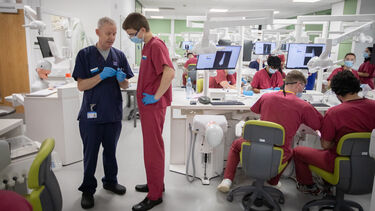
State-of-the-art training facilities
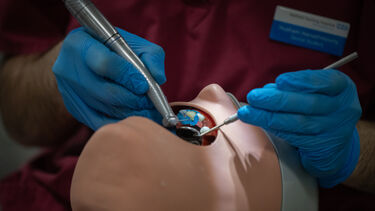
Undertake rigorous clinical skills training, including the use of ‘phantom heads’ and virtual reality, to develop your clinical confidence and competence.
Have an impact in your local community
Develop an oral health promotion project and take part in outreach placements, supporting adults and children from a range of backgrounds.
Learn as part of a team
We believe in training the dental team together. You’ll learn alongside Dental Surgery students in a way that prepares you for the realities of working in a dental team.
£5,000+ annual NHS training grant
NHS training grants are available for all eligible UK home students to help you with your studies.

Dental hygienists and dental therapists are integral members of the dental team. They help educate and advise patients, and carry out a range of procedures to preserve and improve oral health.
Our BSc Dental Hygiene and Dental Therapy programme has been developed in line with the General Dental Council's (GDC) safe practitioner framework.
Throughout the course, you’ll develop the clinical skills, knowledge, and professional behaviours required to practice safely and effectively. You will be taught by a multidisciplinary team which includes experienced dental professionals, biomedical scientists and social scientists. Many of our staff are involved in world-leading research, so you'll learn the latest techniques and advances in the field of dentistry to help inform your future practice.
Teaching in your first year and the first semester of your second year is shared with Dental Surgery students. This means you’ll learn side-by-side, in a way that prepares you for the realities of working in a dental team.
You’ll benefit from early clinical exposure, combining simulated learning with real patient interactions from your very first year. These interactions will progress throughout your degree - from observations of simple procedures through to treating adult and paediatric patients, under the supervision of qualified dental professionals.
In your final year, you’ll use the knowledge you’ve gained so far to carry out an oral health promotion project, working in a local community to help promote good dental health.
Accreditation
We are working towards accreditation of our BSc Dental Hygiene and Dental Therapy programme with the General Dental Council, so that students can register with the General Dental Council upon graduation. We currently have students enrolled on a Dental Hygiene and Dental Therapy Higher Education Diploma programme, which is accredited by the General Dental Council.
Foundation year
The foundation year of this programme provides students with non-standard entry qualifications, a thorough and supportive academic preparation for successful degree level study in the School of Clinical Dentistry.
Clinical placements
During your time at Sheffield, you'll combine your academic studies and simulated learning with real hands-on clinical practice.
We have a close working relationship with Charles Clifford Dental Hospital, a specialist facility adjacent to the School, where most of your clinical placements will take place. Over time, you’ll gain experience in a range of dental clinics, supporting both children and adults.
During your second year, you’ll attend outreach placements, where you’ll get the chance to observe and treat patients of all ages and backgrounds in general dental practices or community dental clinics. These real work environments will help you develop both your practical and interpersonal skills so that you are well prepared to start your career as a dental hygienist or dental therapist.
In your final year we will prepare you for your transition to the world of work, helping you to consolidate your knowledge of the legal, ethical and professional obligations that underpin responsible dental care and practice management.
Modules
There may be changes before you begin your studies. As you progress through your course, we’ll confirm additional details of what you will study.
UCAS code: B750
Years: 2027
- ICS 1a (Integrated Clinical Sciences)
-
This module will provide you with knowledge about the underpinning medical foundations of the human body, including the head and neck. As well, you will learn about the development and structure of the teeth and will be introduced to clinical topics such as microbiology, pharmacology, medical emergencies and common dental diseases.
20 credits
You should expect to learn through attending a variety of teaching events, for example: lectures, practicals and online learning. - CKS 1a (Clinical Knowledge and Skills)
-
This module aims to introduce you to the theory, protocols, behaviours and broad range of operative dentistry skills required to work safely and effectively in a clinical environment and prepare you for supervised treatment of patients on dental clinics, in particular, preventive care and non-surgical periodontal treatment.
20 credits
You will begin clinical skills training in the Clinical Skills Learning Environment (CSLE) so you can treat patients. You will be introduced to the concept of putting patients' needs first, as well as an evidence based approach to careful and thorough treatment. You will learn how to deliver effective oral health education and diet, smoking, alcohol and substance misuse advice to patients. You will take part in simulated clinics to help build your confidence and communication skills in a clinical environment in order to help you become a caring, competent and confident member of the dental team.
This module's assessments are a gateway to treatment of patients in a clinical setting. - PPD 1 (Personal and Professional Development)
-
In this module you will be introduced to the requirements of being a dental professional. It emphasises ethical conduct and integrity in both professional and personal life, alongside the importance of patient-centred communication, adapting to individual needs, and effective collaboration with colleagues for optimal patient care. You will cover general principles of consent, their application in oral healthcare, and patients' rights to informed involvement. Key legal requirements, including data protection, fair treatment, and support for those with protected characteristics, are discussed. You will learn about the expectations of you as undergraduates and future professionals. You will learn about the importance of self-awareness, reflection, and responding to feedback.
20 credits
You will learn about the academic foundations for professional expertise. You will cover information retrieval and management, academic integrity in professional communication, and effective preparation for assessments while supporting your wellbeing. The focus then shifts to research methods in oral health, emphasising your role in evidence-based prevention-focused, and sustainable patient care. Different research methods and study designs are outlined, including their strengths, limitations, and how these impact the conclusions that can be drawn. You will learn how research informed evidence-based guidelines are used in patient care during your undergraduate programme and beyond. - ICS 1b (Integrated Clinical Sciences)
-
In this module you will build on your existing knowledge of the human body and extend it to cover the gastro-intestinal tract and skeleton, as well as the development and growth of the mouth, face and jaws. Childhood development will be covered and you will study what makes children different from adults as well as management of dental emergencies in children. Dental caries will be studied in depth, from microbiology to pathology and diagnosis and management alongside your pre-clinical training in operative dentistry. You will also study special senses, including pain and its management and control as well as immunology.
20 credits
You should expect to learn through attending a variety of teaching events, for example: lectures, practicals and online learning. - CKS 1b (Clinical Knowledge and Skills)
-
In this module, through lectures and practicals in the clinical skills learning environment, you will acquire and develop the knowledge and skills to be able to undertake routine operative dentistry procedures for patients of all ages, including the principles of dental anaesthesia.
40 credits
You will develop the skills in clinical record keeping, including clinical photography, and compliance with clinical governance and health and safety policies.
Sustainable oral health care will be introduced, and you will learn about both the environmental and patient compliance aspects.
You will learn about the structure and properties of the materials commonly used for dental operative procedures.
This module includes attendance outside of routine University term dates to ensure sufficient class contact time for progression to the clinical setting. This module's assessments are a gateway to treatment of patients in a clinical setting for procedures taught in this module. - CP 1 (Clinical Practice)
-
You will attend dental clinics where you will carry out supervised treatment on patients safely and efficiently. You will gain the ability to examine patients systematically, formulate diagnoses and develop treatment plans tailored to your patients' individual needs. You will also learn how to carry out a range of special tests to aid diagnosis and treatment plans.
In this module you will adopt the principles and requirements of professional practice as they relate to professional standards such as patient-centred approach, confidentiality, and valid consent. You will develop your team working skills necessary to work effectively and efficiently as part of a multidisciplinary team. You will develop communication skills essential for professional practice. Your professional behaviour will be assessed through tutor observation as part of your clinical portfolio.
This module includes attendance outside of routine University term dates to ensure sufficient patient contact time.
- ICS 2 (Integrated Clinical Sciences)
-
Building on sciences you have learnt in Year 1, this module will teach you about human diseases, focusing on those that are particularly relevant when providing safe dental care. You will start with the basics of cell and molecular biology before moving on to practical skills such as taking patient histories related to various body systems, such as the cardiovascular, respiratory, and nervous systems. You will also learn how to measure vital signs and administer injections in a clinical skills setting.
20 credits
In addition, the module introduces common disease treatments and the microbiology of infections, along with their management. You will learn the fundamentals of radiography and X-ray imaging. - CKS 2a (Clinical Knowledge and Skills)
-
In this module you will acquire and develop the knowledge and skills to be able to undertake further operative dentistry procedures for patients of all ages.
20 credits
You will learn about the classification, histology and microbiology of pulp and periapical disease and treatment of disease of the tooth pulp.
You will further develop your skills in restorative dentistry, learning how to restore teeth affected by deep caries, and will learn about the materials used for restoration of the hard tissue. The treatment of acute periodontal conditions will be taught, including treatment options. You will also be introduced to dental implants and how they are maintained in the mouth.
You will also learn about safeguarding and special care dentistry. - PPD 2a (Personal and Professional Development)
-
Building on the principles of patient-centred care from year 1, in this module you will learn to communicate effectively with diverse patients in different contexts, emphasising the importance of adaptability. This includes understanding patients' health literacy and how dental professionals' cultural competence ensures effective communication across populations. You will also explore dental anxiety: its prevalence, impact, and strategies for prevention, management, and reduction. Furthermore, you will learn specific communication approaches and challenges when providing oral healthcare to children. You will consider the communication skills necessary for challenging consultations, including delivering bad news.
20 credits
You will be introduced to the concepts of social accountability and a public health perspective in dentistry.
You will consider oral health promotion and its aim to address the social determinants, to improve oral health at individual, community, and population levels. - PPD 2b Oral Health Promotion Project Planning (Personal and Professional Development)
-
This module aims to build your personal and professional development by applying knowledge from previous modules in the programme.
20 credits
You will design an oral health promotion intervention for a specific group, using knowledge of the population approach to health, health promotion, determinants of health, critical appraisal, and writing skills. In addition, you will learn about ethical considerations of what you plan. You will then continue with your project in the 3rd year of study.
Secondly, in small groups, you will consider clinical scenarios that have legal, ethical, and communication challenges. Collectively and individually, you will consider how to respond to and manage them through various communication methods and using your ethical reasoning that you learned in previous modules and using teamwork. - CP 2a DHDT (Clinical Practice)
-
In this module you will continue to develop your knowledge as you learn about special care dentistry, primary tooth dental extractions, and principles of child management. You will learn about advanced periodontal instrumentation, orthodontics, indirect restorations such as crowns and bridges, and removable prosthesis such as dentures. You will develop your knowledge of systemic conditions and how these impact oral health and the care that you provide.
You will develop your professional practice as you attend clinics in operative dentistry, paediatric dentistry and specialist rotations. During these clinical sessions, you may observe procedures, assist others in treating patients, or provide dental care yourself. You will attend paediatric dentistry general anaesthesia clinics and carry out dental extractions. You will continue to develop your communication skills and work as part of a multidisciplinary team. Your professional behaviour will be assessed through tutor observation as part of your clinical portfolio.
Towards the end of this module, you will be introduced to our Outreach placements and further clinical rotations in preparation for semester two. Alongside these, you will further develop your knowledge on the National Health Service, and the oral healthcare team and how skill mix can work in dentistry.
The module will be taught by using lectures, tutorials, clinical skills and patient clinics. - CPO 2b DHDT (Clinical Practice and Outreach)
-
In this module you will continue to develop your professional practice as you attend clinics in operative dentistry, paediatric dentistry, outreach and specialist rotations. During these clinical sessions, you may observe procedures, assist others in treating patients, or provide dental care yourself. You will attend paediatric dentistry general anaesthesia clinics and carry out dental extractions of primary teeth. You will continue to develop your communication skills and work as part of a multidisciplinary team. You will build on the knowledge you gained in year 1 to learn how to take various dental radiographs and how to interpret and report on these.
40 credits
- PPD 3 Oral Health Promotion Project (Personal and Professional Development)
-
This module aims to extend your personal and professional development by applying knowledge and skills learned throughout your programme, particularly in relation to public health and health promotion.
40 credits
Having designed your oral health promotion intervention and received ethical approval, you will implement, evaluate and report on your oral health promotion intervention that you designed for the target group identified. In doing this, you will gain experience and skills in health advocacy, collaboration, management of time and resources, academic report writing, and reflection. - ICP 3a DHDT (Integrated Clinical Practice)
-
In this module you will build on the knowledge you gained throughout your programme to learn about the aetiology, diagnosis and management of oral diseases, including oral cancer. The module also covers how ageing can impact oral health.
20 credits
You will gain a thorough understanding of the different types of periodontal surgery and post-operative care. You will learn about public health, dental public health and preventing oral diseases and promoting oral health at a population level. You will take part in interactive tutorials to develop your knowledge and understanding of teamwork, leadership and management in dentistry.
To prepare you for a successful career as a dental professional, you will consolidate your knowledge of the legal, ethical and professional obligations that underpin responsible dental care and practice management. - ICP 3b DHDT (Integrated Clinical Practice)
-
In this module through lectures, seminars and clinical practice, you will refine and continue to develop further your holistic professional practice. You will attend clinics in operative dentistry, direct access and specialist rotations. During these clinical sessions, you may observe procedures, assist others treating patients, or provide dental care yourself. You will also continue to refine your communication skills and work as part of a multidisciplinary team.
60 credits
In preparation for your transition to dental practice upon graduation, you will have tutorials on job searching, completing application forms and interview techniques.
The content of our courses is reviewed annually to make sure it's up-to-date and relevant. Individual modules are occasionally updated or withdrawn. This is in response to discoveries through our world-leading research; funding changes; professional accreditation requirements; student or employer feedback; outcomes of reviews; and variations in staff or student numbers. In the event of any change we will inform students and take reasonable steps to minimise disruption.
Learning and assessment
Learning
Our Dental Hygiene and Dental Therapy programme combines theory with hands-on clinical practice. You’ll learn the basic scientific and pathological processes that underpin dental disease, at the same time as you learn the skills to manage patients and promote good oral health.
Teaching will also cover your personal and professional development as a dental practitioner, and will include topics such as management and leadership, personal wellbeing, and supporting the wellbeing of others.
You will learn through a combination of lectures, seminars, practicals, online learning, clinical skills sessions and clinical placements, as well as self-directed learning.
Throughout the course you’ll be taught by knowledgeable and passionate staff - including registered dental professionals and academics who are internationally respected for their research. Our teaching team will incorporate the latest research into their teaching, so your learning is evidence-based.
Assessment
Various forms of assessment are used throughout the programme. These include:
- Written exams (digital and paper-based)
- Practicals
- Objective Structured Clinical Examinations (OSCEs)
- Reflective reports
- An oral health promotion project
- Oral exams discussing clinical cases
- A Dentistry Portfolio, where you will detail and reflect on every clinical encounter
Entry requirements
Selection process
Find out more about the Dental Hygiene and Dental Therapy selection process, including our screening and interview process and how we make offers. This includes our policy on A Level resits.
Dental Hygiene and Dental Therapy selection process and admissions
With Access Sheffield, you could qualify for additional consideration or a contextual offer - find out if you're eligible.
The A Level entry requirements for this course are:
ABB
including Biology + pass in the practical element of any science A Levels taken
- A Levels + a fourth Level 3 qualification
- BBB + B in a Dentistry or health-related EPQ
- International Baccalaureate
- 33, with 5 in Higher Level Biology
- BTEC Extended Diploma
- DDD in Applied Science* (including Biomedical Science, Analytical & Forensic Science, and Physical Science streams*)
- BTEC Diploma
- DD + B in A Level Biology; DD in Applied Science* + B at A Level
- T Level
- Distinction in the Health, Healthcare Science or Science T Level, including grade A in the core component
- Scottish Highers + Advanced Higher/s
- AABBB + B in Biology
- Welsh Baccalaureate + 2 A Levels
- B + AB, including Biology
- Access to HE Diploma
- The award of Access to HE Diploma in a science subject, with 45 credits at Level 3, including 30 at Distinction (to include 15 Biology credits), and 15 at Merit
-
6 GCSEs at grade 4/C including English, Maths and Science
-
Pre-admissions test: All applicants are required to complete Casper as part of their application. Casper is an online, open-response situational judgment test that takes 65-85 minutes to complete.
-
*BTEC Applied Science must include at least two of the followng units: Physiology of Human Body Systems; Human Regulation and Reproduction; Biological Molecules and Metabolic Pathways; Genetics and Genetic Engineering; Diseases and Infections; Microbiology and Microbiological Techniques; Biomedical Science; or Medical Physics Applications
-
Graduate student requirements: 2.1 in a bachelor's degree in a related or core science subject
-
Dental Nurse requirements: GDC-approved Level 3 Dental Nurse Qualifications at Pass + BB at A Level, including Biology + pass in the practical element of any science A Levels taken
The A Level entry requirements for this course are:
BBB
including Biology + pass in the practical element of any science A Levels taken
- A Levels + a fourth Level 3 qualification
- BBB + B in a Dentistry or health-related EPQ
- International Baccalaureate
- 32, with 5 in Higher Level Biology
- BTEC Extended Diploma
- DDM in Applied Science* (including Biomedical Science, Analytical & Forensic Science, and Physical Science streams*)
- BTEC Diploma
- DD + B in A Level Biology; DD in Applied Science* + B at A Level
- T Level
- Distinction in the Health, Healthcare Science or Science T Level, including grade B in the core component
- Scottish Highers + Advanced Higher/s
- ABBBB + B in Biology
- Welsh Baccalaureate + 2 A Levels
- B + BB, including Biology
- Access to HE Diploma
- The award of Access to HE Diploma in a science subject, with 45 credits at Level 3, including 24 at Distinction (to include 15 Biology credits), and 21 at Merit
-
6 GCSEs at grade 4/C including English, Maths and Science
-
Pre-admissions test: All applicants are required to complete Casper as part of their application. Casper is an online, open-response situational judgment test that takes 65-85 minutes to complete.
-
*BTEC Applied Science must include at least two of the followng units: Physiology of Human Body Systems; Human Regulation and Reproduction; Biological Molecules and Metabolic Pathways; Genetics and Genetic Engineering; Diseases and Infections; Microbiology and Microbiological Techniques; Biomedical Science; or Medical Physics Applications
-
Graduate student requirements: 2.1 in a bachelor's degree in a related or core science subject
-
Dental Nurse requirements: GDC-approved Level 3 Dental Nurse Qualifications at Pass + BB at A Level, including Biology + pass in the practical element of any science A Levels taken
You must demonstrate that your English is good enough for you to successfully complete your course. For this course we require: GCSE English Language at grade 4/C; IELTS grade of 7.0 with a minimum of 6.5 in each component; or an alternative acceptable English language qualification
Equivalent English language qualifications
Visa and immigration requirements
Other qualifications | UK and EU/international
Casper
All applicants should take the casper test by the UCAS deadline for equal consideration in January. Casper measures different personal and professional skills that are important for successful students and graduates of our programme. You can find out more information about the test on the Dental Hygiene and Dental Therapy selection process webpage.
Clinical requirements
We have a series of clinical requirements for students on our clinical courses. Before accepting an offer of a place, you must confirm that you will comply with these requirements.
If you're offered a place, you'll need to comply with our immunisation requirements. Due to the early clinical exposure of our clinical courses, you will need to provide proof of your childhood vaccinations (Measles, Mumps, Rubella, Chickenpox and TB) at the start of the course during Welcome Week.
Dress codes
As a clinical student working in a clinical environment, you will need to comply with local Trust dress code policies, including any "bare below the elbow" policies. Follow the links below for the full policy details on hand hygiene and dress code for our main clinical placement in Sheffield Teaching Hospitals NHS Foundation Trust.
Professionalism and fitness to practise
As a clinical student, you will need to maintain appropriate levels of professionalism and behaviour during your interactions with colleagues, staff and patients.
For more information on the standards expected of a dental professional, refer to the General Dental Council (GDC) documents linked below.
Our patients are treated as part of an NHS service. As such, all students must adhere to the principles and values contained within the NHS Constitution.
Read the clinical student entry agreement
Selection days
Applicants who are successful in our initial shortlisting processes will be invited to a selection day. You can find out more information about our selection days on the Dental Hygiene and Dental Therapy selection process webpage.
Time commitment
This is a professional, pre-registration healthcare course. Healthcare programmes can be intensive, and as such you should expect to have higher contact hours than other undergraduate degrees. Our programmes will not follow the usual structure of other University programmes when it comes to semester breaks.
The General Dental Council (GDC) has a framework of learning outcomes and behaviours that you must meet in order to register as a dental professional. To meet this safe practitioner requirement your study hours will be the equivalent of a full-time job.
The Dental Schools Council (DSC) encourages prospective students to consider the intensity of oral healthcare courses, and their potential geographical distance from their support networks, when applying to dental schools.
If you have any questions about entry requirements, please contact the school.
Graduate careers
Graduating with a Dental Hygiene and Dental Therapy degree from the University of Sheffield opens doors to a range of rewarding careers within healthcare, and beyond.
The majority of our graduates go on to register with the General Dental Council and work as dental hygienists or dental therapists, either in NHS or private dental practices, hospital services, community dental services or in the armed forces. Some of our alumni have returned to higher education to become researchers or academic tutors, or to study to become a dentist.
A Dental Hygiene and Dental Therapy degree can also lead to career opportunities within multinational organisations specialising in healthcare and pharmaceutical products.
School of Clinical Dentistry
Department statistics
Top 10 in the UK for dentistry
The Guardian University Guide 2027
Top 10 in the UK for dentistry
The Complete University Guide 2027
Top 10 in the UK for dentistry
The Times and Sunday Times Good University Guide 2027
Top 50 in the world for dentistry
QS World University Rankings by Subject 2026

Dentistry students are based in the School of Clinical Dentistry. The School has a close working relationship with the adjacent Charles Clifford Dental Hospital, a specialist facility offering dental services to people in Sheffield and the surrounding areas. This is where most of our clinical teaching takes place.
We believe in training the whole team together. Our Dental Surgery and Dental Hygiene and Dental Therapy students learn alongside each other in a way that helps to prepare them for practice. Our combination of integrated teaching and practical experience will help you become a caring, confident and highly-skilled dental professional.
Our teaching is driven by world-leading and internationally recognised research. You'll learn about the new techniques and advances that are rapidly taking place in the field of dentistry, and how to critically evaluate research and apply this to your practice.
We're committed to delivering an exceptional student experience. Our staff are involved in the quality assurance of teaching in Sheffield and at other universities. Many have been recognised for their outstanding contributions to learning and teaching through professional bodies such as the Association for Dental Education in Europe (ADEE), Faculty of Dental Trainers (FDT) and the Higher Education Academy (HEA). Some have gained national recognition, such as the ADEE Excellence in Dental Education Award, Principal Fellow of the Higher Education Academy and National Teaching Fellow. The School is also recognised as a leader in the field of environmental sustainability in dental education.
Facilities
Our teaching is underpinned by state-of-the-art clinical skills training facilities.
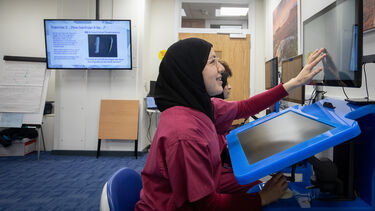
Alongside your clinical placements, you’ll spend a significant amount of time in our clinical skills learning environment and virtual reality (VR) simulation suite. These cutting-edge facilities are fitted with the same equipment used by qualified dental teams, alongside ‘phantom head’ and VR simulators which you’ll use to practise and perfect techniques - from fillings to extractions.
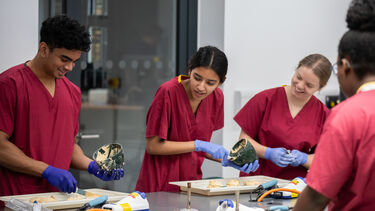
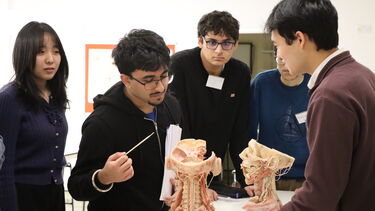
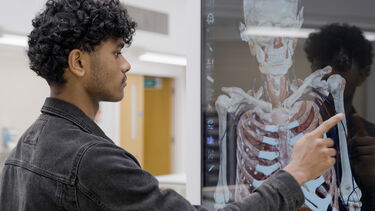
You’ll also benefit from expert-led anatomy and histology teaching, utilising real human plastinated specimens and Anatomage tables, one of the most advanced 3D anatomy visualisation tools available.
Explore our dentistry facilities
These are just some of the facilities that dentistry students can access
University rankings
A world top-100 university
QS World University Rankings 2027 (82nd)
Number one in the Russell Group for student voice
National Student Survey 2026
92 per cent of our research is rated as world-leading or internationally excellent
Research Excellence Framework 2021
University of the Year for Student Experience
The Times and The Sunday Times Good University Guide 2026
Number one Students' Union in the UK
Whatuni Student Choice Awards 2024, 2023, 2022, 2020, 2019, 2018, 2017
Number one for Students' Union
StudentCrowd 2025 University Awards
7th best University for Work Experience
Higherin 2026-27


Fees and funding
Fees
Contact the Student Fees team to check the fee for this course.
Additional costs
The annual fee for your undergraduate course includes a number of items in addition to your tuition. If an item or activity is classed as a compulsory element for your course, it will normally be included in your tuition fee. There are also other costs which you may need to consider. These costs may increase due to price increases outside of the University’s control, if you defer entry or if you choose to change course.
Examples of what’s included and excluded in undergraduate fees
Funding your study
Depending on your circumstances, you may qualify for a bursary, scholarship or loan to help fund your study and enhance your learning experience.
Use our Student Funding Calculator to work out what you’re eligible for.
Additional funding
If you are a UK (Home) student on our dental hygiene and dental therapy course you can apply for the NHS Learning Support Fund to help support your studies, which you won’t need to pay back.
This includes a training grant of £5,000 per academic year, money back for clinical placement travel costs, as well as extra funding for students with dependent children or those facing hardship.
Visit
University open days
We host five open days each year, usually in June, July, September, October and November. You can talk to staff and students, tour the campus and see inside the accommodation.
Online events
Join our online information sessions to find out more about different aspects of University life.
Subject tasters
If you’re considering your post-16 options, our interactive subject tasters are for you. There are a wide range of subjects to choose from and you can attend sessions online or on campus.
Offer holder days
If you've made an application to study with us, we may invite you for an interview. If you are then successful in receiving an offer, we'll invite you to one of our applicant days. These applicant days have a strong department focus and give you the chance to really explore student life here, even if you've visited us before.
Campus tours
Our weekly guided tours show you what Sheffield has to offer - both on campus and beyond. You can extend your visit with tours of our city, accommodation or sport facilities.
Events for mature students
Mature students can apply directly to our courses. We also offer degrees with a foundation year for mature students who are returning to education. We'd love to meet you at one of our events, open days, taster workshops or other events.
Apply
The awarding body for this course is the University of Sheffield.
Recognition of professional qualifications: from 1 January 2021, in order to have any UK professional qualifications recognised for work in an EU country across a number of regulated and other professions you need to apply to the host country for recognition. Read information from the UK government and the EU Regulated Professions Database.
Any supervisors and research areas listed are indicative and may change before the start of the course.