
University renews commitment to Sheffield’s campus trees
The University of Sheffield has published a new Tree Management Strategy, setting out how it will protect, manage and enhance trees across its estate over the next 30 years.

Trees are a vital part of Sheffield’s identity. The city is estimated to contain more than 4.5 million trees, giving it more trees per person than any other city in Europe. As one of the largest landowners in the city, the University has an important role to play in protecting and enhancing this green infrastructure. Trees and green spaces are also an important part of the campus experience, contributing to the character, wellbeing and appeal of the University for students, staff and visitors.
The University currently manages around 10,400 trees across its estate, including major areas of tree cover at Endcliffe and Ranmoor, as well as trees across the main campus, public realm, sports facilities and satellite sites. Our approach is based on caring for trees as a long-term asset. This means protecting our most valuable trees, planting for the future, improving the resilience of our tree stock, and increasing canopy cover where we can.
Over the next 30 years, the University aims to develop a tree and woodland resource across the whole campus that is valued, enhanced and managed sustainably through best arboricultural practice. We will maintain and, where possible, increase canopy cover, favour larger canopy trees in appropriate locations, and work towards a campus that is defined more by soft landscape than hard surfaces.
This supports the aims of the University’s Environmental Sustainability Strategy 2025-2030, which commits the University to becoming a nature-positive institution that protects, restores and enhances biodiversity on and beyond campus. This includes improving the biodiversity value of the existing estate, expanding green and blue spaces, and integrating biodiversity into planning and estate management.
Our new tree strategy sets out an approach across four main aims:
- increasing the genetic diversity of our tree stock to improve resilience to climate change
- increasing overall canopy coverage to deliver ecological, social and economic benefits
- identifying and protecting our most valuable trees for future generations
- promoting trees as a vital asset for research, education, community engagement and partnership working
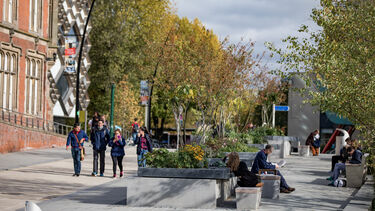
Managing trees across a large and changing urban estate means balancing long-term tree health, biodiversity, safety and the future development of the campus. The University regularly inspects its trees to understand their condition and identify any safety risks, disease or defects. Our 2024 visual tree assessment found that the majority were in good health, with 75% rated as healthy, 23% in fair condition and 2% in critical decline or dead.
We are also proactively managing threats such as Ash dieback, one of the most significant tree health issues affecting the UK. The University currently has 217 Ash trees, with 21 having succumbed to Chalara, also known as Ash dieback, since the disease was first identified on the estate.
While our priority is always to retain and protect trees wherever possible, tree removal is sometimes necessary, including where a tree is diseased, unsafe, reaching the end of its natural life, or affected by major development work. Where trees do need to be removed, the University’s policy is to replace every tree with two new trees, planted in the same location or as close as reasonably practicable.
The new strategy will ensure that as the University shapes its campus for the future, high-value trees will be considered from the earliest stages of design and protected during construction wherever possible. New planting will be carefully planned to support biodiversity, climate resilience, sustainable drainage and long-term canopy cover, helping the University work towards its target to increase canopy cover across the estate by 2% by 2040.
Holly Fisher, Green Space Development Lead at the University of Sheffield, said:
“Trees are one of the most visible and valued parts of our campus, but they need careful, long-term management. Our new tree strategy builds on our existing maintenance work, setting out a more proactive, long-term approach to improving, protecting and planning our tree resource for the future. Our focus is on understanding the condition of our trees, protecting them wherever we can, and making sure new planting is suitable for its location and resilient for the future.
“We know tree removal can be sensitive, and it is never something we take lightly. Where it is necessary, whether because of disease, safety, natural decline or essential development, our policy is to replace each tree with two new trees as close as reasonably practicable to the original location.”
Professor Ruth Blakeley, Institutional Lead for Sustainability at the University of Sheffield, said:
“Trees and green spaces are central to the future of our campus and are a visible embodiment of our commitment to sustainability. They support biodiversity, improve wellbeing, help us adapt to climate change and connect the University to Sheffield’s wider identity as a green city. They are also deeply valued by our students, staff and visitors, and play an important role in making our campus a welcoming and distinctive place to study, work and spend time.”
“This work is an important part of our Environmental Sustainability Strategy and our commitment to becoming a nature-positive university. As we shape our campus for the future, we want nature and biodiversity to be built into our decisions from the start.”
The Tree Management Strategy will be reviewed every five years and supported by action plans, annual reporting and ongoing engagement with staff, students, local communities and city partners.