SSCR gets creative with the Fundamentals of Creative Facilitation!
Kadi and Mari-Liis learned how to create more inclusive, collaborative and engaging environments for research and practice.

In July, SSCR Research Trainee, Mari-Liis Tamm, and SSCR Public Engagement and Involvement, and Co-production Associate, Kadija Bouyzourn, attended Durham University's “Fundamentals of Creative Facilitation” training programme, delivered by the Institute for Medical Humanities' Creative Facilitation Unit. The two-day course brought together researchers, practitioners and professionals from a range of sectors to explore how creative facilitation can help create more inclusive, collaborative and engaging environments for research and practice. Through activities, group discussions and opportunities for reflection, Mari-Liis and Kadija developed practical facilitation skills that they can apply in their own work at SSCR. Mari-Liis and Kadija will present their learning during the SSCR Lunch and Learn event in early 2027.
Summary
- In July, an SSCR Research Trainee and a Public Engagement, Involvement and Co-production Associate attended a learning course at Durham University.
- The course was called Fundamentals of Creative Facilitation.
- Mari-Liis and Kadija learned alongside people who work in universities, charities and local government.
- They learned practical ways to help people work together in groups and make sure everyone has a chance to take part.
- They joined in different group activities and creative exercises to practise leading groups.
- The course helped them build their confidence and develop new skills to run inclusive and engaging group sessions where people feel comfortable sharing their ideas.
Reflections from Mari-Liis
When I found out about the course, I had started planning for a Centre of Care funded project that I am conducting with unaccompanied asylum seeking children, and grabbed the opportunity to attend this course. As a social worker, much of my practice has been on a one-to-one basis, so the idea of leading group sessions felt daunting. I arrived in Durham hoping the course would help me manage my growing anxieties about facilitating focus groups with young people, after spending hours searching for icebreakers and drafting session plans.
I am pleased to say that I left the course feeling motivated, inspired and much more confident about facilitating groups. Rather than simply talking about creative facilitation, the facilitators modelled it throughout the two days, using the same techniques they encouraged us to adopt in our own practice. Experiencing these approaches first-hand made it much easier to understand how they could be used to create comfortable and engaging group environments.
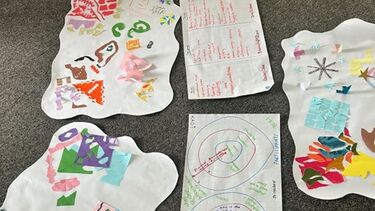
There were many practical ideas that I will take into my own work, from using fidget toys and sticky walls, to simple ways of signalling transitions between activities. Every activity had a clear purpose, and each was followed by time to reflect on how it felt as a participant and how it could be adapted for different groups. One exercise that particularly stood out involved co-producing group agreements, encouraging participants to think about what they wanted the sessions to feel like and what everyone could do to create that environment together.
The course brought together people from a wide range of backgrounds, including local government, charities, universities and the arts sector, with varying levels of facilitation experience. By the end of the course, we had developed a genuine sense of trust and openness, where people felt comfortable sharing ideas, asking questions and respectfully challenging one another. Experiencing this group dynamic as a participant gave me confidence that, with thoughtful planning and the right environment, it is possible to foster the same sense of belonging within the groups I facilitate.
I am incredibly grateful to the SSCR Research Capacity Fund for supporting me to attend this course. It has changed the way I think about facilitation- not as something to feel anxious about, but as a creative, collaborative process. I am excited to take these approaches into my project with unaccompanied asylum seeking children and to create sessions that are engaging, inclusive and enjoyable for everyone.
Reflections from Kadi
As someone whose role at SSCR involves working with public partners, researchers and communities, I was particularly interested in the course because facilitation is central to much of my work. I was keen to think beyond the practicalities of running a meeting or workshop and consider how we can create spaces where people feel comfortable contributing, particularly when participants have different experiences, levels of confidence and relationships to research.
One of the things that stood out to me was how much attention was given to the environment in which participation takes place. The course demonstrated that seemingly small choices, from how a session is introduced to how transitions are managed and how activities are structured, can have a significant impact on how people experience a group. I found it particularly useful to experience the activities as a participant first and then reflect on how they might work with different groups. This reinforced for me that inclusive facilitation is not simply about having a range of activities available, but also about being responsive to the people in the room and creating different ways for people to participate.
The course also made me reflect on the relationship between facilitation and co-production. Good facilitation is not about having complete control over a session or ensuring that everyone follows a predetermined plan. It is about creating the conditions for people to shape the conversation together, while being attentive to whose voices are being heard and whose might be missing. This feels particularly relevant to my work at SSCR, where we are often trying to bring together people with very different experiences and forms of knowledge.
I came away with a much larger toolkit of practical ideas, but also with a different way of thinking about what it means to facilitate. I am looking forward to applying these approaches in my work with public partners and in co-produced activities at SSCR, particularly when designing spaces that are more accessible, creative and comfortable for people to contribute in different ways.