

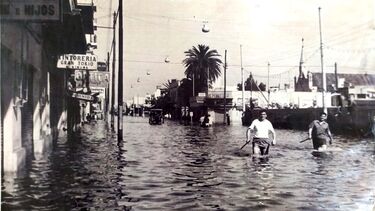
In 1967, a devastating flood in Buenos Aires, Argentina, left dozens of people dead and thousands homeless. Those most affected were the city's poorest residents, living in informal settlements along the river basin. Yet despite its impact, the tragic event remained largely unknown, even to residents living within the city itself.
Last year, through our Grantham Amplification Fund, we supported a research project led by Adriana Laura Massidda that focused on this historical climate disaster. The project sought to understand how urban poverty and ecological vulnerability intersect from the perspective of urban environmental history.
“The project focuses on the 1967 flood in Buenos Aires, with particular emphasis on local experience and from a grassroots angle” explains Adriana. “Our analysis concentrated on the largest informal settlement at the time, Villa Jardín, and its surrounding areas, and from this we constructed an understanding of all the areas affected.”
Using written, visual and oral history sources, most of them scrutinised for the first time, the project explored three inter-related questions:
- Why did Villa Jardín and surrounding areas flood in 1967?
- How did residents' experience of the flood affect their lives and the collective imaginary of the area?
- What does the flood tell us about wider issues of urban environmental justice?
An unknown historical climate disaster
Despite growing up in Buenos Aires, Adriana only first heard of the flood during her doctoral fieldwork and has wanted to focus her research on the event ever since.
“Neither me nor my friends, family and close colleagues (all of us from more central and slightly more advantaged areas of the city) had ever heard about it. When talking to long-time residents of the Riachuelo river basin, in contrast, and especially when mentioning the 1960s, the flood was the first that would come to their minds, as it had changed their lives in a matter of hours.”
“The intensity of local enthusiasm that we found upon starting this project confirmed, and exceeded, my expectations from doctoral fieldwork. Older residents who had experienced the flood were incredibly keen to discuss it, to share their memories and their anger, to make their viewpoints known. It was almost a cathartic exercise. Younger local generations, who had heard about it in passing but without much detail, were extremely intrigued by it and keen to learn more about what their parents, grandparents and neighbours had gone through. Finally, for the project's academic and artistic collaborators who (like me) came from other urban areas and were completely unaware of the flood, it was a journey of discovery.”
Raising awareness of the floods
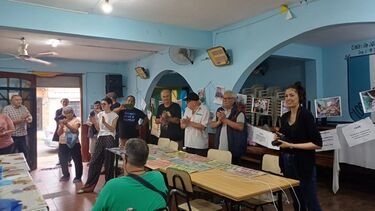
The project involved hosting a series of regional exhibitions featuring newspaper articles, unpublished photographs, personal collections generously shared by residents, and a rich archive of oral histories.
“I wanted to both give back to the local residents who took part in the project and to make this event known to a wider public” said Adriana. “We wanted to give back locally by first, reflecting back the results and sharing them with those who shared their testimonies; and, secondly, by constructing the inter-generational exchange that everyone was so keen on. In all cases, me and my collaborators wanted to both reconstruct the flood but also to use this to discuss wider urban, political and environmental injustices.”
Why research like this matters
To Adriana, research into events like this is vital if we are to understand the realities of climate inequality.
“We are going through a global climate crisis, but this does not affect all of us in equal measure. As the proverb says, 'a rope breaks at its thinnest part', and so it is the poor and the oppressed -- those who have been historically displaced from the best land, from suitable infrastructure and from decision-making power -- who suffer its consequences most deeply. The ecological systems around them bear this heavy burden as well. Climate disasters reflect these inequalities in a particularly clear way: by studying them, we can see how environmental and socio-economic disadvantages are closely entangled.”
How the Grantham Amplification Fund helped
Following initial support from the British Academy/Leverhulme Small Research Grant, which covered two foundational exhibitions, the Grantham Amplification Fund allowed the team to expand the project’s reach.
“First, following on from the project's success, we had been invited to display the material in a third location this coming October, in the city centre. Through the Grantham Amplification Fund we could hire two exhibition designers who drafted ideas to bring the material from one scale to the other. Moreover, the visual repositories we found exceeded our expectations and we were keen to produce a freely-available, open access catalogue of the exhibition material. Through the Grantham Amplification Fund, we could hire a designer and editor who produced this, and a small amount of hard copies which were distributed as a thank-you gift among project participants.”
What is next for the project?
The third and final exhibition will take place in September 2026, but the team is already planning further research.
“We are currently writing a grant bid for a larger project which follows on from this one. Focused on the flood's aftermath, it expands its reach to also analyse two later floods in the city, and it deepens our inquiry on the political, spatial and cultural dimensions of so-called 'natural' disasters in low-income urban areas.”
The project was just one of 14 innovative sustainability research projects which received funding through the Grantham Amplification Fund Initiative.