
PRO-FIT
PRO-FIT: Participatory Research for Optimising Faecal Immunochemical Test returns, enhancing bowel cancer detection and addressing health inequalities

About colorectal cancer (bowel cancer)
Colorectal cancer (also known as bowel cancer) is the 4th most commonly diagnosed cancer in the United Kingdom. Approximately 44,000 new cases are diagnosed each year. It costs lives and is the second-highest cause of cancer mortality. When detected early, colorectal cancer is treatable and saves lives. Diagnosis at the earliest stage (stage 1) is associated with a good outcome, with a 95% five-year survival rate. However, when diagnosed late (stage 4 being the latest), the survival chances are reduced to 10%. Therefore, it is very important to diagnose and treat colorectal cancer at the earliest possible stage to ensure the best outcomes.
Detecting colorectal cancer
Colorectal cancer is mostly detected in people with bowel-related symptoms following Primary Care (GP) consultations (67%) or when they attend Accident & Emergency presenting with an emergency (23%). Only 10 % of all colorectal cancer cases are detected in people without symptoms (asymptomatic) through the national bowel cancer screening programme.
FIT kits and challenges with completion of tests
The Faecal Immunochemical Test (FIT) is a simple test for detecting microscopic levels of blood in the stool, which can be due to benign polyps or an early sign of bowel cancer. It is not a diagnostic test for cancer and is only used for triaging those who need further investigations if the test is positive. It comes as a simple home-testing kit, which involves collecting a small sample of stool in a tube and sending it for processing. Though it is a simple home testing kit, people sometimes face challenges, including concerns of hygiene and having anxiety regarding a potential diagnosis of cancer.
Approximately 30% of the colorectal cancer screening FIT kits and 10% of the FIT kits distributed to people with symptoms are not returned, which equates to approximately 2,120,000 FIT kits not being used each year. This implies that approximately 2.1 million people in the United Kingdom are missing out on an opportunity to have any colorectal cancer detected at an early stage.
Research has shown that there is a variation in the uptake of the FIT kits. Certain population groups of people may face additional challenges and have been shown to have a poorer uptake of FIT, leading to a health inequity as they miss the opportunity of an early diagnosis and tend to present later, which results in poorer outcomes and survival.
Aims of the PRO-FIT study
The PRO-FIT study aims to explore and understand the additional challenges faced by specific underserved population groups comprised of the following:
- People from Black African/Caribbean backgrounds
- People from White working-class backgrounds
- People from South Asian backgrounds
- People living with complex mental health issues
This research project aims to develop and evaluate methods for effectively engaging underserved groups in co-producing a community-based intervention to improve faecal immunochemical test (FIT) uptake and return.
Objectives:
- Build robust and sustained partnerships with diverse and underserved communities to address the barriers in FIT access and uptake and reduce the resulting health inequities.
- Understand the challenges and barriers to the use of FIT kits among underserved groups.
- Co-produce a tailored intervention package along with the stakeholders and create an implementation plan which integrates evidence, behaviour change theory and lived experiences.
- Establish a roadmap for inclusive, ethical engagement of underserved populations in research to enhance FIT reach, uptake, and impact.
Study design
The PRO-FIT study consists of three interlinked work packages:
Work Package 1: Building and developing community partnerships
This work package involves engaging with underserved community groups, forming sustained relationships, establishing a Patient and Public Involvement Panel. It also involves the recruitment of Community Research Link Workers and a Lived Experience Research Link Worker.
Work Package 2: Participatory systems mapping
This work package involves conducting workshops with members from different underserved communities locally and healthcare professionals to map the current system and identify barriers to using the FIT. It also involves developing a Theory of Change and Logic Model.
Work Package 3: Co-production of the intervention
This work package involves systematically reviewing the current research literature evidence on ways of improving FIT kit returns. It also involves working with community members and healthcare professionals over several workshops to co-design a new intervention to address FIT uptake and returns, refine the intervention package and implementation plan.
Link Worker Bios
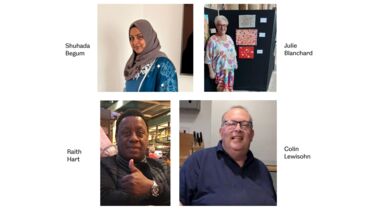
PRO-FIT has a wonderful team of Community Research Link Workers (CRLWs) and Lived Experience Link Workers (LELWs) leading collaboration between the project team and their respective underserved communities and groups. Several of them have written a quick word about their role in the project and their wider experience with community-focused research as a whole.
Shuhada Begum, CRLW for the South Asian community
My name is Shuhada Begum, I am the Community Research Link Worker for the South Asian Community. At present I am working on a few projects with The University of Sheffield, this is a great opportunity to be a voice for the South Asian Community, to give as well as spread the word about the research work The University of Sheffield are doing. My past careers have always involved me working with all types of communities and this particular job is helping me to shape a future for the coming generation. Being a mum of three it is very important that we help the younger generations to have the right information and the right treatments for them. It makes me proud to be involved in research that the coming generations can benefit from.
Raith Hart, CRLW for the Black African and Caribbean community
Raith Hart has over 30 years’ experience as an environmental consultant and is a CRLW based in South Yorkshire. Since 2022, he has been actively involved in public and patient involvement (PPI), mental health research, and community engagement. Raith has worked with organisations including the University of Sheffield and Sheffield Teaching Hospitals NHS Foundation Trust, contributing to cultural competence training, reverse mentoring, and PCREF projects. His work has been recognised with an award for impact, and he currently serves on the REMAP Steering Group and Advisory Board and PRO-FIT supporting diverse and representative public involvement in research. He is also a CRLW on a partnership project with SACMHA and the Yorkshire Adoption Agency.
Julie Blanchard, LELW for the Complex Mental Health Issues group
Colin Lewisohn, LELW for the Complex Mental Health Issues group
Funding
PRO-FIT is funded by the NIHR (National Institute of Health and Care Research) Programme Development Grants (PDG).
Project start and end dates: 1st April 2025 to 31st March 2027.
Research team
| Name | Role | Institution |
|---|---|---|
| Dr Matthew Kurien | Chief Investigator and Senior Clinical Lecturer in Gastroenterology, Honorary Consultant Gastroenterologist | University of Sheffield |
| Ms Naseeb Ezaydi | Project Manager, Research Associate | University of Sheffield |
| Ms Katie Biggs | CTRU Assistant Director | University of Sheffield |
| Prof Ian Kellar | Professor of Health Psychology | University of Sheffield |
| Ms Jennifer Brown | Senior Lecturer | University of Sheffield |
| Dr Kate Fryer | Research Fellow | University of Sheffield |
| Dr Savita Shanbhag | GP Cancer Lead, Primary Care Expert | Hywel Dda University Health Board |
| Prof David Humes | Professor of Colorectal Surgery, Expertise in FIT Implementation | University of Nottingham |
| Ms Jackie Hatton | PPI Co-applicant | University of Sheffield |
| Dr Nupur Chowdhury | Research Assistant | University of Sheffield |
| Mr George Cleaver | Trial Support Officer | University of Sheffield |
Contact us
You can get in touch with the programme team via: