
Can ventilatory technology change the future?
By Suzanne Glover
- In this post Suzanne shares her experience of speaking to representatives from parliament in Northern Ireland about the urgent need for newborn screening for Spinal Muscular Atrophy (SMA).
- The piece reflects on Suzanne’s recent visit to the Stormont Buildings to deliver her important message.
It focuses in particular on how Suzanne’s mouthpiece ventilator supplemented her breathing and enabled her to speak continuously to share her experiences as someone living with SMA.
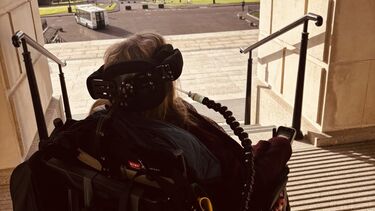
Imagine being in a loud, busy room surrounded by the very people who decide how a country is run. You have a message that could change lives, but you don’t have enough air to share it clearly and confidentiality.
Frustrating? Embarrassing? Lonely? It is all of those things. But on Monday, 3rd November 2026, I realised my new ventilation actually made things a little easier.
Northern Ireland Falls behind the rest of the UK
I had the honour of attending the Stormont Buildings, the home of Northern Ireland politics. Invited by Muscular Dystrophy UK for an event organized and funded by Novartis—and supported alongside SMA UK—my purpose was clear: to speak directly to Members of the Legislative Assembly (MLAs) about the urgent need for newborn screening for Spinal Muscular Atrophy (SMA).
The landscape across the UK is shifting rapidly, but unevenly:
- Scotland: Rolled out SMA newborn screening in March 2026, and the first baby has already been successfully identified and treated.
- England: Currently implementing a phased national rollout.
- Wales: Committed to making the structural changes necessary to enable testing.
- Northern Ireland: Regrettably, no active plans or timelines have been made to join the rest of the UK.
Newborn screening requires adding a specific SMA test to the routine heel-prick sample taken days after birth. Diagnosing SMA at this stage allows babies to receive disease-modifying therapies before major symptoms appear, dramatically reducing the medical complexities of living with the condition.
I am proud to have SMA—it has shaped who I am today. But advocating for future generations so they might face fewer chest infections, fewer surgeries, less pain, and reduced muscle weakness is a cause I will wholeheartedly advocate for.
The Power of the Breath Behind the Voice
At 1:00 PM on 3rd November, I had the opportunity to deliver this message directly to the Health Minister for Northern Ireland and MLAs across all political parties. For three and a half hours, until 4:30 PM, I spoke continuously—sharing the reality of life with SMA, explaining the science of early intervention, and reinforcing just how time-critical this decision is.
Not that long ago, a marathon speaking effort like that would have been physically impossible for me. I didn't have the lung capacity to project my voice clearly in a crowded room, nor did I have the stamina to sustain hours of non-stop talking.
That changed just over a year ago when I took the leap toward using daytime ventilation—specifically mouthpiece ventilation (MPV). Mouthpiece ventilation delivers a targeted sip of air whenever I need it, supplementing my breathing.
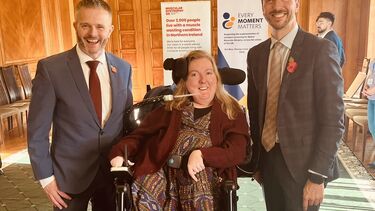
Changing the Future, One Sip of Air at a Time
So, can ventilatory technology change the world?
When a piece of ventilatory technology gives someone the physical breath needed to speak to the Health Minister and colleagues to advocate for life-saving policy changes, the answer is an absolute yes.
However, we still need to recognise that there are issues of inequitable access here. Many people do not get a say when it comes to policy-making for sure, but quite specifically, the ways in which these parliamentary meetings are arranged (in-person, big room, background noise, limited ways to speak or use voice beyond spoken word) means that even if you get a seat at ‘the table’ for some people, being heard is a mammoth challenge. Do we need to find ways to hold and facilitate these meetings so that quieter voices can be heard more comfortably? Absolutely, yes we do.