
Blog post #26 Round up! Disability Studies Conference 2026
By Julie Ellis and the Cripping Breath Team
In this post we will tell you about the Cripping Breath work we presented at the Disability Studies Conference in April.
We also offer some reflections from members of our community researcher team about being part of the conference as virtual attendees.
The biennial Disability Studies Conference hosted by the Centre for Disability Studies at the University of Leeds is always an exciting event for scholars, researchers and activists working in the field. But for the Cripping Breath team, the recent 2026 conference was particularly special! Not only did we have the opportunity to give two presentations about the work we have been doing in our narrative and arts streams, our very own Principal Investigator Kirsty Liddiard gave the conference’s opening keynote lecture!
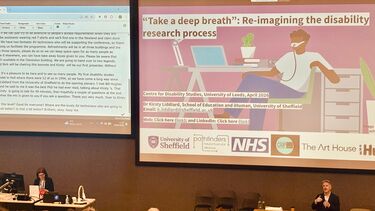
This is what she had to say about the experience:
“Giving a keynote at the conference (available here) was a wonderful opportunity to share the brilliant work going across the project, but for me personally was quite a full circle moment: I gave my very first ever conference talk as a very nervous PhD student in 2010, when this conference was based at Lancaster. I met so many wonderful people who went on to shape and support my career, so it was quite surreal to be back there as a keynote speaker! In essence, I was so proud to share our work in the project, and so grateful to the team for your support, kind messages and notes - all of this gave me so much confidence on the day. We also had such lovely feedback from audience members too, which can serve as a reminder that our team, and our research, are unique and have so much to contribute”.
As Kirsty explains, this was a wonderful opportunity to talk about our collective efforts on Cripping Breath, but being invited to speak at such a vibrant disability research event is also a reflection of the important contribution Kirsty’s work and collegial leadership is making to rethinking research processes and coproduction across the field of disability studies more broadly. So for this personal achievement we say… ‘go Kirsty’ and echo the words of Mitch, a community researcher: “a big thank you to Kirsty for showcasing what it means to be a lived experience researcher”.
Now to Jen and our narrative work stream. Jen represented the Community Researcher Co-operative, presenting on ‘Cripping Breath: Co-production, community and complexity’. The talk reflected work in progress on a planned journal article, which aims to provide insightful and practical ‘useful lessons’ based on the experience of being community researchers in academia. This will be a co-written piece, based on a collaborative process, led by Suzanne (our lead community researcher), in which community researchers share their thoughts on co-production and reflect on their positionality as community researchers, both researching and living with respiratory illness. At this stage in the process, community researchers have met for two co-writing sessions to talk about their experiences, and Suzanne is organising these reflections and teasing out what are the broader useful lessons we can take from our work so far.
In the paper presented at the conference, Jen provided some background on co-production, slow scholarship and co-writing, shared thoughts from community researchers (including videos provided by Amanda and Conor), and summarised some of the useful lessons Suzanne is in the process of developing, based on insights from community researchers. We highlighted the importance of understanding the motivation (and hesitancy) of community researches applying for projects such as Cripping Breath (and the full paper will include more on institutional barriers in this regard); the need to design research around the team, considering accessibility, flexibility and inclusive ways of working; how we can embrace and crip ‘slow scholarship’ (and the importance of allowing unstructured time to share experiences and listen to each other); and the significance of positionality, as literally living and breathing the work of the project requires a care-ful approach. It was great that the paper was well-received by attendees, who are interested in reading more about our work on co-production, and any practical resources we develop as part of this project - so watch this space!
Our presentation from the arts team also had a focus on narratives - specifically medical ones. In their talk, Grace and our artists in residence, Louise and Jamie explored how measuring lived experiences of breathing through creative methods resituate disabled people within their own medical narratives. In an audio clip, which we included in the presentation, Jamie thinks through the practices that support their professional work: their breath work as a poet, performer, and director. These are the experiences by which, in part, we describe and know our relationships to respiration. Jamie brings this self-knowledge into dialogue – and tension – with clinical knowledges. They introduce the way that, in a clinical setting, information about the body derived from artistic pursuits is received as subjective, and therefore unreliable. You can listen to Jamie’s reflections here.
It was also great to reflect with community researchers who attended part of the conference virtually and accessed some of the recorded sessions.
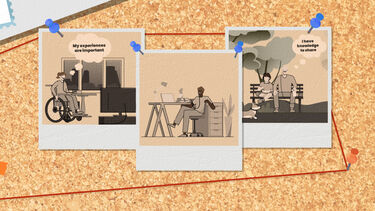
Amanda really enjoyed hearing Kirsty’s keynote and being able to read the titles of all the papers being presented at the conference and the recorded sessions. For Suzanne it was the second time she had attended the conference and she said:
“It felt even more exciting this year as so many of my colleagues were presenting our work as well as some having the opportunity to meet face-to-face. The conference opened with Kirsty's keynote, "Take a breath: Reimagining the disability research process" which illustrated co-production in a light that captured the bits we don't often speak about – the intimate relationships developed through research and how we can create spaces where disabled bodies are valued rather than suppressed or forced to adjust. I felt incredibly honoured and proud to be a small part of this work and hope that we continue to evolve genuine co-production. In the future, it would be even more inclusive if those accessing the conference remotely could have the opportunity to watch and participate in live seminars and networking opportunities. I hope that funding to enable these sorts of opportunities is part of someone's initial research plans, as I write this!”
Like Suzanne, Mitch would have liked to be able to see more of the conference live-streamed and he also reflected on the importance of in-person involvement at similar events:
“I appreciate that funding and things like that for these events can be tricky to secure, however it would be great in future if we were able to attend a conference such as this in person”.
Mitch’s reflections on language use and access in academic spaces are really important too. He said:
“I got to see Kirsty's presentation and I'm always impressed by Kirsty's work. It was detailed, but really stayed on topic and I found myself still engaged at the end of the presentation, which isn't always the case at some of these types of events. To me language was really important and I felt like it was accessible in that way. There were some other good sessions, although there were times where I felt my brain was filled with jargon a little bit, and I had to step away for a while”.
Thanks to our friends in Leeds for hosting the event and we look forward to bringing more news to future conferences as Cripping Breath develops.