
Blog post #24 Toward an Accessible Method: Theatre, Breath and Disability
By Jamie Hale

- In this blog post, Artist-in-Residence Jamie Hale reflects on the work of theatre collaborators in the Arts Stream of the project.
- Our theatre collaborators are Kate Mellor, Stephanie Castelete-Tyrrell, and Tatum Swithenbank, and our Research Associate Grace Joseph has been co-leading this work.
- Jamie reflects on developing the play, theatre workshops, and creating community.
- Jamie explores the meanings of co-creating access and Crip-centred spaces.
The Theatre Collaborators stream of Cripping Breath is almost at the half-way mark of our series of thirteen workshops exploring breath and ventilation through the lens of Romeo and Juliet, and I wanted to reflect on what we’ve done and learned thus far.
We are using these workshops to prepare for a performance of Romeo and Juliet which draws on themes of breath and ventilation - and disability more widely - to look at the play through a lens of autonomy, infantilisation and independence. In doing so, we talk through breath and ventilation and their roles in our own life as people who will use, use, or have used ventilation. We’ve done everything from reading round the table to voice workshops, and have a movement workshop coming up next. We’ve found parts of the play that speak to us, and through that, talked about how we relate to ventilation ourselves. In discussing the ending of Romeo and Juliet, we’ve discussed grief, social expectations, and assisted suicide/dying.
For me, the work we’ve done around the play has been one incredibly valuable thing, but another equally valuable thing has been the community that we’ve created. It’s been wonderful to take turns opening the door for one another, passing things, setting up computers, without any patronising or do-gooder energy, just a case of those who can, doing what they can for those who need it, with no pressure or demand. To be able to chat in a space where everyone shares similar experiences and nothing you say will be new. To have the power to bring in a ventilator of a different model and have someone else try it and get the chance to get used to it before their clinic swapped them over. To figure out wheelchair mounts for tablets for scripts as a group of wheelchair users. To work out how to build a custom voice amplifier. So many possibilities, when a group of disabled people come together.
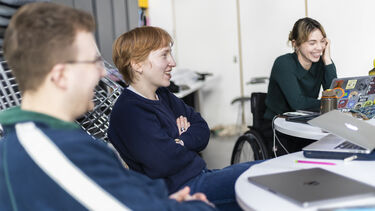
It’s been in Romeo and Juliet as it becomes a play that the magic appears. Conversations with Kate about world-design and stage size sparking ideas about how I would create the piece. Watching Steph and Tatum move away from the scripts and start to embody their roles and their connections as Romeo and Juliet themselves - the chill of watching as someone speaks their death into being. But that magic would not appear without the workshops discussed above, in which we all brought our experience together and tenderly laid it bare for everyone else to experience; and it certainly would not appear without those moments of social bonding that brought us all together.
Developing the play is going exceptionally well. We've pulled together three scenes that show the arc of Romeo and Juliet which can be staged, eventually we hope, as a short piece. This will open up space for discussions about our experiences of breath, ventilation, and disability more widely in relation to Romeo and Juliet. As well as those three scenes, we're also learning the rest of the play and preparing to stage it at the Barbican in May 2027. Those scenes will remain the core of it, but they will be developed out with a full-size cast.
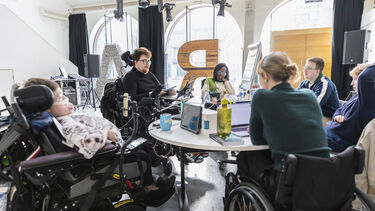
I want us to do this Romeo and Juliet properly, and for me, a big part of doing it properly is developing some kind of a method which understands, encompasses, and meets everyone's access needs. That's no small ask in a cast like ours - but to me, doing it properly means that nobody is left needing support in the rehearsal room that they did not get. Therefore, that is central to how we go about creating the process and the piece: rehearsal days that don't drain, exhaust, and break you down before building you into a performance, but that instead nourish, refill, and refurbish. Exactly how we do this with limited timelines and limited budgets is a question that is still seeking an answer, and a question that we are still working on, but for me it would be a creative failure if access wasn’t properly incorporated. Incorporating it with a large-scale cast and team is going to be a whole new experience, but one I’m excited to take on.
It’s a privilege to be working on Cripping Breath, to be working in genuinely crip-centred spaces, and to be creating work in those spaces. To be working with all the collaborators I am, on all the projects I am, and to be looking at the future of working together on this the way that I am.
Thank you, everyone.