
Collaboration rapidly develops rare-earth-free materials
Alloy Development and Characterisation collaboration supports groundbreaking work for Materials Nexus to predict material properties and reduce reliance on rare earth materials.
British firm, Materials Nexus (operating as MatNex) has developed an AI-powered materials discovery tool that combines first-principles physics and machine learning to accelerate the design of sustainable, high-performance materials. Earlier work used the platform to guide development of rare-earth-lean and rare-earth-free magnets (including work under the “MagNex” banner). With an initial focus on magnets, the platform has screened well over 100 million compositions to address industry needs around supply-chain security, cost, performance and environmental impact-compressing discovery timelines that historically took decades.
Rare earth magnets are an essential component to motors in electric vehicles (EVs), wind turbines and all sorts of other electrical equipment. As we move to more sustainable sources of power generation and cleaner vehicles the demand for these magnets is expected to soar, with the EV industry usage expected to “rise tenfold before the end of this decade” (The Independent, 19 June 2024).
Rare earth materials are concentrated in China, subject to supply chain disruptions often caused by geopolitical tensions, and their extraction is dangerous to individuals and the surrounding environment due to carbon emissions and the mining process. Conventional processes to discover new materials are slow and often based on a trial and error method, but MatNex developed this magnet in just three months using their AI programme.
Project DREAM overview
MatNex and the team at Royce at the University of Sheffield partnered on DREAM, an Innovate UK–funded programme to accelerate the discovery of rare-earth-free permanent magnets using an AI-driven, physics-informed workflow. By chaining multiple levels of Density Functional Theory/Molecular Dynamics and related models to generate high-fidelity synthetic data and feeding those data into machine-learning models, the project demonstrated a practical path to compress materials research and development timelines from ~5 years to ~1 year.
Across the year of collaboration, the platform produced shortlists of candidate alloys at three-month intervals. The team at Royce at the University of Sheffield synthesised the suggested compositions, post-processed the samples and measured their structures and magnetic properties, with results flowing straight back into the platform so the next round of predictions could be more targeted. In the final three months, the partners produced a mini-scale demonstration of the leading candidate using additive manufacturing to assess manufacturability alongside intrinsic performance.
What changed for both teams
For Materials Nexus, DREAM was an opportunity to refine the discovery pipeline under real laboratory constraints. The project helped the team identify which model strategies worked best, where uncertainty was highest and how to package recommendations so they are directly actionable in the lab. For the Royce team, the programme exercised a rapid “design–make–test–learn” rhythm, building capacity to evaluate, iterate and validate new magnetic materials much faster than conventional trial-and-error approaches.
Impact
The project demonstrated that combining physics-based modelling with machine learning and tightly coupled experimentation can shorten development cycles dramatically while improving the quality of candidates that reach the lab. By including guidance on likely phases and processing windows, the platform reduced dead-ends and focused experimental time on alloys with the best chance of success. The additive-manufacturing step provided early insights into scalability and process robustness, bridging the gap between small-scale samples and practical components.
What’s next
Building on the DREAM results, the partners plan to scale up the most promising composition and extend the platform to a wider set of chemistries and processing routes. We will also strive to tighten the feedback loop between prediction and proof. The end goal is to deliver manufacturable, rare-earth-free magnet options to industry at a lower cost and with a smaller environmental footprint.
The combination of Materials Nexus’s approach of using AI for materials discovery and the world-class facilities we have for manufacturing advanced alloys in the Henry Royce Institute here at Sheffield has allowed a novel magnetic material to be developed with breathtaking speed. This achievement showcases the bright future of materials and manufacturing. The next generation of materials, unlocked through the power of AI, is highly promising for research, industry, and our planet.
Professor Iain Todd
Royce Partner Lead at the University of Sheffield
Equipment used
- Casting facilities (Arc-melter, VIM)
- Post-processing (Furnaces, HIP)
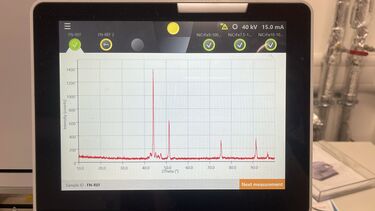
- Analysis (XRD, TGA, DSC, SQUID)
Access schemes
- Innovate UK Grant - Project DREAM