Decades-old DNA mystery solved after strands are captured zipping together for the first time
Researchers have captured the moment two DNA molecules zip together, overcoming their identical negative charges to pair up, solving a mechanism that has puzzled scientists for more than 20 years

- Two DNA double helices have been visualised locking together, the first time this fundamental biological process has been captured
- Using high-powered atomic force microscopy, researchers from the University of Sheffield and the University of York have solved a decade-old mystery on how DNA molecules overcome their identical negative charges to pair up
- Advanced computer simulations revealed that positively charged metal ions act as tiny molecular bridges, nestling inside the grooves to lock the two strands together
- This discovery could help researchers identify regions of the genome specially involved in DNA pairing, which may become particularly important when mutations disrupt normal cellular processes and contribute to cancer
Researchers have captured the moment two DNA molecules zip together, overcoming their identical negative charges to pair up, solving a mechanism that has puzzled scientists for more than 20 years.
Using high-powered atomic force microscopy, scientists at the University of Sheffield and the University of York directly imaged two DNA double helices locking together, the first time this fundamental biological process has been visualised.
Like charges normally repel one another, yet DNA molecules must pair up inside living cells to carry out essential biological processes. This pairing plays a crucial role in genetic recombination, gene silencing, chromosome packaging and the development of cancer.
The researchers observed short DNA fragments matching up with exact precision, groove for groove. Advanced computer simulations revealed that positively charged metal ions, including nickel, magnesium and calcium, act as tiny molecular bridges, nestling inside the grooves to lock the two strands together.
Dr. Thomas Catley, co-lead author from the School of Chemical Materials and Biological Engineering at the University of Sheffield, said: “To be able to directly visualise this long-hypothesised mechanism for the first time was incredible. The advanced imaging techniques at our disposal have allowed us to uncover these key DNA interactions which have implications in many key cellular processes. It opens the door to studying other DNA interactions that, until now, have only existed as theory.
“Hopefully, these programmable interactions could eventually help engineers design custom DNA structures for future biotechnology, such as DNA origami and shed light on how DNA is actually packaged inside cells.”
Professor Agnes Noy, from the School of Physics, Engineering and Technology at the University of York who co-led the research, said: “This discovery could help researchers identify regions of the genome specially involved in DNA pairing. These regions may become particularly important when mutations disrupt normal cellular processes and contribute to cancer.”
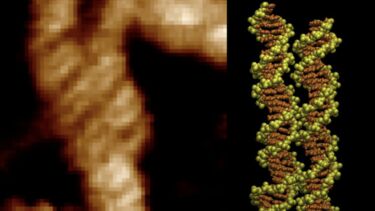
The findings confirm a theory dating back more than two decades known as the “DNA zipper” model, originally proposed by Professor Alexey Kornyshev from Imperial College London and his collaborators. The model suggested that surrounding salt ions create alternating charge patterns, allowing DNA molecules to line up like interlocking spiral staircases.
To test this, the team used atomic force microscopy to scan DNA samples and build topographical maps. At the same time, detailed computer models tracked the movement of individual atoms and ions. They discovered that double-charged metal ions act like two charged arms, holding both DNA strands simultaneously across the gap.
Dr. Victor Velasco-Berrelleza, first author from the University of Sheffield's School of Mathematical and Physical Sciences, who led the computer simulations and analysis, added: “While microscopy can show us what happens, it’s the simulations that allow us to uncover the molecular mechanism behind it. This mechanism could be another tool in the DNA regulatory toolkit, where some DNA sequences may not encode proteins but could instead influence where DNA molecules interact with each other, helping the genome form higher-order structures such as chromosomes.”
The team also discovered that DNA pairing is not uniform. Certain DNA sequences form much stronger contacts than others, creating specific hotspots where two helices are particularly likely to align.
The project demonstrates how curiosity-driven research can align with wider societal priorities.
The study, Imaging and mechanism of DNA–DNA recognition mediated by divalent ions, is published in the journal Nucleic Acids Research.