
Award-winning writer Johny Pitts and space exploration pioneer Sue Horne receive honorary degrees from University of Sheffield
Presenter, writer and photographer Johny Pitts and space exploration pioneer Sue Horne will receive honorary degrees from the University of Sheffield, in recognition of their outstanding achievements and contribution to society

- Award-winning writer Johny Pitts, will be made an Honorary Doctor of Letters by the University of Sheffield this week (Wednesday 22 July 2026) in recognition of his work exploring African-European identities and documenting the Black experience across Europe
- Space exploration pioneer, Sue Horne, will also receive an Honorary Doctor of Science (Wednesday 22 July 2026), in recognition of her work championing the UK's Mars science community over the last two decades
- Drawing on a journey that took him from a working-class upbringing to some of publishing and broadcasting's biggest stages, Johny Pitts has offered graduates advice on navigating imposter syndrome and unfamiliar institutional spaces
- As a long-time advocate for women in STEM, Sue Horne has offered her top tips on breaking into the space sector for the next generation of scientists
Award-winning writer Johny Pitts and space exploration pioneer Sue Horne will receive honorary degrees from the University of Sheffield, alongside the latest cohort of graduating students.
The self taught writer, photographer and broadcaster Johny Pitts, will be made an Honorary Doctor of Letters on Wednesday 22 July, in recognition of his work exploring African-European identities and documenting the Black experience across Europe.
Born and raised in Sheffield, Johny is the curator of Afropean.com, an award-winning digital platform and multimedia project that maps, explores, and celebrates the African diaspora in Europe. His book, Afropean: Notes from Black Europe, won the 2020 Jhalak Prize, the 2020 Bread and Roses Award and the 2021 Leipzig Book Award for European Understanding and has been translated into eight languages.
It's a career that has taken him from a working-class upbringing to some of the most prestigious stages in publishing and broadcasting, a journey that shapes the advice he now offers graduates navigating imposter syndrome and unfamiliar institutional spaces.
He said: “Slowly over the years I've noticed that the very things that used to make me feel like an imposter now imbue me with a sense of self-confidence. If you are from a working-class background or disenfranchised community, and you find yourself in an exclusive or prestigious environment , you know why you're there, and it usually isn't because of money or nepotism. To carry that journey with you, to be rooted in but not restricted by a peripheral space, and be a bridge between worlds, is the highest calling. We are roses blooming through concrete.”
As a photographer, Johny's work has featured in solo exhibitions at FOAM in Amsterdam and The Photographers' Gallery in London. As a broadcaster, he has presented for MTV, ITV and the BBC, and currently hosts Open Book on BBC Radio 4.
Reflecting on his connection to Sheffield, he said: “No matter where I go, or what kind of creative work I do, the atmosphere of a midweek afternoon in Sheffield, especially in the city's hinterlands, is something that always inspires me. I yearn for that unhassled state in which the pressure is off, and nobody is looking. Sheffield is a city like that; it doesn't ask you for anything, just that you drop your shoulders and stay down to earth.
“The poet Robert Frost wrote that "Home is the place where, when you have to go there, they have to take you in", and I sense that even for people who weren't born and raised in Sheffield, the city offers the feeling of being home, for however long you want to stick around.”
Also receiving an honorary degree on Wednesday is space exploration pioneer Sue Horne, who will be made an Honorary Doctor of Science, in recognition of her work building, shaping, supporting and championing the UK's Mars science community over the last two decades. She said: "An honorary degree particularly from Sheffield means so much to me. I am so proud about how the space community has developed, what they are achieving, and that they think I have helped them achieve their ambitions is brilliant."
Thanks to her efforts, the UK is a world leader in Mars research, and she has been a driving force behind the UK's flagship Mars rover, Rosalind Franklin, due to launch in 2028. She has received an MBE for services to the Space Science Programme and to education.
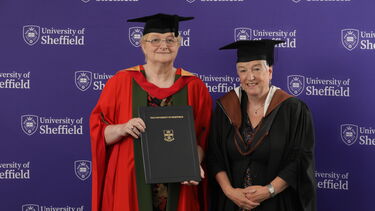
As Head of Space Exploration at the UK Space Agency for over 10 years, Sue was responsible for developing the strategy for, and managing, the UK's involvement in the international space exploration programme. This included UK participation in the European Space Agency Exploration Programme, building scientific instruments in industry and universities, developing technology for future programmes, and outreach activities.
Now retired, Sue continues to support the next generation of scientists, advocating for women in STEM and campaigning for systemic changes such as part-time funding flexibility for female researchers. Offering advice for getting into the space sector, she said:
“Go for it. The space industry wants good people, being good is what matters to them. In the past I have found myself the only woman in the room but I have never found this to be a problem with the space industry. I have also found that once there is one woman, it encourages other women into the field. So, if you are the only woman, remember you are opening the way for others.”
She continued: "Space is a very open industry. It is not bad for something to go wrong, but it is unforgivable not to be open to learning why it went wrong and how to improve. Space is about teamwork so make sure to understand your strengths and weaknesses. Then you can build a team that covers your weaknesses. Final piece of advice: learn how to give a Paddington hard stare - it saves on arguments."
Other honorary graduates
Johny Pitts and Sue Horne will be joined by three other esteemed individuals, who will all be recognised throughout the week for their own unique contributions to Sheffield and their wider fields.
Paul Blomfield
Paul Blomfield will be receiving a Doctor of Letters.
A tireless campaigner and powerful advocate for the city of Sheffield and Higher Education, Paul Blomfield served as MP for Sheffield Central from 2010 until he stepped down ahead of the 2024 general election. During that time, he led several cross-party groups including being Chair of the All-Party Parliamentary Group on International Students, Co-Chair of the Group on Students and Vice Chair of the Group on Universities.
In 2015 he was named The Guardian’s ‘most inspiring leader in higher education’. A shadow Brexit minister, working alongside Keir Starmer, from 2016 to 2020, he subsequently served on the Health and Social Care Select Committee, contributing to its inquiry into assisted dying.
Before entering Parliament, Paul spent many years as the General Manager of the University’s Students’ Union, where he was responsible for establishing and maintaining its position as one of the leading Students' Unions in the UK, winning numerous awards.
Geoffrey Garnett
Geoffrey Garnett will be receiving a Doctor of Medicine.
Alumnus Geoff Garnett is a leading name in global health and disease control. Based in Seattle, he currently serves as Deputy Director for Global Health on the TB and HIV team at the Bill & Melinda Gates Foundation, his work focuses on improving the efficiency and effectiveness of healthcare delivery.
Before joining the Foundation, Geoff was a Professor at Imperial College London, researching the epidemiology, evolution and control of HIV and other sexually transmitted infections. His work combines mathematical modelling of the transmission dynamics with methods for evaluating the impact, effectiveness and budget impact of interventions.
Geoff has chaired the UNAIDS Reference Group on Estimates Models and Projections, and on a number of Institute of Medicine and Wellcome Trust panels. His work has shaped and strengthened the global HIV prevention, testing and care landscape through collaboration, inclusivity and championing excellence.
Kate Barker
Kate Barker will be receiving a Doctor of Letters.
Dame Kate is one of Britain’s leading economists and has made important contributions to the UKs economic, housing and planning policy. She served as the Chief Economic Adviser at the CBI between 1994-2001, before becoming a member of the Bank of England’s Monetary Policy Committee from 2001 to 2010.
Since leaving the Bank of England, she has held a wide range of non-executive directorships across financial services, pensions, housebuilding, private equity and government bodies.
Dame Kate has extensive pensions industry experience having been Chair of the USS Board of the British Coal Staff Superannuation Scheme since 2014, and a pension trustee for the Yorkshire Building Society from 2015 to 2019.
Kate also has a strong grounding in higher education, having chaired the Board of Governors at Anglia Ruskin University and served on the Council of Oxford University. She was awarded a CBE in 2006 and a DBE in 2014, and is a Fellow of the Academy of Social Sciences.


Experience Sheffield for yourself
Find out what studying at Sheffield is like by visiting us or booking onto an online event.