
Producing usable additive manufacturing feedstock from titanium swarf via CONFORM
Using waste from the aerospace industry to make cheaper material for production through continuous extrusion

Pictured: Lucas at the Royce Translational Centre with Will Pulfrey, Engineering Lead and Technician in Thermomechanical Processing, and Jorge Elkin, Technician for Royce at the University of Sheffield.
Titanium is a very expensive material to produce via traditional primary production processes. The aim of using swarf as a feedstock to produce material is to reduce the costs associated with titanium and its production to make it a more viable material for production.
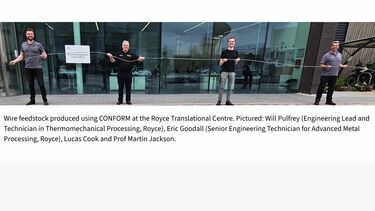
Titanium waste is a major issue and while secondary sources of titanium (swarf) are widely available, they are very rarely utilized to produce viable material. By applying the CONFORM process, a continuous direct extrusion process that relies on friction and pressure to consolidate the swarf, this waste can be used to produce wire. The resulting wire was then compared to wire produced from a conventionally produced bar and wire produced from out-of-specification additive manufacturing powder. To further increase the sustainability of the process, the required tooling for CONFORM was produced via the FAST process from other out-of-specification powder. The findings were extremely positive, the wire produced from the swarf showed very similar properties to that of the conventionally produced bar and showed that a single step production method via CONFORM can produce viable feedstock wire.
Increasing the use of titanium waste sources can have a major effect on material and part costs and allow titanium use in a greater number of applications in various sectors. The production of cheap titanium wire can have a major effect on the additive manufacturing sector, revolutionising production.
Prof Martin Jackson
University of Sheffield
The use of waste material for the production of viable feedstock has potential major impacts for the industry by removing the need for primary production processes of titanium and allowing reliance on secondary sources. Some titanium parts can have up to 90% of the material machined away and left to be remelted and reused via traditional routes. If this waste material can be used to produce feedstocks in a one-step process this would not only reduce the costs associated with titanium but also reduce the carbon footprint of any produced material. This would then allow titanium to be used in a much larger number of fields and increase its use in a wider area of fields, with particular impacts for areas which are struggling to conform to emissions regulation. Finally, reducing the cost of titanium feedstock will make it more economically viable and with a higher strength to weight ratio than steel weight can be reduced without sacrificing quality or safety.
Equipment Used
CONFORM machine at the Royce Translational Centre.

Biography
I received a B.Eng. (Hons.) degree from the University of Sheffield in 2023, where the focus of my final year project was the production of titanium plate material via the FAST-Roll process, via out of specification powder waste from the additive manufacturing sector. My Eng.D. is in partnership with DSTL at the University of Sheffield, with research focusing on the production of viable additive manufacturing feedstock material for the AFSD process.