
Measuring Residual Stresses in Nitinol PBF-LB Samples with Neutron Diffraction
Non-destructive testing of additively-manufactured NiTi alloys to observe residual stresses produced during manufacturing
Residual stresses are a common challenge associated with the Powder Bed Fusion – Laser Beam (PBF-LB) metallic additive manufacturing process. They are stresses which exist within a material in the absence of any external forces, and can cause several detrimental effects in printed parts. Such effects include cracking, distortion, and diminished mechanical properties. In this work, neutrons were used to measure residual stresses in nitinol (NiTi) samples that were manufactured by PBF-LB. This was carried out using a process called neutron diffraction at Oak Ridge National Laboratory (ORNL), Tennessee.
The laser-based PBF-LB process selectively melts metallic powder particles to create components layer-by-layer, following the specific cross-sectional pattern of the intended part. While this additive manufacturing method excels at producing intricate geometries with reduced need for post-processing, it remains susceptible to various defects. Common manufacturing issues include elevated surface roughness, significant porosity, and the development of internal residual stresses.
Researchers utilize both destructive and non-destructive techniques to evaluate these residual stresses. Destructive approaches include the contour method and hole drilling, whereas non-destructive analysis typically relies on diffraction techniques like neutron diffraction and X-ray diffraction (XRD). For this study, neutron diffraction was employed to analyze PBF-LB printed NiTi samples. This method is particularly advantageous for residual stress measurement as it allows for bulk analysis, providing the capability to obtain data from deep within the metallic structure.This allows residual stress to be mapped in printed samples with respect to sample width and sample height.
During the research at Oak Ridge, neutron diffraction was utilized to quantify residual stresses within NiTi specimens produced via PBF-LB. This analysis examined the impact of varying powder composition as well as processing parameter variations, consisting of laser power and scanning speed variations. The resulting data provided a comprehensive mapping of internal stresses across the longitudinal (x), transverse (y), and vertical build (z) orientations.
Travelling to Oak Ridge to perform neutron diffraction on my samples was a fantastic opportunity and a great experience. I gained a huge insight into the operation of neutron diffraction, and how it can be used to evaluate residual stresses that are present in PBF-LB NiTi components.
Thomas Gillick
The information gathered from these measurements has the potential to be highly impactful, with regard to the production of NiTi alloys that are manufactured by PBF-LB. Information on how residual stresses develop during the printing process, with respect to powder composition and PBF-LB processing parameters, will provide a new understanding of how residual stresses influence the final printed part. Information gathered will aid in the optimisation of processing parameters to yield parts with lower residual stresses, which can potentially lead to shorter post-processing times, and can improve the mechanical properties of printed parts. The reduction of residual stresses in printed parts can enhance the shape-memory and superelastic properties of the material. It is hoped that the improvement of the mechanical properties of printed parts due to residual stress reduction, as well the reduction of surface roughness and the elimination of part porosity, can allow PBF-LB to be adopted to produce NiTi parts across a wide range of sectors, including the biomedical and aerospace sectors.
Equipment Used
Residual stress measurements were carried out on the High Intensity Diffractometer for Residual Stress Analysis (HIDRA) instrument, which is a neutron beam line instrument located at the High Flux Isotope Reactor (HFIR). This reactor is the most powerful reactor-based neutron source in the United States, and aside from neutron production, has been utilised for a number of additional purposes including the production fuel that was used to power NASA’s Perseverance Mars rover. These facilities are located at Oak Ridge National Laboratory, which is one of the largest national labs in the United States. The HFIR has a user program, which grants users beam time to carry out measurements at the facility. Beam time is awarded pending the successful approval of a user proposal.
Biography
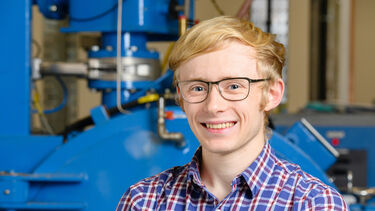
Thomas Gillick is currently a PhD researcher who is based at Dublin City University (DCU). He graduated from DCU in 2023, with a bachelor’s and master’s degree in biomedical engineering. His PhD is focused on analysing residual stresses in nickel-titanium alloys that develop during the Powder Bed Fusion – Laser Beam (PBF-LB) additive manufacturing process. His work focuses on how the variation of PBF-LB processing parameters, as well as different nickel-titanium powder compositions influence how residual stresses and mechanical properties developed during the printing process.